TL;DR: In a Hong Kong study of 6,935 people and a pooled review, lithium and valproate showed no clear difference in suicide risk in bipolar disorder, and both were linked to lower risk than no treatment. Observational studies cannot show cause.
Key Findings
- Hong Kong cohort: 44 of 1,379 in the lithium group and 165 of 5,556 in the valproate group had a suicide attempt or death. After adjusting for baseline differences, gap not statistically significant.
- Pooled studies: 8 observational studies combined also showed no significant difference between lithium and valproate (hazard ratio 0.87).
- Versus no treatment: Network analysis: 54% lower risk in lithium group, 37% lower in valproate group.
- Attempts versus deaths: Lithium looked better than valproate in 4 studies of suicide attempts, not in 5 studies of suicide deaths.
- Randomized trials: Only 3 found, too small and overlapping to combine.
Source: Psychological Medicine (2026) | Wei et al.
Lithium is often called the standard medicine for cutting suicide risk in bipolar disorder. Valproate, an anti-seizure drug, is prescribed for the same condition just as widely. Does lithium really protect better?
This analysis found no clear difference between the two.
The Hong Kong study and the pooled analysis
Suicide is a serious risk in bipolar disorder, and the medicines used to steady mood have long been studied for whether they also protect against it. Lithium has the longer track record. Valproate is widely used. What has been missing is a direct comparison of the two, so this paper tries to fill that gap in two ways.
The Hong Kong records
The researchers used records from Hong Kong’s public hospital system, which covers most people who need long-term treatment there. The researchers identified adults with bipolar disorder who started either lithium or valproate on its own, between 2003 and 2023. That gave them 1,379 people in the lithium group and 5,556 in the valproate group.
People were followed until a suicide attempt or death, or until they stopped the medicine (a gap of more than 90 days without a refill), added the other drug, or the data ended. This means the results describe risk while people were actually taking the medicine.
The two groups were not identical. The lithium group was younger (average age 37.7 versus 41.9). The researchers used a statistical technique called inverse probability weighting to make the groups look alike on age, sex, other health conditions, depression, alcohol and substance use, and earlier medicines. It can only balance what was measured.
The pooled analysis
The team also searched databases for studies that compared lithium, valproate, or no treatment on suicide attempts and suicide deaths. The team found 3 randomized trials and 12 observational studies from 7 countries.
The team combined the results two ways. A pairwise meta-analysis pools studies that compare the same two things head to head, here lithium against valproate. A network meta-analysis also uses indirect links: if one study compares lithium with no treatment and another compares valproate with no treatment, the two can be lined up with each other.
Lithium versus valproate
Results are reported as hazard ratios. A ratio of 1.0 means no difference in risk between groups, below 1.0 means lower risk, and the range in brackets shows how uncertain the estimate is. If the range includes 1.0, the result is not statistically significant.
In the Hong Kong records, 44 of 1,379 people in the lithium group (3.2%) and 165 of 5,556 in the valproate group (3.0%) had a suicide attempt or death. With lithium as the reference, the valproate group’s adjusted hazard ratio was 0.76 (range 0.54 to 1.08). That points slightly in valproate’s favor, but the range includes 1.0, so it is not a clear difference either way.
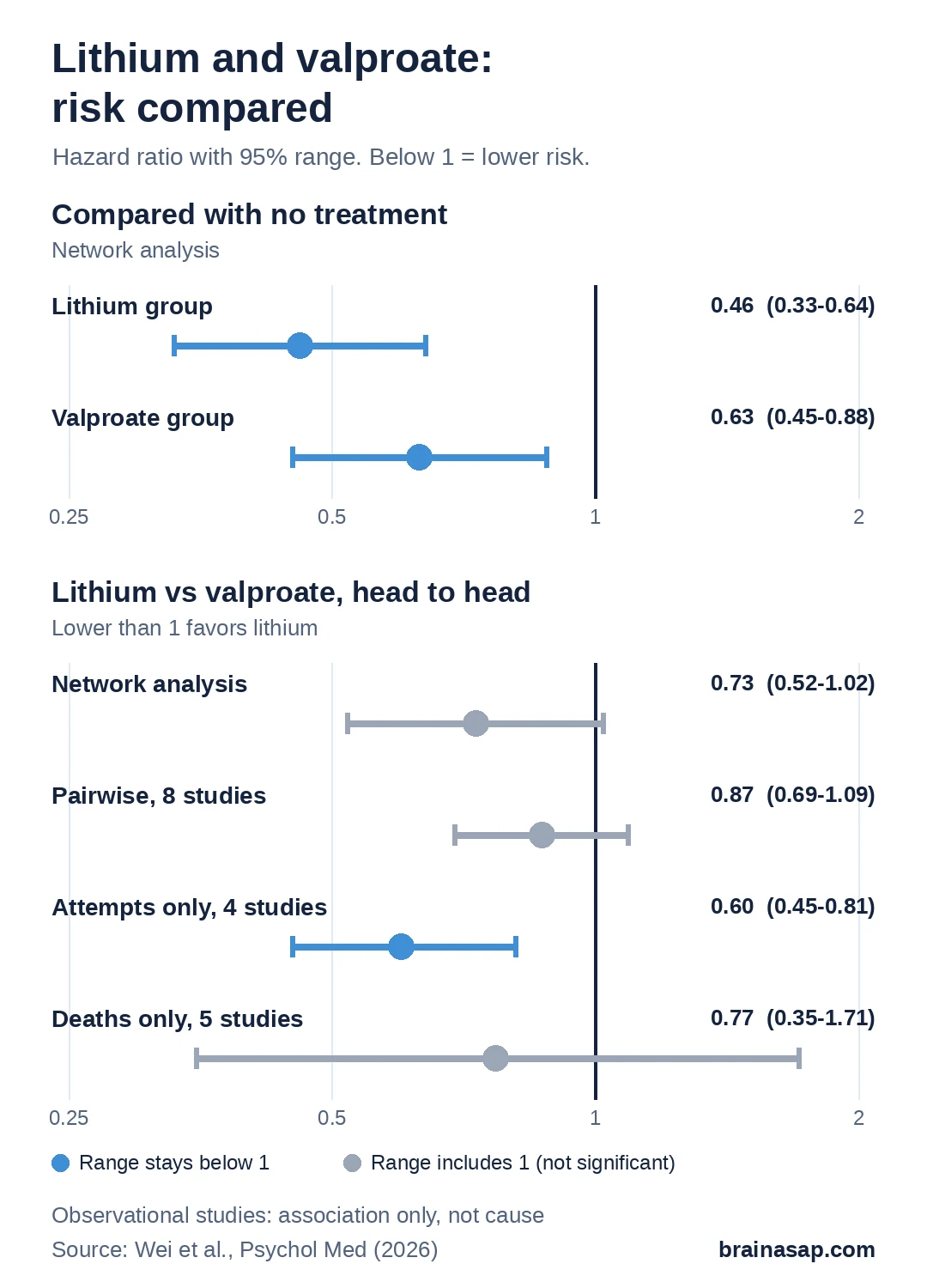
The pooled studies leaned the other direction. Across 8 observational studies (7 earlier ones plus the Hong Kong cohort), the lithium group’s hazard ratio against the valproate group was 0.87 (0.69 to 1.09). The network analysis gave 0.73 (0.52 to 1.02). Both lean toward lithium, and both still include 1.0. The studies also disagreed with each other quite a bit, which makes any single pooled number less certain.
Both versus no mood stabilizer
The network analysis also brought in studies of people who were not on either medicine. Against that no-treatment group, the lithium group’s hazard ratio was 0.46 (0.33 to 0.64), and the valproate group’s was 0.63 (0.45 to 0.88). Both ranges sit fully below 1.0.
Suicide attempts versus suicide deaths
When the pairwise analysis was split by outcome, 4 studies of suicide attempts found lower risk in the lithium group than in the valproate group (0.60, range 0.45 to 0.81), and those studies agreed closely. Five studies of suicide deaths did not show a clear difference (0.77, range 0.35 to 1.71), and they varied widely. Deaths are rarer, so those estimates are less precise. The authors suggest lithium’s edge, if real, may be easier to see in nonfatal outcomes, but say more data are needed.
One more wrinkle: when one large US veterans study was left out, the lithium advantage became statistically significant (0.66, range 0.48 to 0.91). So the overall “no clear difference” depends partly on which studies go in.
Limits of the evidence
The cleanest evidence, randomized trials, could not break it. The 3 trials could not be combined: two reports came from the same trial (98 adults randomized), and the third, in children and teens, had too few events to give a usable estimate. So the head-to-head evidence comes from observational data, with these limits:
- No cause and effect: Doctors choose medicines for reasons. Weighting balances measured traits, not unmeasured ones like stressors or how consistently someone takes a pill.
- No-treatment comparison is indirect: Untreated groups can differ in ways that make them look riskier.
- Mixed studies: Design, country and outcome definitions varied, so pooled results were uneven.
- Age 65+ result is fragile: Much lower risk for valproate in people 65 and older, but only 6 events (2 lithium, 4 valproate). Authors say it needs replication before it informs care.
- Hong Kong only for new data: Private care records may be incomplete. Review covered only English-language papers.
Choosing between the two
This work does not overturn lithium’s reputation, but it suggests the gap between lithium and valproate may be smaller than that reputation implies. Both were tied to lower risk than going without a mood stabilizer.
The authors note that the choice should also weigh safety. Valproate carries well-established risks in pregnancy, while lithium needs monitoring of kidney and thyroid function. Anyone taking either medicine should talk with their prescriber before making changes rather than stopping on their own.
If you or someone you know is struggling with thoughts of suicide, help is available. In the US, call or text 988 to reach the Suicide & Crisis Lifeline, or contact your local emergency or crisis services.
Citation: DOI: 10.1017/S0033291726105881. Wei C, Su JCY, Wong PCY, Xu Z, Lai FTT. Comparing lithium and valproate in reducing suicide risk: A territory-wide retrospective cohort study with pairwise and network meta-analysis. Psychological Medicine. 2026;56:e289.
Study Design: Retrospective new-user cohort study of Hong Kong Hospital Authority records (2003–2023) with inverse probability of treatment weighting, combined with a PROSPERO-registered (CRD42024564712) systematic review, pairwise meta-analysis, and network meta-analysis (3 randomized trials, 12 observational studies identified).
Sample Size: 6,935 adults with bipolar disorder who started lithium (1,379) or valproate (5,556) alone.
Key Statistic: Cohort weighted HR 0.76 (95% CI 0.54–1.08; valproate versus lithium); pairwise pooled HR 0.87 (0.69–1.09) and network HR 0.73 (0.52–1.02) for lithium versus valproate; network HR versus no treatment 0.46 (0.33–0.64) for lithium and 0.63 (0.45–0.88) for valproate.
Caveat: Observational data with possible residual confounding; substantial heterogeneity in the pooled analysis (I² 78%); randomized trials could not be pooled; the age 65+ finding rests on very few events.