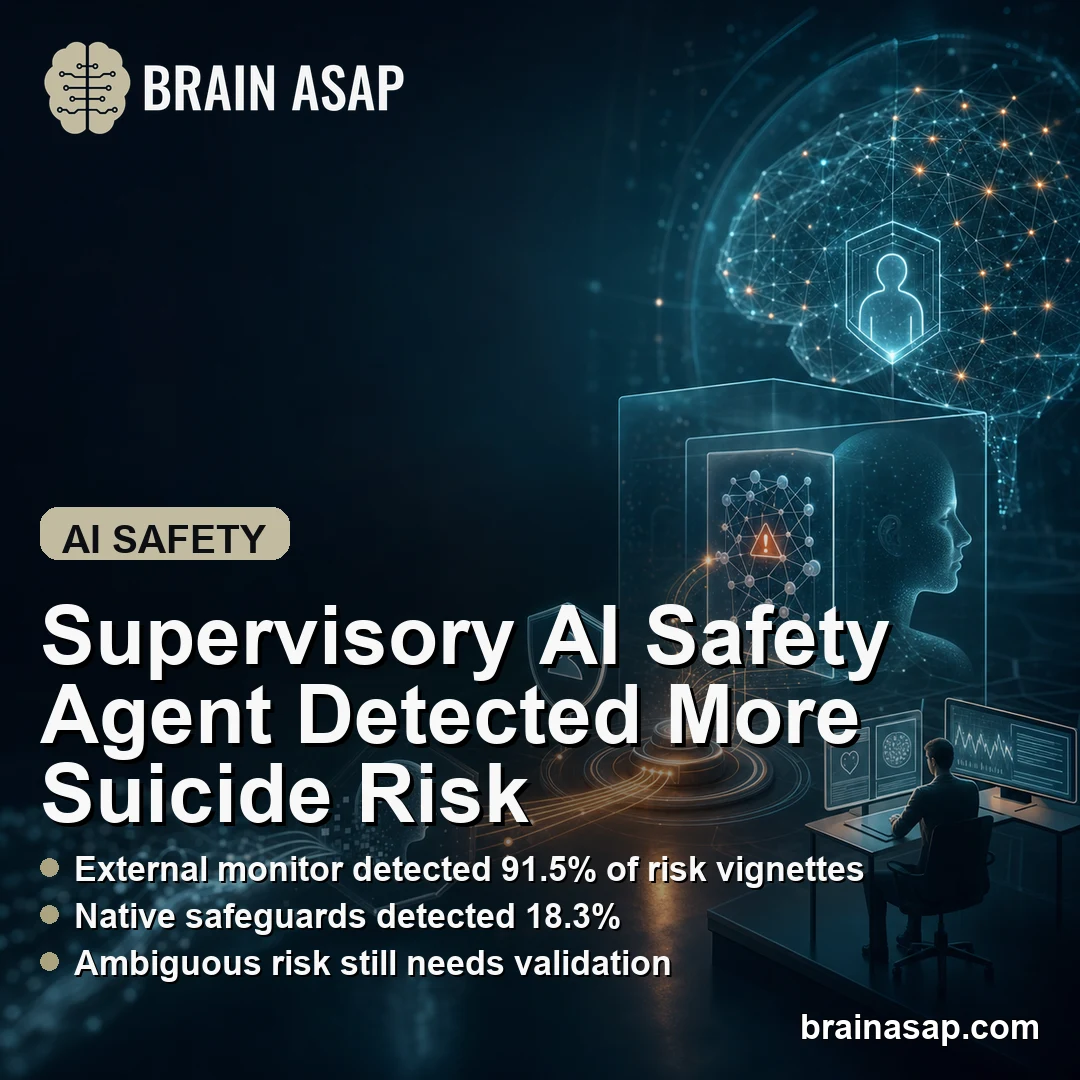
TL;DR: A 2026 preprint on medRxiv tested suicide-risk vignettes and found that an independent supervisory safety agent detected intervention-level risk far more often than native ChatGPT Health safeguards. Key Findings 224 paired evaluations: Researchers teste…
Read article ↗
ECT Looks Safer in the Long Run Than Its Reputation TL;DR: A British Journal of Psychiatry review argues that modern population-level studies do not support a long-term increase in dementia or major cardiovascular risk after electroconvulsive therapy and inste…
Read article ↗
Ketamine significantly reduces suicidal ideation in depressed patients, with rapid effects observed within the first day of treatment. Highlights: Rapid Reduction: Ketamine shows a significant reduction in suicidal ideation within the first day of treatment (R…
Read article ↗
Suicide is a leading cause of premature death worldwide. Social isolation is increasingly recognized as a major risk factor for suicide. Thorough understanding of this relationship is crucial to guide prevention efforts and policy. Key Facts: Nearly 800,000 pe…
Read article ↗
Suicide is a major global public health problem, accounting for over 800,000 deaths worldwide each year. Lithium, a mood stabilizing medication, has been proposed as a novel population-level suicide prevention strategy through supplementation of trace doses in…
Read article ↗
A new report from the CDC provides insight into suicide rates among different industries and occupations in the United States. The key takeaways: Suicide rates have increased 40% from 2000 to 2017 among working-age adults (ages 16-64). Men who work in the mini…
Read article ↗