TL;DR: Linking 10 placebo-controlled trials statistically, lumateperone ranked top among add-on depression drugs, improving scores 4.7 points more than placebo on a 60-point scale. Its maker paid for the analysis, and each drug rests on just two trials.
Key Findings
- Symptom scores: Lumateperone plus antidepressant lowered depression scores 4.7 more points than placebo plus antidepressant. Other regimens: 1.1 to 3.2 points.
- Response and remission: Lumateperone had 2.3 times the odds of a 50% score drop and 2.2 times the odds of remission, versus placebo group.
- Ranking: First on all four improvement measures, but authors’ own bar for “favored” was not met against aripiprazole on response or remission, or against several brexpiprazole and quetiapine XR doses.
- Weight: Only regimen with weight change comparable to placebo. All 10 others showed more gain.
- Side effects: Better than average for akathisia (inner restlessness), below average for drowsiness.
Source: Advances in Therapy (2026) | Cutler et al.
If an antidepressant only helps partway, doctors often add a second medicine. Which one? Nobody has ever tested the approved options against each other, so the answer has to come from a statistical workaround. In that workaround, the newest drug, lumateperone, came out on top for symptoms and for weight. It did worse on drowsiness.
Five antipsychotics are FDA-approved for this add-on job in the United States: aripiprazole, brexpiprazole, cariprazine, quetiapine XR, and, since 2025, lumateperone. They work differently and carry different side effects, so the choice matters to the person taking one.
This paper lines up each drug’s original approval trials and compares them through their shared placebo groups.
How to compare drugs that never met
The researchers pulled the depression trials listed in each drug’s FDA label. That gave them 10 randomized, double-blind trials, two for each of the five drugs. Every trial gave adults with depression who had not improved enough on an antidepressant either the drug or a placebo, on top of their ongoing antidepressant. Most ran for 6 weeks, and one cariprazine trial ran 8.
Because every trial had a placebo arm, the placebo group works as a common yardstick. If drug A beat placebo by a lot and drug B beat it by a little, you can estimate how A and B compare, even though they never met in one study. This is called a network meta-analysis. In this paper the network is star-shaped: 11 drug-and-dose options, each connected only to placebo.
Here is what the group names mean in this article:
- Placebo group: people who kept taking their antidepressant and also received a placebo pill.
- Lumateperone group: people taking their antidepressant plus lumateperone 42 mg per day, the one dose tested in its two trials.
- Other add-on drugs: the same setup with aripiprazole, brexpiprazole, cariprazine, or quetiapine XR, at one to three doses each.
Across the trials, participants were 43 to 47 years old on average, most were women, and most were overweight, with average body mass indexes of 27 to 31. Their depression was moderate at the start of the trials.
Lumateperone lowered depression scores the most, by 4.7 points
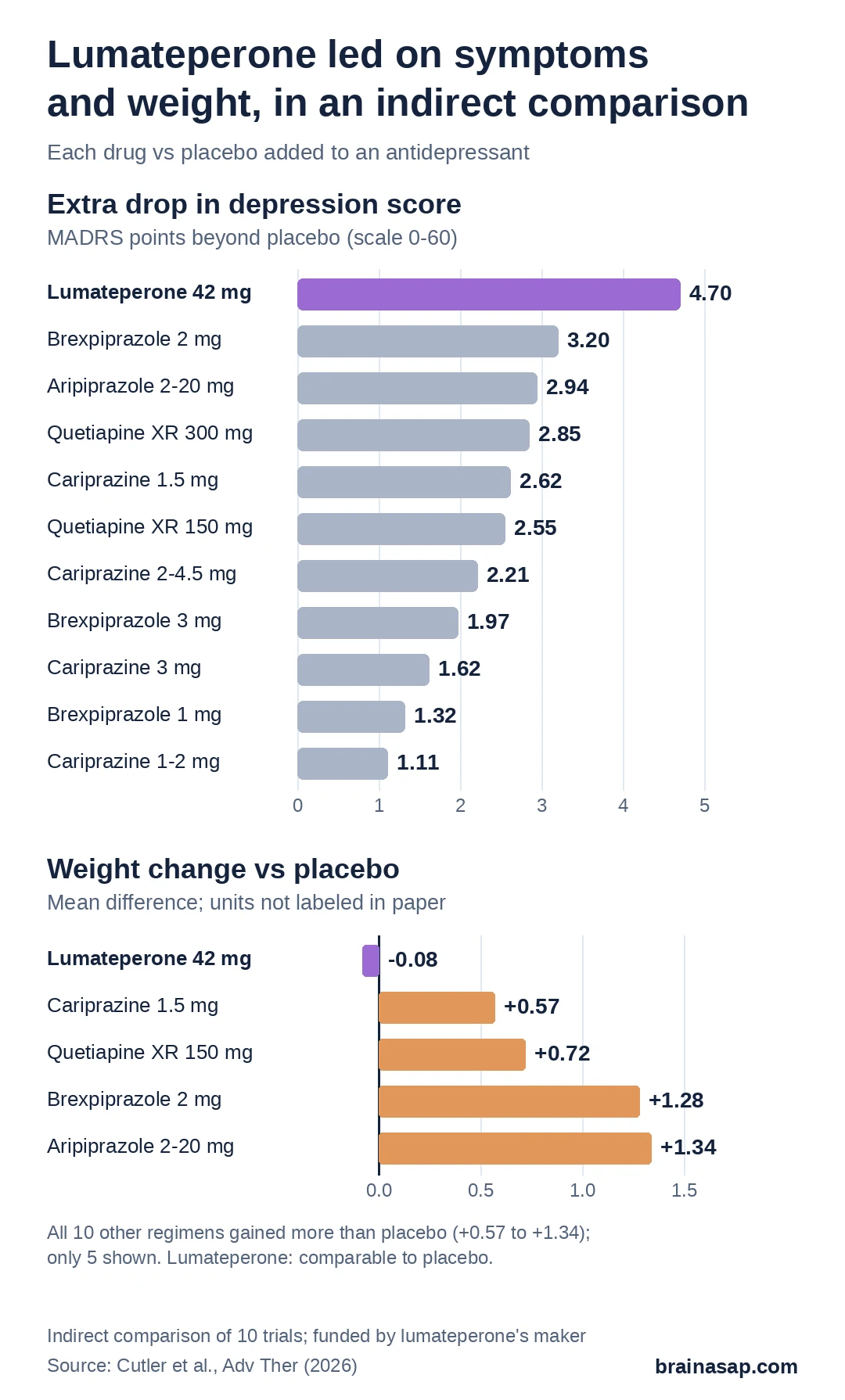
The main measure was the MADRS, a 10-item depression scale scored by a clinician from 0 to 60, with higher scores meaning more severe depression. The trial groups started at averages of roughly 25 to 33. The chart below shows how many extra points each regimen lowered the score compared with placebo.
Every regimen was estimated to beat placebo, though for brexpiprazole 1 mg and cariprazine 3 mg and 1–2 mg the credible interval still included no difference. Lumateperone’s advantage was the largest, at 4.7 points (95% credible interval 3.6 to 5.8). Brexpiprazole 2 mg (3.2 points), aripiprazole (2.9), and quetiapine XR 300 mg (2.9) came next. Cariprazine 1–2 mg per day was lowest at 1.1 points.
The other measures pointed the same way. Compared with the placebo group, the lumateperone group had:
- Response (a drop of at least 50% on the scale): 2.33 times the odds, with a credible interval of 1.75 to 3.07.
- Remission (a score of 10 or lower, or 10 or lower with a 50% drop, depending on the trial): 2.21 times the odds, with a credible interval of 1.56 to 3.04.
- Clinician-rated severity (CGI-S, a 7-point scale): 0.6 points lower.
The authors also ranked the options with a score called SUCRA, which runs from 0% to 100%. It reflects how often a treatment lands near the top when the analysis is simulated many times. It is a ranking, not a measure of how large a difference is. Lumateperone scored 97.4% for MADRS change, 91.9% for response, 90.4% for remission, and 98.9% for severity, first place each time.
How Firm the Top Ranking Is
Indirect pairwise estimates show where the lead is firmer. On the MADRS, lumateperone’s edge over aripiprazole was 1.75 points (credible interval 0.32 to 3.21) and over quetiapine XR 300 mg it was 1.85 points (0.04 to 3.67). Over cariprazine 3 mg it was 3.08 points.
Versus brexpiprazole 2 mg, though, the 1.50-point gap had a credible interval running from 3.53 points better to 0.53 points worse (the authors still labeled it “favored,” at a 93% probability). On response, lumateperone did not clear the authors’ bar for being favored over aripiprazole or brexpiprazole 1 mg and 3 mg; on remission, over aripiprazole, brexpiprazole 2 mg, or quetiapine XR 300 mg. In other words, lumateperone tops the list, but the top few may not be far apart.
Weight Gain and Other Side Effects
The side-effect picture is where the drugs looked most different.
- Weight: Lumateperone was the only regimen whose average weight change was comparable to placebo (a difference of −0.08, credible interval −0.30 to 0.14). Every other regimen showed more gain than placebo, from +0.57 for cariprazine 1.5 mg to +1.34 for aripiprazole. The paper’s figure does not label the units. For gaining 7% or more of body weight, lumateperone’s odds ratio versus placebo was 0.40, but the interval (0.04 to 1.38) is very wide.
- Akathisia: This is an inner restlessness that makes it hard to sit still. Lumateperone and quetiapine XR 150 mg were the only two regimens comparable to placebo. Lumateperone’s odds ratio was 3.95, but with an interval of 0.40 to 17.61, a higher risk cannot be ruled out. It ranked better than average for akathisia.
- Drowsiness: Lumateperone had 6.02 times the odds of somnolence versus placebo (2.86 to 12.13). The estimate was lower than for quetiapine XR (8.89 and 10.68 at its two doses) and brexpiprazole, though the authors marked it as favored only against brexpiprazole 3 mg and quetiapine XR 300 mg. The estimate was higher than the estimates for aripiprazole (2.23) and cariprazine (1.84 to 2.29). Its overall rank was below average.
Limitations and Funding
- No head-to-head trials: Cross-trial comparison assumes trials were similar enough. They ran at different times and places, with different dosing plans, and one cariprazine trial lasted 8 weeks instead of 6.
- Thin evidence per drug: Two trials per drug, one or two per dose. With no loops in the network, authors could not test whether indirect and direct estimates agree.
- Lumateperone tested at one dose: Others used flexible or multiple doses; effect of other lumateperone doses unknown.
- Funded by lumateperone’s maker: Johnson & Johnson Innovative Medicine paid for the analysis. Several authors work for it; others work for a consulting firm it hires.
- Short and narrow: Most trials lasted 6 weeks, so long-term weight and side effects are not covered. Only regulatory trials, mostly white adults aged 18 to 65 with no other psychiatric conditions. Quality of life and sexual side effects not compared.
Head-to-Head Trials Are Needed
For someone whose antidepressant is not enough, the practical question is often not just which add-on works, but which one they can live with. Weight gain and restlessness are common reasons people stop these drugs, and this analysis suggests the newest option may avoid the first without giving up effectiveness. That fits the authors’ view that lumateperone could suit people worried about weight.
Still, this is a comparison built from separate trials, and it comes from the manufacturer. It does not prove that lumateperone works better than the others, and drowsiness counts against it. Anyone weighing an add-on drug should talk through these trade-offs with their prescriber.
What the field still lacks is a direct, head-to-head trial, and the authors call for longer and real-world studies.
Citation: DOI: 10.1007/s12325-026-03630-3. Cutler AJ, Lemyre A, Zhang Q, Mao C, Totev TI, Gauthier-Loiselle M, et al. Efficacy and Safety of Lumateperone and Other Atypical Antipsychotics Approved as Adjunctive Treatment for Major Depressive Disorder in the United States: A Network Meta-Analysis. Advances in Therapy. 2026;43:4079–4103.
Study Design: Fixed-effect Bayesian network meta-analysis of 10 placebo-controlled registrational randomized trials (2 each for aripiprazole, brexpiprazole, cariprazine, lumateperone, and quetiapine XR) identified from US prescribing information; 11 treatment-dose nodes anchored on placebo plus antidepressant.
Sample Size: Ten trials; the paper’s Table 1 lists 362 to 819 people enrolled per trial, and the two lumateperone trials enrolled 485 and 480.
Key Statistic: Lumateperone 42 mg/day versus placebo plus antidepressant: MADRS change −4.70 (95% CrI −5.77 to −3.63); response OR 2.33 (1.75 to 3.07); remission OR 2.21 (1.56 to 3.04); SUCRA 90.4% to 98.9% across efficacy outcomes.
Caveat: Indirect comparison with two trials per drug and no closed loops; funded by Johnson & Johnson Innovative Medicine; short-term data.