TL;DR: In a 2026 lab study, researchers looked at the chemical switches that turn genes on and off in medulloblastoma, a brain cancer that mostly affects children. Removing a protein called KDM2B slowed the growth of 2 of the cancer’s main types in lab dishes and in mice, but no medicine that does this exists yet.
Key Findings
- Genes on standby in 2 tumor types: in Group 3 and Group 4 medulloblastoma, genes that help young nerve cells mature were often held in a “standby” state, ready to switch on but kept off.
- KDM2B sat at those genes: KDM2B was the most strongly increased of the candidate switch-controlling proteins in Group 4 tumors, and it bound the standby genes.
- Tumor cells needed it: removing KDM2B slowed the growth of Group 3 tumor cells in dishes and Group 4 patient tumors grown in mouse brains.
- Other brain tumors didn’t: removing KDM2B did not slow the SHH type of medulloblastoma or a different brain cancer, high-grade glioma.
- Mice lived longer: with tumors under the skin, mice given a compound that destroys KDM2B (13 mice) had slower tumor growth and lived longer than untreated mice (13 mice).
Source: Nature Genetics (2026) | Tao et al.
Medulloblastoma is a fast-growing cancer of the cerebellum, the part of the brain at the back of the head that coordinates movement. It mostly strikes children.
Doctors now sort it into 4 main types: WNT, SHH, Group 3 and Group 4. For Group 3 and Group 4, there are no treatments aimed at what drives the tumor.
A 2026 study in Nature Genetics, led by researchers at St. Jude Children’s Research Hospital in Memphis and the German Cancer Research Center in Heidelberg, looked for a weak point in those 2 types. It found one candidate: a protein called KDM2B.
What Are Gene Switches, and Why Look at Them?
Inside each cell, DNA is wrapped around spool-like proteins. Small chemical tags on those spools act like switches: some tags mark a gene as on, others as off.
Some genes carry both kinds of tags at once. That combination keeps a gene on standby: ready to turn on, but held off for now.
Changes in genes that control these switches show up in about half of all medulloblastomas, so researchers suspected the switches matter for how the tumors grow.
To map them, Tao and colleagues ran 254 lab tests on 52 frozen tumor samples from patients:
- Group 4: 26 tumors
- Group 3: 19 tumors
- SHH: 5 tumors
- WNT: 2 tumors
Each test measured one of 6 switch tags across the whole genome. These maps were then compared with gene activity data from 167 patients and mutation and DNA-methylation data from up to 223 patients.
Nerve-Cell Genes Were Held on Standby
Group 4 tumors had the most DNA in one kind of standby state, followed by Group 3. WNT and SHH tumors had the least.
In Group 4, 666 genes were marked this way much more often than in the other 3 types. Those genes were also less active in Group 4 tumors than in the other types, which fits with them being held off.
Many of the 666 genes help young nerve cells grow up into mature neurons. That matters because medulloblastoma is thought to start in immature brain cells that get stuck and keep dividing instead of maturing.
One Protein Kept Those Genes Switched Off
Next came the search for the protein that places these standby marks. Among the candidates, KDM2B was the one most strongly increased in Group 4 tumors compared with the other types.
It was also the only enzyme of its kind, among those that add or remove these particular tags, whose activity differed between Group 4 and the other types.
In tumor samples grown in mice, KDM2B was attached to the standby genes. More follow-up experiments suggested how it works: KDM2B pulls in 2 groups of proteins, called Polycomb complexes, that hold genes in the off position.
Destroying KDM2B in Group 3 tumor cells made 1,038 genes more active and 280 less active. Among the genes that switched on were many of the nerve-maturation genes.
Did Removing KDM2B Slow the Tumors?
It did, in Group 3 and Group 4 models, across 3 kinds of tests:
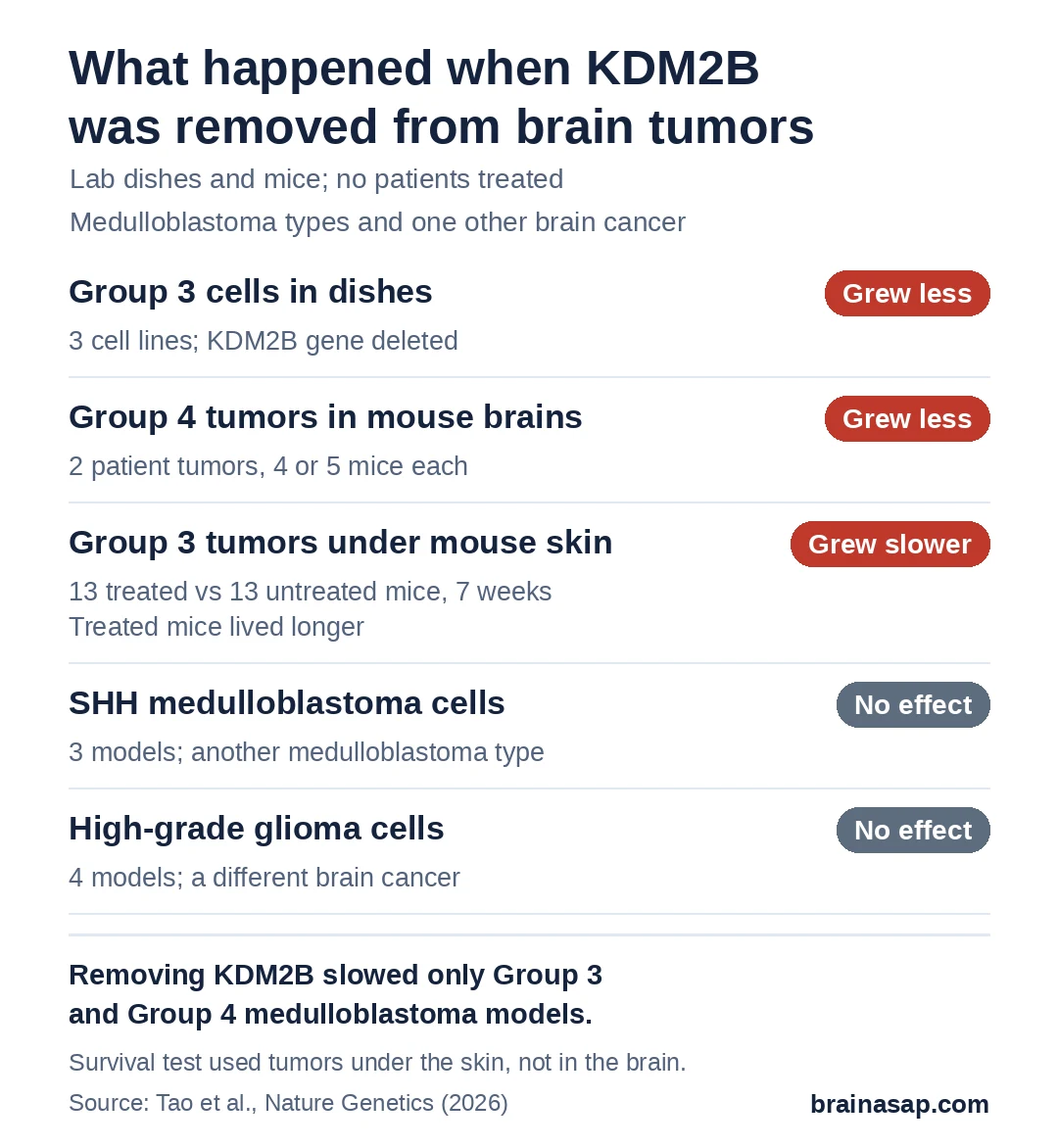
- Tumor cells in dishes: the KDM2B gene was deleted in part of each culture, and the team tracked whether those cells fell behind the unedited cells in the same dish over 2 to 4 weeks. In 3 Group 3 cell lines, they did.
- Patient tumors in mouse brains: no Group 4 cell lines exist, so the team grew 2 Group 4 patient tumors in the brains of mice (4 or 5 mice per group). By the time the mice became ill, cells missing KDM2B made up a smaller share of each tumor than at the start; control cells with an unedited gene did not shrink this way.
- A compound that destroys KDM2B: KDM2B was tagged in a Group 3 cell line so a research compound, called dTAG, could break it down quickly.
For the last test, mice had these tagged tumor cells placed under the skin of their side, not in the brain, because the dTAG compound can’t cross from the blood into the brain.
Ten days later, 13 mice got the compound 5 days a week for 7 weeks, and 13 mice got an inactive solution. Tumors in the treated mice grew more slowly, and those mice lived longer.
Treated tumors had fewer dividing cells. Cell death did not change, which suggests KDM2B loss mainly slowed the cancer down rather than killing it.
Only Some Tumor Types Needed KDM2B
Deleting KDM2B did not slow 3 models of SHH medulloblastoma or 4 models of high-grade glioma, a different and aggressive brain cancer. That suggests Group 3 and Group 4 tumors rely on KDM2B in a way other brain tumors don’t.
Tao and colleagues also pinned down which part of KDM2B matters. Its enzyme part, which removes chemical tags, was not needed for tumor growth. Its DNA-grabbing part, which pulls in the Polycomb proteins, was.
So drugs designed to block only the enzyme part would likely not help, the team suggested. Drugs that destroy the whole KDM2B protein might, but none exists for patients yet.
What This Study Did Not Test
- No patients treated: all growth results come from cell cultures and mice.
- Tumors outside the brain: the survival test used tumors under the skin, so it doesn’t show whether destroying KDM2B works for a tumor in the brain.
- A research compound, not a medicine: dTAG only works on a specially tagged version of KDM2B and can’t be used in people.
- Few models: 3 Group 3 cell lines and 2 Group 4 patient tumors.
- Safety in healthy brain cells untested: KDM2B is most active early in normal brain development, and the study did not check what removing it does to healthy cells.
Could a KDM2B-Destroying Drug Help Children With This Cancer?
This work points to a specific target for 2 types of medulloblastoma that lack targeted treatments, and it explains why a drug would need to remove the protein rather than just block its enzyme part.
What’s needed next is a drug that destroys KDM2B, reaches the brain, and slows tumors in the cerebellum without harming the developing brain around them.
Citation: DOI: 10.1038/s41588-026-02745-1. Tao R, Erkek-Ozhan S, Xu B, et al. Divergent medulloblastoma chromatin states disclose KDM2B as a selective dependency. Nat Genet. 2026.
Study Design: Chromatin mapping of patient tumors (histone ChIP-seq), plus CRISPR knockout and dTAG degradation experiments in cell lines, patient-derived xenografts and mouse flank tumors.
Sample Size: 52 tumors (254 ChIP-seq profiles); 3 Group 3 cell lines, 2 Group 4 patient-derived xenografts; 13 vs 13 mice in the dTAG survival test.
Key Statistic: KDM2B degradation slowed flank tumor growth and prolonged survival in mice (log-rank P = 3.19 × 10⁻⁶).
Caveat: Preclinical only; survival test used flank tumors, not brain tumors; no KDM2B-targeting medicine exists.