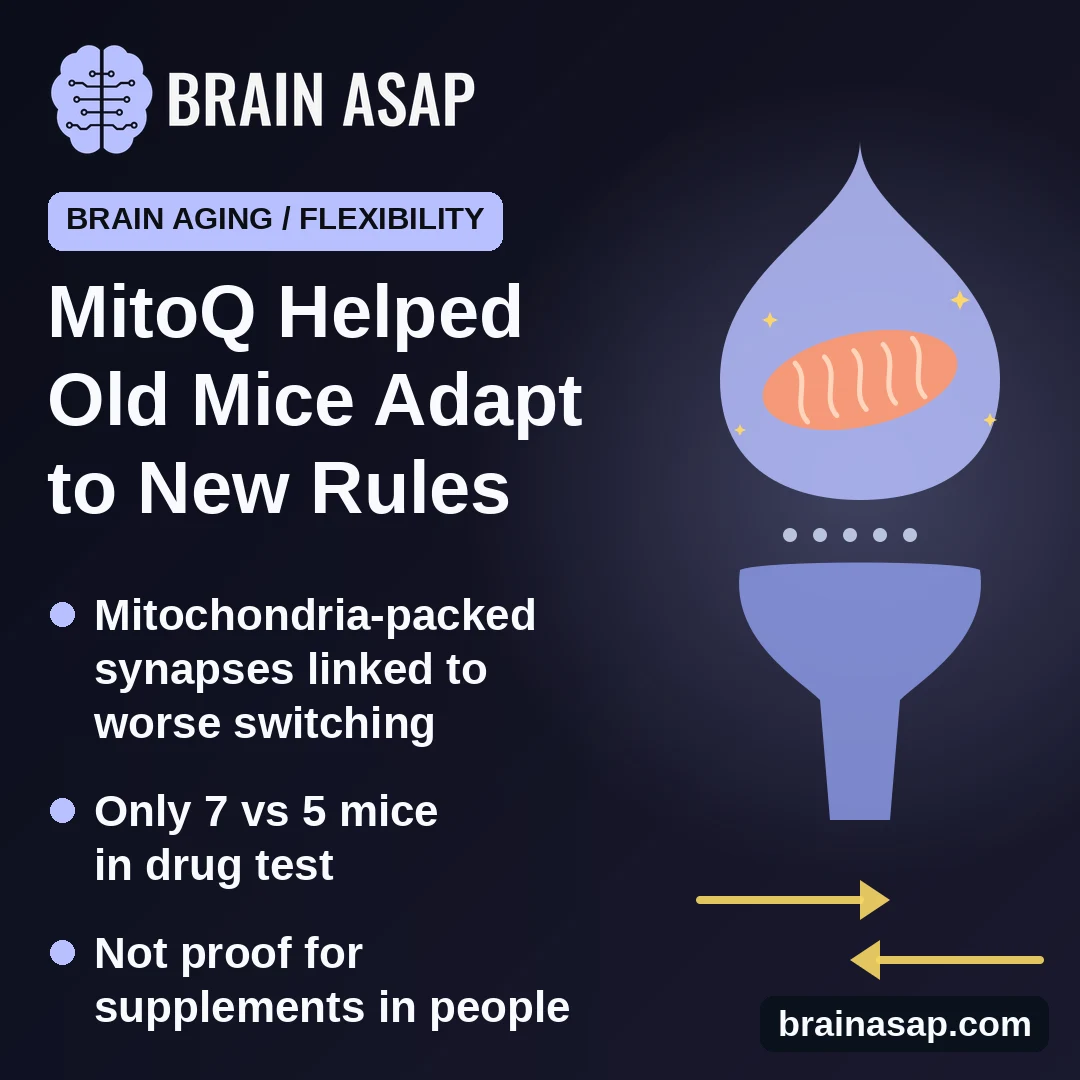
TL;DR: Some old mice lost the ability to switch strategies while others stayed sharp, and the struggling mice had more energy-producing mitochondria crowded into their brain connections. Twenty weeks of the antioxidant MitoQ improved strategy switching in a small group of old mice.
Key Findings
- Aging hit some mice, not all: Some old mice failed a rule-switching task; others matched young mice.
- Fewer connections did not explain it: Old mice lost brain synapses, but the loss did not track performance.
- Mitochondria did: More synapses packed with mitochondria went with worse switching in old mice.
- MitoQ helped switching: 7 treated old mice beat 5 controls on the switch test (p = 0.0496), with no change in basic learning.
Source: Aging Cell (2026) | Yamada et al.
Some people stay mentally nimble into their 80s, while others struggle to change plans or adapt to new rules. That ability, called cognitive flexibility, depends heavily on the prefrontal cortex at the front of the brain.
A team in Japan asked why aging erodes flexibility in some individuals but spares others, and looked for the answer at the level of single brain connections in mice.
Old Mice Split Into Two Camps
Male mice learned a touchscreen task. First they learned to pick a particular picture for a reward. Then the rule changed without warning: now the side of the screen mattered, not the picture. Switching to the new rule is a test of flexibility.
Young and middle-aged mice (8 to 50 weeks) adapted. Among aged mice (75 to 85 weeks, roughly the human equivalent of older adulthood), some failed the switch while others did as well as young mice. Their earlier picture learning did not predict who would struggle.
Mitochondria at the Synapse Stood Out
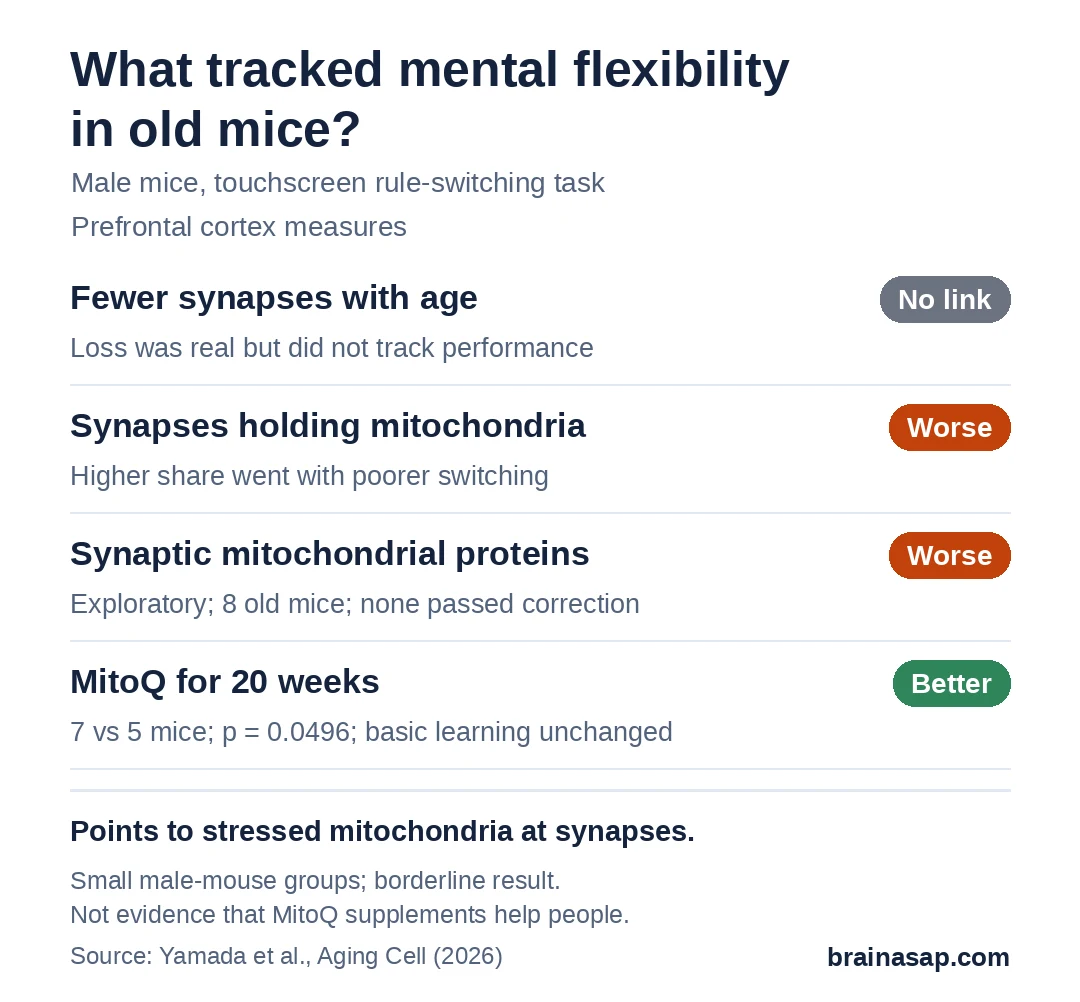
Using 3D electron microscopy of the prefrontal cortex, the researchers found that old mice had fewer synapses. But the amount of loss did not line up with how well each mouse switched rules.
What did line up was mitochondria, the cell's power plants. In old mice, a higher share of synapses containing mitochondria on the sending side went with worse flexibility. This was not seen in young mice.
Protein profiling pointed the same way. In synapse samples, proteins that rose in poorly performing old mice were heavily concentrated in mitochondrial energy pathways. These correlations came from only 8 old mice, and no single protein held up after correcting for testing thousands at once, so the authors treat them as leads.
An Antioxidant Aimed at Mitochondria Helped
Mitochondria can leak damaging molecules, a process called oxidative stress. To test whether that mattered, the researchers gave mice MitoQ, an antioxidant designed to collect inside mitochondria, in their drinking water from 55 to 75 weeks of age and through testing.
Control mice got dTPP, a look-alike compound without the antioxidant part. The MitoQ group (7 mice) did better on the rule switch than the control group (5 mice), a large but uncertain effect (p = 0.0496). Both groups learned the first picture task equally well.
In the brain, MitoQ lowered several synaptic mitochondrial proteins, especially ones linked to cell-death signaling.
Small Groups and a Borderline Result
- Tiny treatment groups: 7 vs 5 mice; the p value sat just under 0.05.
- Male mice only for the main experiments.
- Correlations, mostly: Mitochondria and protein links show association, not cause.
- Exploratory protein hits: None survived correction for multiple testing.
- One strain matters: A closely related mouse strain behaved differently with age.
Supplements Are Not the Takeaway
MitoQ is sold as a supplement, but this study does not show that it helps people think more flexibly. The dose, timing and species are all different, and the mouse result needs to be repeated in larger groups.
The open question is whether people whose flexibility declines with age also show this buildup of stressed mitochondria at their synapses, and whether targeting it early can keep minds adaptable.
Citation: DOI: 10.1111/acel.70716. Yamada R, Nagai H, Numa C, et al. Synaptic mitochondrial oxidative stress contributes to individual variability in age-related cognitive inflexibility in mice. Aging Cell. 2026;25:e70716.
Study Design: Mouse study combining touchscreen set-shifting, volume electron microscopy, prefrontal proteomics and a 20-week MitoQ treatment versus inactive analog (dTPP).
Sample Size: Groups of 4 to 14 mice per analysis; MitoQ 7 vs dTPP 5.
Key Statistic: MitoQ improved response-direction (rule-switch) performance, p = 0.0496, Hedges' g = 1.21.
Caveat: Small male-mouse groups; borderline significance; exploratory proteomics.