TL;DR: A review of 18 small studies finds that some people with Parkinson's can learn to control brain signals linked to their symptoms using neurofeedback. Whether that reliably improves movement or daily life is still unproven.
Key Findings
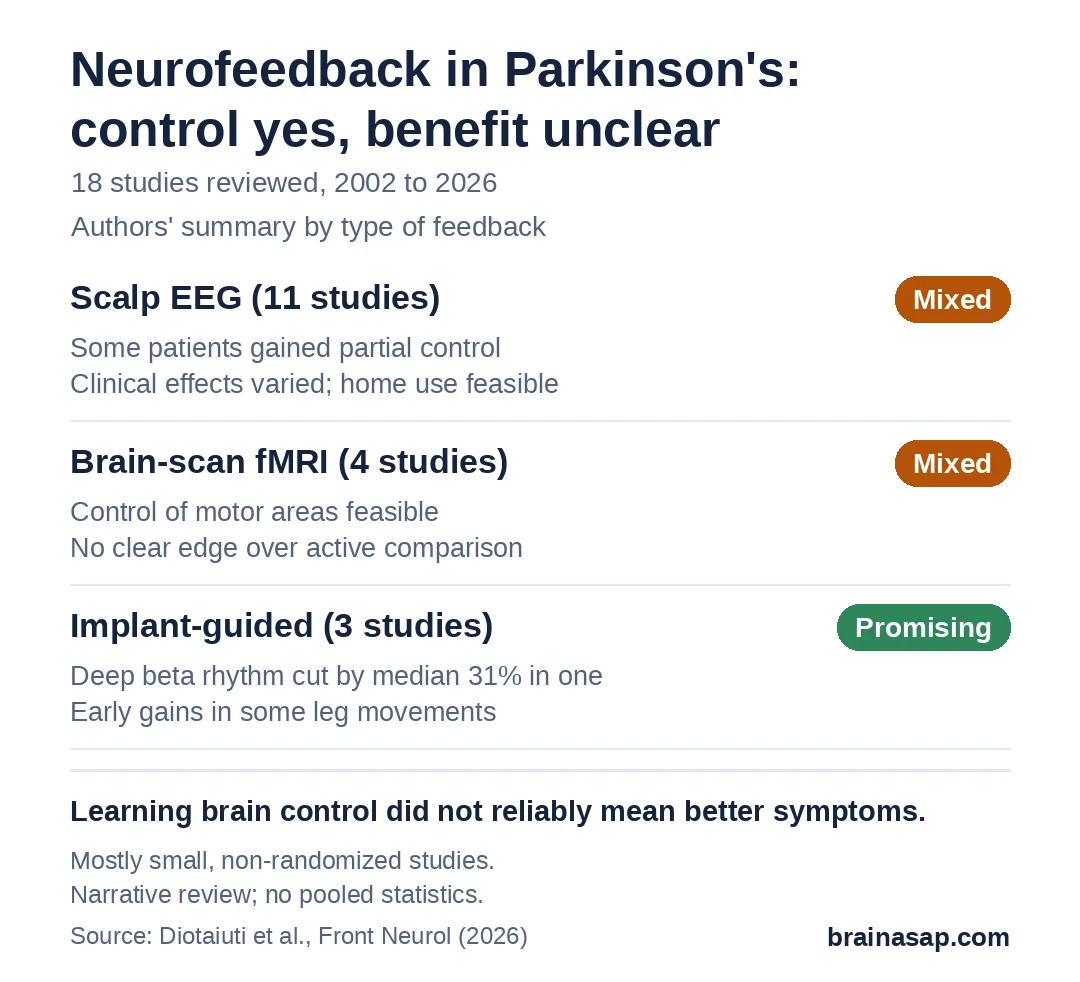
- 18 studies, 3 approaches: 11 used scalp EEG, 4 used MRI scanners and 3 used implanted deep brain stimulators.
- Brain control looks possible: At least some patients learned to shift target signals in each approach.
- Implants gave the clearest signal: In one study, patients cut a key movement-related brain rhythm by a median 31%.
- Clinical benefit is unclear: No approach consistently beat an active comparison.
- Mostly tiny studies: Many were case reports or pilots; randomized trials were rare.
Source: Frontiers in Neurology (2026) | Diotaiuti et al.
Parkinson's medicines and deep brain stimulation ease symptoms, but they do not ask the brain to help itself. Neurofeedback does. It shows people their own brain activity in real time, as a moving bar, a sound or a game, so they can learn to nudge it in a healthier direction.
An Italian and Brazilian team reviewed every study they could find on this idea in Parkinson's to see how far it has come.
Three Ways to Watch Your Own Brain
The researchers searched four databases for studies from 2002 to 2026 and found 18 that met their criteria. These used three kinds of feedback:
- Scalp EEG (11 studies): A cap of sensors tracks electrical rhythms over the movement areas of the brain.
- Brain-scan fMRI (4 studies): People lie in a scanner and try to raise activity in deeper motor regions.
- Implant-guided (3 studies): People who already have deep brain stimulators see signals recorded directly from deep inside the brain.
This is a narrative review. The authors described and compared studies but did not pool their results into a single estimate.
Learning to Shift Brain Rhythms Seems Possible
Across the EEG studies, at least some patients learned to partly control movement-related rhythms. One 2024 study showed that people could do this training at home with a portable setup, and found it acceptable, though it did not show clear motor gains.
In the fMRI studies, patients learned to boost activity in motor planning areas, including the supplementary motor area and the putamen, a deep structure hit hard by Parkinson's.
Implants Offer the Most Direct Target
The implant-guided studies stood out. Parkinson's is linked to excess "beta" rhythm activity in a deep brain hub called the subthalamic nucleus. Patients with fully implanted stimulators learned to turn this rhythm down quickly, with a median 31% drop by the final training block in one study.
A 2025 study found improvements in some leg-movement measures after this training, but not across all kinds of movement. The obvious limit: it only works for people who already have an implant.
Controlling a Signal Is Not the Same as Feeling Better
The authors' key point is that learning to move a brain signal does not automatically mean better movement, mood or daily function. In one randomized fMRI trial, patients showed immediate motor benefit, but it was unclear whether they did better than people doing a comparable control task. In a four-arm EEG trial, neurofeedback combined with magnetic brain stimulation beat neurofeedback alone, whose own effects were more limited.
- Small samples: Many studies were single cases or pilots.
- Few randomized trials: Comparison groups varied from no treatment to sham feedback.
- Different targets: Studies trained many different brain signals, making them hard to compare.
- Short follow-up: Little is known about whether gains last.
- No pooled numbers: Narrative review; study quality was not formally scored.
Larger, Longer Trials Are the Next Step
For people with Parkinson's, neurofeedback is still an experimental add-on, not a replacement for medicine, therapy or deep brain stimulation. The authors see it as promising and grounded in how the disease affects brain circuits.
The question the next studies must answer is simple: when patients learn to calm these brain rhythms, do their walking, tremor or everyday lives improve more than with a fair comparison treatment, and does it last?
Citation: DOI: 10.3389/fneur.2026.1866195. Diotaiuti P, Di Siena F, Vitiello S, Vilarino G, D'Oliveira A, Andrade A, Mancone S. Neurofeedback as an emerging rehabilitation strategy for Parkinson's disease: a narrative review. Front Neurol. 2026;17:1866195.
Study Design: Narrative review of empirical human studies (2002 to 2026) from PubMed, Scopus, Web of Science and Google Scholar.
Sample Size: 18 studies (11 EEG, 4 fMRI, 3 DBS-guided).
Key Statistic: Median 31% reduction in subthalamic beta activity in one implant-guided study.
Caveat: Mostly small, non-randomized studies; no pooled analysis; clinical benefit unproven.