TL;DR: In a survey published in 2026 in Türkiye, 438 adults answered questions about how much online shopping took over their lives, such as feeling restless when they couldn't shop, and about recent anxiety, low mood and stress.
People with more anxiety or low mood tended to score higher for shopping problems, while stress showed no clear extra link once those 2 were counted. The links were modest, and a one-time survey can't show which came first.
Key Findings
- All 3 linked on their own: Higher anxiety, low mood and stress scores each went with higher online-shopping-addiction scores, though modestly.
- Anxiety and low mood stood out: Tested together, anxiety and depression symptoms each kept a link of about the same size; stress did not.
- Small slice explained: Together, the 3 mood measures explained about 9% of the differences in shopping-addiction scores between people.
- Shopping often mattered most: How often people shopped online had the biggest link, but that overlaps with what the shopping questionnaire measures.
- No diagnosis: Scores were not used to label anyone as addicted.
Source: Behavioral Sciences (2026) | Arayici et al.
One-click checkouts and endless sale alerts make it easy to shop at any hour. For some people, that turns into shopping to escape bad feelings, feeling empty when they can't, and failing to cut back.
A 2026 study in Behavioral Sciences, led by Mehmet Emin Arayici at Dokuz Eylül University in Izmir, asked which kinds of distress go with these problems: anxiety, depression or stress.
Who Answered the Survey?
- People: 438 adults in Türkiye, average age 34; 54% women
- How reached: 317 through an online form shared on social media and email, 121 on paper in person
- Who they were: mostly well educated (89% had a college degree) and active on social media (92%)
- Shopping habits: 43% shopped online at least weekly; clothing was the top purchase
Asked how they felt while shopping online, 46% said happy and 27% said excited. Fewer than 1 in 10 said anxious or restless.
What Did the Questionnaires Ask?
- Online shopping addiction: 18 questions covering how much shopping fills a person's thoughts, using it to lift a bad mood, feeling down or restless without it, failed attempts to cut back, and arguments or work problems because of it. Scores run from 18 to 90.
- Depression, anxiety and stress: a standard 21-item checklist about the past week, with 7 items for each.
Researchers treated the shopping score as a sliding scale, not as a yes-or-no diagnosis, because there is no agreed cutoff for shopping addiction.
Which Kind of Distress Went With Shopping Problems?
Each measure on its own showed a modest link with shopping-addiction scores: anxiety slightly more than depression, and stress the least.
Next, the team put all 3 into one statistical model, after accounting for age, gender, education, income, job, marriage and how often people shopped online. This shows what each adds beyond the other 2, since they overlap a lot.
The result? Anxiety and depression symptoms each still went with higher shopping scores, by about the same amount. Stress no longer did.
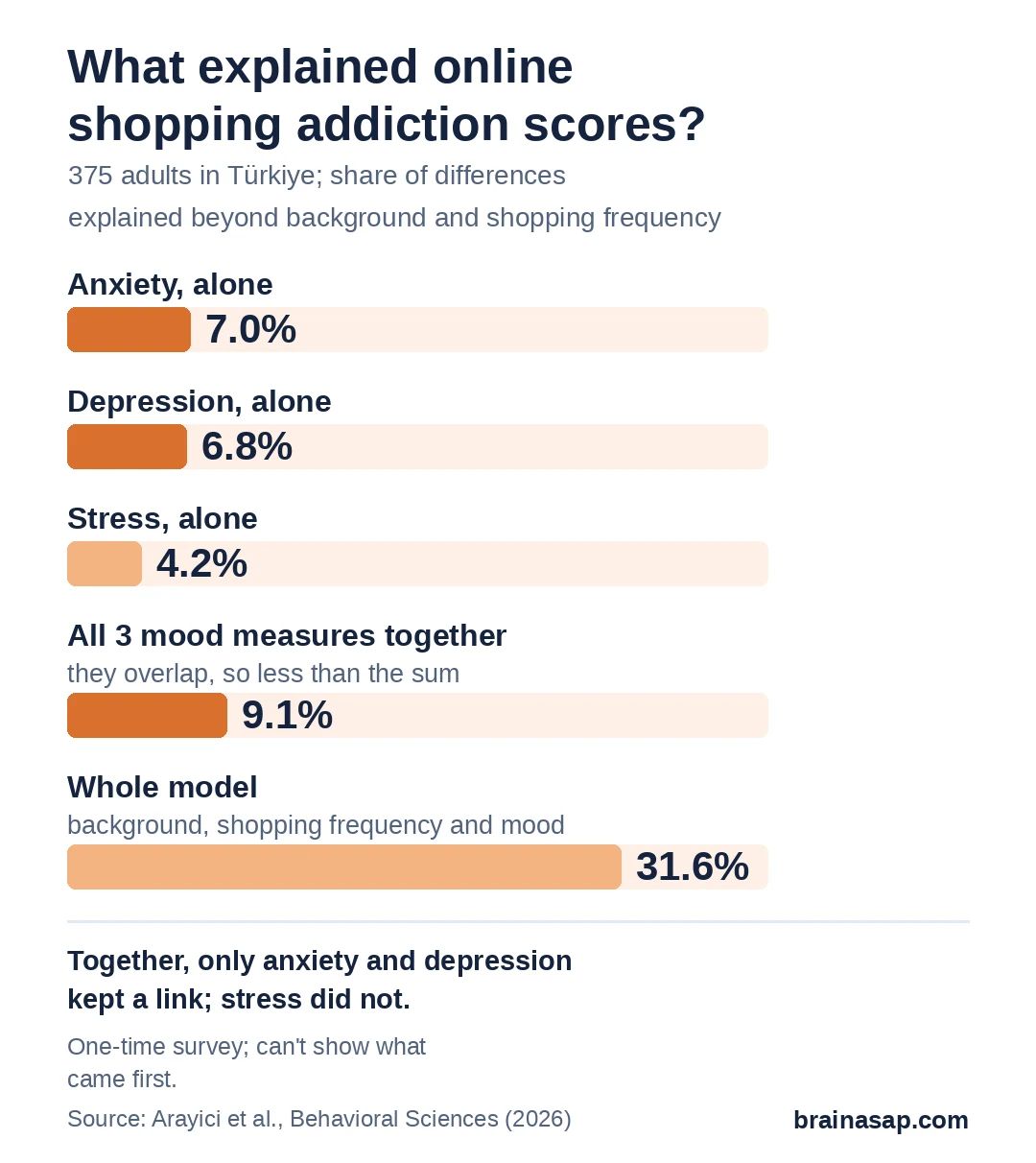
Together, the 3 mood measures explained about 9% of the spread in shopping scores. Everything in the model, including background factors and shopping frequency, explained about 32%, so most of the differences between people were left unexplained.
What About How Often People Shopped?
Shopping frequency had the strongest link with shopping-addiction scores of anything measured. That is not surprising, and Arayici and colleagues cautioned that it partly measures the same thing as the questionnaire.
When frequency was dropped from the model, anxiety and depression still kept their links.
What This Survey Can't Tell Us
- Which came first: Low mood might push people to shop, or heavy shopping might worsen mood, or both.
- Not a typical group: Mostly college-educated, social-media-active volunteers.
- Self-report only: No spending records; the online form had no attention checks or duplicate filtering.
- Missing factors: Impulsivity, money worries, self-control and exposure to shopping apps' design were not measured.
- No diagnoses: High scores can't separate a real problem from someone who simply loves to shop.
Could Treating Anxiety or Low Mood Ease Shopping Problems?
That idea fits these results, but this survey did not test it. Researchers suggested that a person who says shopping feels out of control could also be checked for anxiety, depression and money problems. Studies that follow people over time are needed to see whether distress comes before problem shopping.
Citation: DOI: 10.3390/bs16081441 Arayici ME, Gedik G, Basaran D, Simsek H, Gultekin Arayici S. Online Shopping Addiction in Association with Depression, Anxiety, and Stress: Exploring Independent and Relative Contributions in a Cross-Sectional Study. Behavioral Sciences. 2026;16:1441.
Study Design: Cross-sectional convenience survey (online and paper); Online Shopping Addiction Scale (OSAS, 18 items, continuous), DASS-21; Pearson correlations; hierarchical linear regression with HC3 robust SEs.
Sample Size: 438 adults in Türkiye (mean age 33.8; 54.0% female); complete-case regression sample n = 375.
Key Statistic: Correlations with OSAS: anxiety r = 0.34, depression r = 0.32, stress r = 0.27. Separate models: ΔR² 0.070, 0.068, 0.042. Combined DASS block ΔR² = 0.091; anxiety β = 0.206 (p = 0.002), depression β = 0.200 (p = 0.001), stress β = −0.050 (p = 0.473); total R² = 0.316. Shopping frequency β = 0.280.
Caveat: Cross-sectional; convenience sample of digitally engaged, highly educated adults; self-report; no clinical cutoff; shopping frequency conceptually overlaps OSAS; key confounders unmeasured.