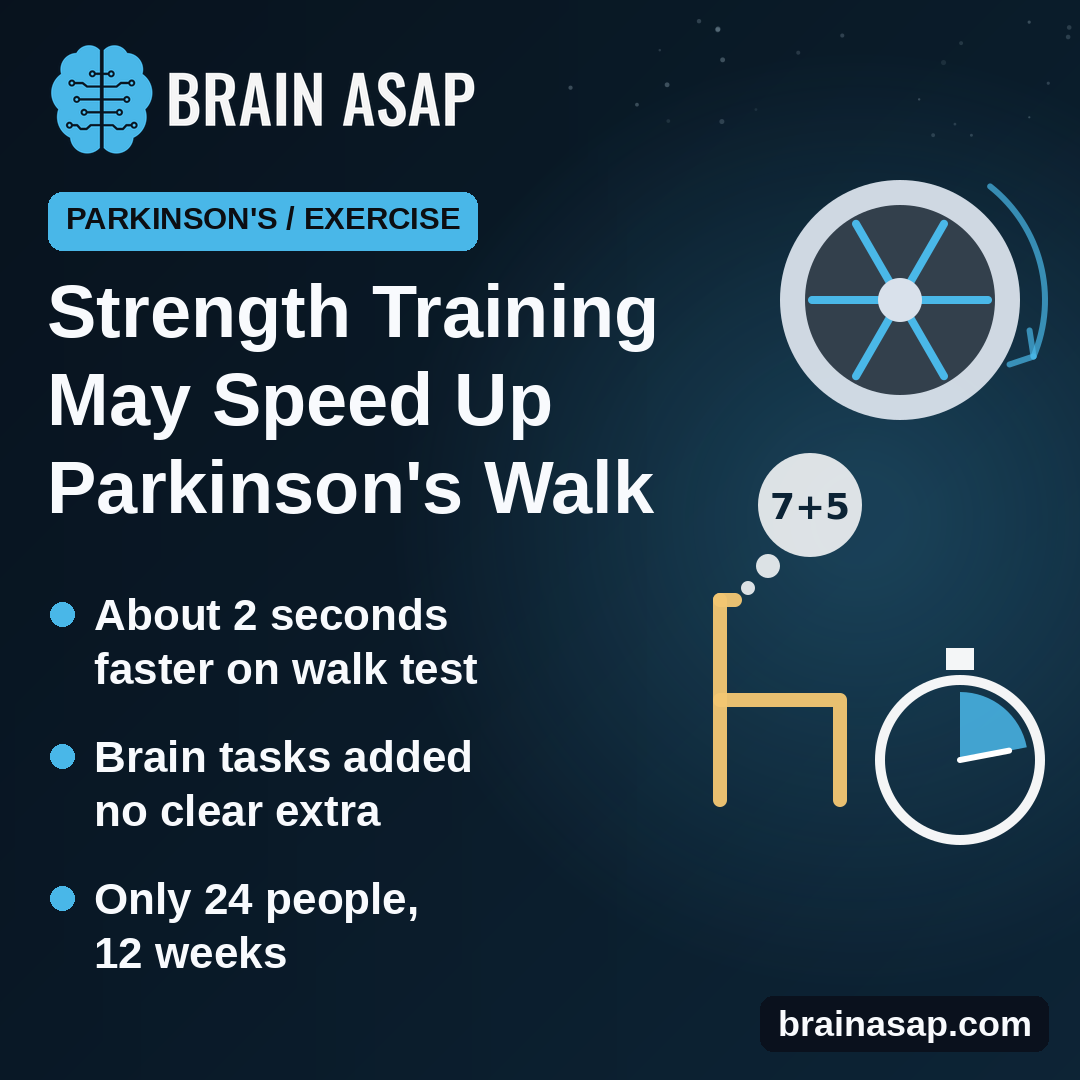
TL;DR: In a small Spanish trial, people with early Parkinson’s who did 12 weeks of strength training, with or without added thinking tasks, got faster on a walking test and stronger on a chair-stand test than people who did not exercise. Adding the thinking tasks gave no clear extra benefit.
Key Findings
- 24 people, 3 groups: Strength training, strength plus thinking tasks, or no exercise for 12 weeks.
- Faster on their feet: About 2 seconds quicker on a get-up-and-walk test than the no-exercise group.
- Stronger legs: More chair stands in a minute in both exercise groups.
- No clear extra from thinking tasks: The two exercise groups did not differ.
- Mood and quality of life: No significant change.
Source: PLOS One (2026) | Magaña et al.
Exercise is one of the few things that reliably helps people with Parkinson’s move better. A popular idea is to make workouts harder for the brain too, by adding mental tasks such as counting or naming words while moving. Does that extra challenge pay off?
The PARKEX trial in Barcelona put the idea to a small, direct test.
Three Groups With Early Parkinson’s
The trial randomly assigned 24 people with early-stage Parkinson’s (all at stage 2 of 5) to one of three groups for 12 weeks:
- Strength training: Three supervised 60-minute sessions a week of resistance exercises, mostly on a flywheel machine that loads the muscles as they lengthen as well as when they push.
- Strength plus thinking tasks: The same program, with some exercises done while solving structured mental tasks at the same time.
- No exercise: People continued their usual care.
Testers who measured the results were not involved in running the classes. No exercise-related side effects were reported.
Both Exercise Groups Got Faster and Stronger
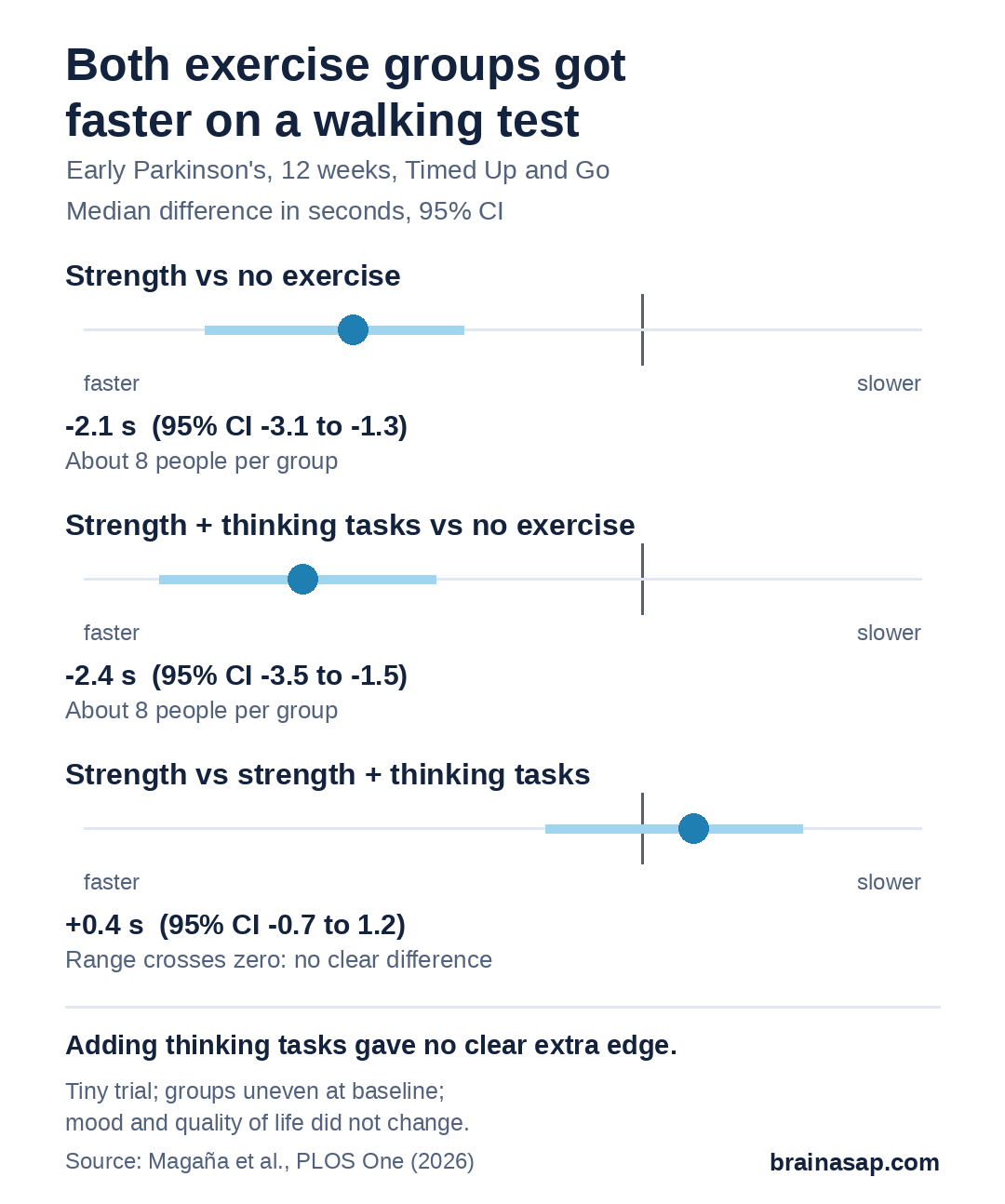
The Timed Up and Go test measures how long it takes to stand from a chair, walk 3 meters, turn, walk back and sit down. Compared with the no-exercise group, people were about 2.1 seconds faster after strength training and 2.4 seconds faster after strength plus thinking tasks.
On a one-minute chair-stand test of leg strength, both exercise groups also did better than the no-exercise group (both p = 0.003). The paper reports median differences of 31 more stands for strength training and 19 for strength plus thinking tasks.
Adding Thinking Tasks Gave No Clear Extra Boost
The two exercise groups did not differ on either physical test (p = 0.47 for walking, p = 0.19 for chair stands). With only about 8 people per group, a modest extra benefit could easily have been missed. The walking test was also done only as a simple task, not while doing a second mental task, which is where dual-task training might help most.
Mood and Quality of Life Did Not Clearly Change
Depression scores and a Parkinson’s quality-of-life questionnaire showed no significant group differences. Some parts of the questionnaire, such as emotional well-being and daily activities, leaned toward improvement with medium-sized effects, but none were statistically clear. Participants rated the programs highly.
Uneven Groups From the Start
- Very small: About 8 people per group.
- Not built for these outcomes: The trial was designed to study cell energy (mitochondria), not movement or mood.
- Groups differed at baseline: The no-exercise group had higher body weight, worse Parkinson’s symptom scores and lower thinking scores.
- No attention control: The comparison group got no classes or contact, so expectations may have played a part.
- Short: 12 weeks, with no long-term follow-up.
Strength Work Is a Solid Start for Early Parkinson’s
For people in the early stages of Parkinson’s, this trial adds to evidence that regular supervised strength training can make everyday movements like standing and walking easier. Whether adding mental challenges to workouts gives extra benefit is still open.
A larger trial with evenly matched groups, and walking tests done while multitasking, would show whether dual-task training earns its extra effort.
Citation: DOI: 10.1371/journal.pone.0358534. Magaña JC, Enríquez-Calzada S, Prat R, et al. Effects of basic and dual-task training programs on physical function in Parkinson’s disease: the PARKEX study. PLoS One. 2026;21(9):e0358534.
Study Design: Three-arm randomized controlled trial (NCT05963425); clinical outcomes were secondary to a mitochondrial endpoint.
Sample Size: 24 randomized with Hoehn and Yahr stage 2 Parkinson’s.
Key Statistic: Timed Up and Go vs no exercise: -2.07 s (95% CI -3.13 to -1.28) strength training; -2.43 s (-3.46 to -1.48) strength plus thinking tasks.
Caveat: Very small; baseline imbalances; no attention-matched control.