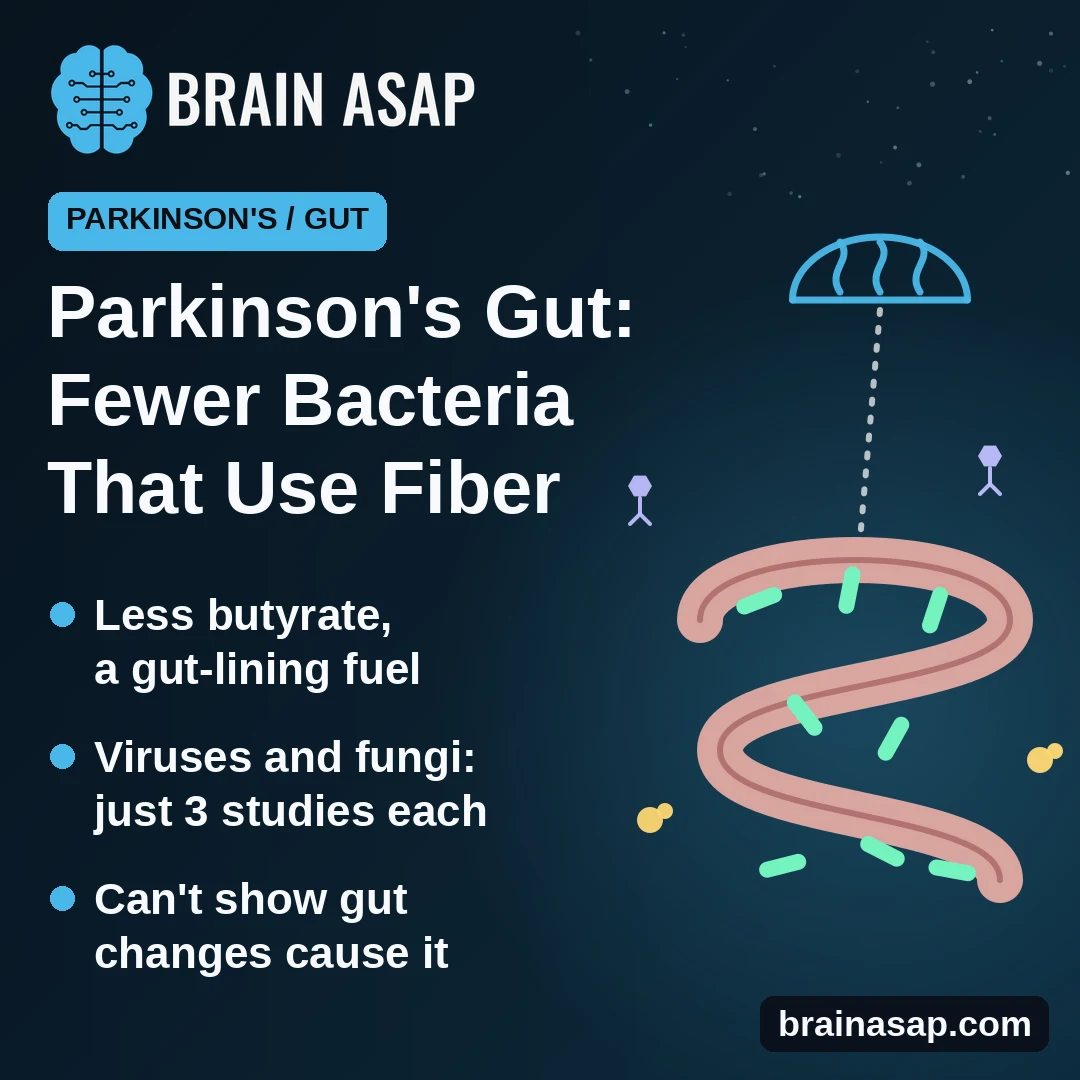
TL;DR: A 2026 review gathered human studies comparing the gut contents of people with and without Parkinson’s disease. Bacteria and the compounds they make showed the most consistent differences, including fewer bacteria that ferment fiber, while research on gut viruses, fungi and proteins is still too thin to draw firm conclusions.
Key Findings
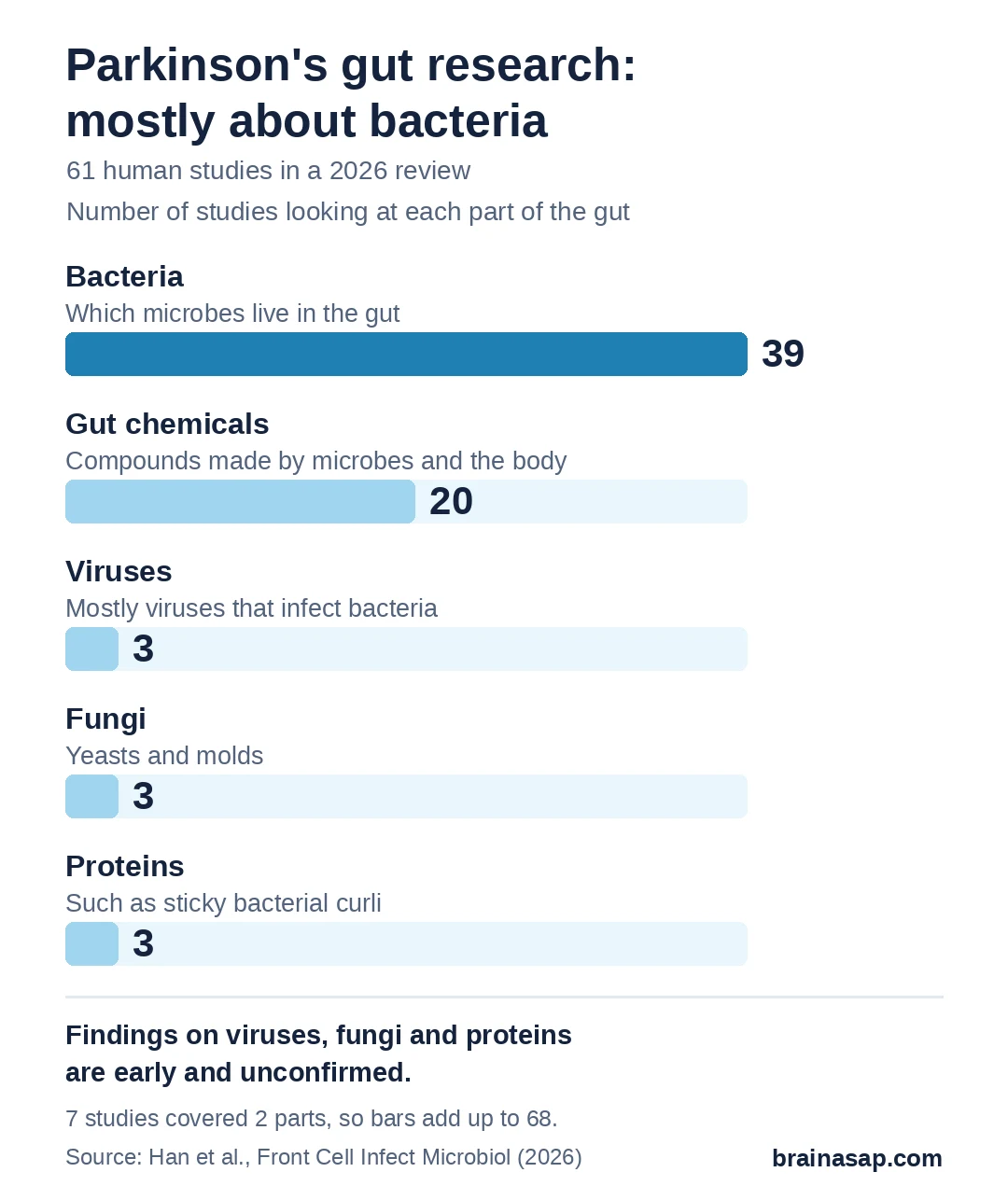
- Evidence is lopsided: of 61 studies, 39 looked at gut bacteria and 20 at gut chemicals, but only 3 each looked at viruses, fungi or proteins.
- Fewer fiber-fermenting bacteria: people with Parkinson’s often had fewer bacteria that turn fiber into short-chain fatty acids, compounds that help keep the gut lining healthy.
- Bacteria and chemicals agreed: stool from people with Parkinson’s also tended to contain less of those fatty acids, especially butyrate. This was the clearest match between 2 kinds of evidence.
- Differences were modest: gut bacteria of people with and without Parkinson’s overlapped a lot, so no single microbe marks the disease.
- Cause still unknown: most studies measured people once, so they can’t show whether gut changes come before Parkinson’s or result from it, its medicines or constipation.
Source: Frontiers in Cellular and Infection Microbiology (2026) | Han et al.
Constipation can show up years before the tremor and stiffness of Parkinson’s disease. That timing has led many researchers to wonder whether the disease might start, at least in part, in the gut.
Most gut research in Parkinson’s has focused on bacteria. But the gut also holds viruses and fungi, plus chemicals and proteins made by microbes and by the body.
A 2026 systematic review in Frontiers in Cellular and Infection Microbiology, by researchers at the University of Maryland and Case Western Reserve University, pulled together human studies on all 5 of these layers to see which findings hold up.
How the Review Picked Its Studies
Han and colleagues searched 2 research databases for studies published through October 2025. Every study had to involve people with Parkinson’s, not animals.
For bacteria and gut chemicals, where research is more plentiful, the bar was higher. Studies that simply observed people had to:
- compare people with Parkinson’s against a group of people without it
- include at least 50 people in each group
- score at least moderate on a standard quality checklist
Treatment trials, such as probiotic studies, were included without those size limits.
In total, 61 studies made the cut. A few looked at more than one layer, so they count more than once in the breakdown below.
What Was Different About Gut Bacteria in Parkinson’s?
Across studies, people with Parkinson’s tended to have:
- Fewer fiber fermenters: bacteria such as Faecalibacterium, Roseburia and Blautia, which make short-chain fatty acids from fiber.
- More mucus eaters: Akkermansia, which breaks down the mucus layer that protects the gut wall.
- More of some other groups: Lactobacillus and Bifidobacterium, and in some studies E. coli and Klebsiella pneumoniae.
Short-chain fatty acids, especially butyrate, feed the cells lining the gut and help keep that lining sealed. Less butyrate plus a thinner mucus layer could let bacterial products leak through and stir up inflammation, which some researchers think may reach the brain.
That chain of events is a model, not a proven sequence. And the bacterial differences were modest: gut bacteria of people with and without Parkinson’s overlapped a lot.
Some studies found part of the difference remained after accounting for Parkinson’s medicines and constipation. Results still varied with country, diet, stool consistency and lab methods.
Gut Chemicals Backed Up the Bacteria Findings
The 20 studies of gut chemicals gave the strongest support. Stool from people with Parkinson’s tended to contain less short-chain fatty acids, especially butyrate, which matches the drop in bacteria that make them.
Han and colleagues called this the clearest agreement between any 2 layers in the review. Blood levels of those fatty acids, however, did not follow a consistent pattern across studies.
Viruses, Fungi and Proteins: Only 3 Studies Each
Each of these layers had only 3 studies, so the review treated every finding here as early and unconfirmed:
- Viruses: most gut viruses infect bacteria. One early study found fewer viruses in people with Parkinson’s; later studies found more variety. Those results point in different directions.
- Fungi: fungi were scarce in people with and without Parkinson’s. People with Parkinson’s had a wider mix of fungi, but many of the fungi detected come from food, such as yeast.
- Proteins: some gut bacteria make sticky proteins, called curli, that can make alpha-synuclein clump together in lab tests. Alpha-synuclein is the protein that builds up in brain cells in Parkinson’s. Whether this happens in people is unknown.
Probiotics and Fiber: Early Trials, Short-Term Effects
Small trials have tried probiotics, prebiotic fibers, resistant starch and short-chain fatty acid supplements in people with Parkinson’s.
Some were linked to short-term improvements in constipation, inflammation markers in the blood, or symptoms. But the trials were small, varied in design and short. They show the gut can be changed, not that changing it slows Parkinson’s.
What This Review Can’t Show
- Cause and effect: most studies measured people at one point in time, so gut changes could be a result of Parkinson’s, its medicines, constipation or diet rather than a cause.
- No pooled numbers: findings were summarized study by study rather than combined in a meta-analysis.
- Different methods: studies used different lab techniques, which makes it hard to tell a real disease signal from a quirk of one study.
- Plan not registered in advance: the review’s methods were refined during the work rather than registered beforehand.
Do Gut Changes Come Before Parkinson’s?
That is the question this field still can’t answer. Answering it will take studies that follow people over years and measure bacteria, viruses, fungi, chemicals and proteins together, using the same methods.
For now, the most reliable finding is fewer fiber-fermenting bacteria and less butyrate in people with Parkinson’s. Whether boosting them could change the disease has not been tested in a meaningful way.
Citation: DOI: 10.3389/fcimb.2026.1900578. Han H, Luo O, Li K, Rahaman S, Ok EU, Zhang L, Liang M, Lin H. Beyond bacteria: a multi-omics view of the gut–brain axis in Parkinson’s disease. Front Cell Infect Microbiol. 2026;16:1900578.
Study Design: Systematic review (PubMed and SciFinder, through October 2025) with structured evidence mapping across bacteriome, metabolome, virome, mycobiome and proteome; no meta-analysis.
Sample Size: 61 human studies (68 domain entries: 39 bacteriome, 20 metabolome, 3 virome, 3 mycobiome, 3 proteome).
Key Statistic: Clearest cross-layer agreement: fewer short-chain fatty acid producing bacteria alongside lower stool short-chain fatty acids in Parkinson’s.
Caveat: Mostly cross-sectional observational studies; heterogeneous methods; review not prospectively registered.