TL;DR: In a survey published in 2026, 519 physical education teachers in China rated how often they had 16 common symptoms of anxiety and depression over 2 weeks.
Among those symptoms, moving or speaking unusually slowly, or being unusually fidgety, was the one most strongly linked to all the others, more than worry or low mood. Men and women showed a similar pattern.
Key Findings
- Movement changes sat at the center: Being slowed down or restless in a way others could notice had the strongest overall links to the other 15 symptoms.
- Not what the team expected: Researchers had predicted that worry symptoms would be most central, as in many earlier studies.
- Bridges between anxiety and depression: Feeling down or hopeless, plus the movement changes, had the strongest links between anxiety symptoms and depression symptoms.
- Men and women looked alike: Average scores and the overall symptom pattern were similar for male and female teachers.
- Most scored low: About 1 in 8 teachers scored above the anxiety cutoff and about 3 in 10 above the depression cutoff the researchers used.
Source: Behavioral Sciences (2026) | Wu and Yao
Physical education (PE) teachers are often pictured as the healthiest people in a school. Yet earlier surveys in China have found many of them under heavy stress, from long hours and safety duties to feeling their subject is valued less than others.
A 2026 study in Behavioral Sciences, by Mei Wu of Guizhou University of Finance and Economics and Chengkui Yao of Guizhou Normal University, looked at which anxiety and depression symptoms sit at the heart of that distress.
How Teachers Were Surveyed
The study included 519 full-time PE teachers at primary and secondary schools in Guizhou Province, in southwest China. Most were men (70%), and the average age was 32.
Each teacher filled in 2 standard online questionnaires about the past 2 weeks:
- An anxiety questionnaire with 7 items, such as feeling nervous, worrying too much and being easily annoyed
- A depression questionnaire with 9 items, such as losing interest in things, feeling down, poor sleep and thoughts of self-harm
Each item was rated from 0 (not at all) to 3 (nearly every day).
What Is a Symptom Network?
Most studies add up questionnaire items into one anxiety score and one depression score. This study instead treated each of the 16 items as its own point and mapped how strongly each one went with every other, after accounting for the rest.
A symptom with many strong links sits at the center of the map. A common idea in this kind of research is that a central symptom may help keep the others going, so easing it could ease the rest. This study could not test that.
Which Symptom Mattered Most?
One depression item stood out: moving or speaking so slowly that other people could notice, or the opposite, being so fidgety or restless that you move around a lot more than usual.
- Most central overall: This movement item had the strongest combined links to the other symptoms.
- Strongest single link among depression items: Movement changes and thoughts of self-harm or being better off dead.
- Strongest single link between the 2 lists: Being easily annoyed (anxiety) and losing interest in things (depression).
- Least connected: Poor sleep and thoughts of self-harm had the weakest overall links.
Wu and Yao distinguished mood-related slowing or restlessness from tiredness after teaching sport. The survey did not establish the cause of each teacher's movement symptoms. They suggested it may stand out in PE teachers because their work centers on moving well, though that idea was not tested.
Wu and Yao also found 4 symptoms that belonged to more than one cluster of closely related items: feeling restless, being easily annoyed, feeling bad about yourself, and the movement changes.
Did Men and Women Differ?
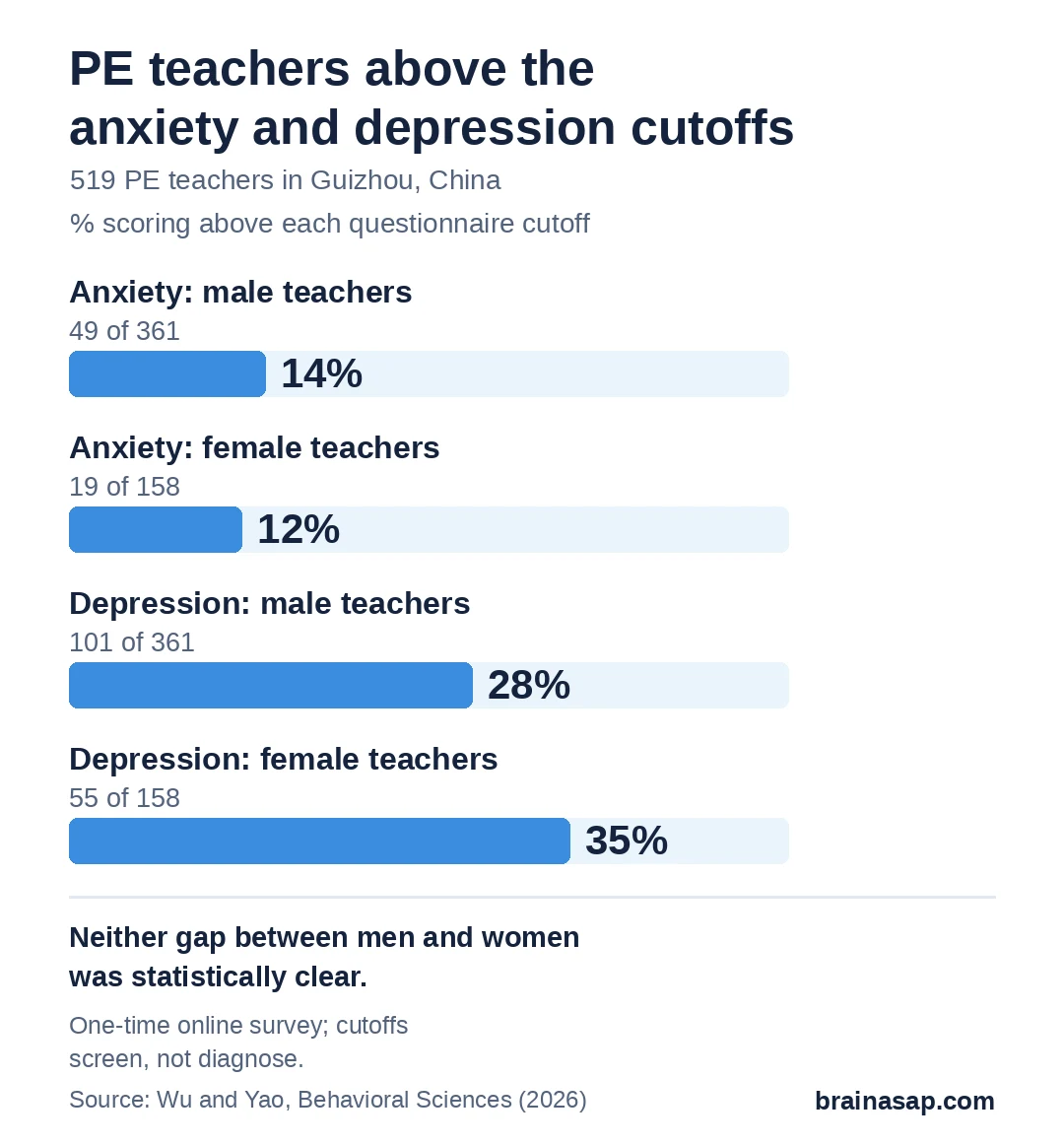
Not by much. Average anxiety and depression scores were almost the same for male and female teachers.
- Above the anxiety cutoff (10 of 21 points): 14% of men vs 12% of women
- Above the study's depression cutoff (7 of 27 points): 28% of men vs 35% of women
Neither gap was statistically clear, and the overall symptom pattern was similar too. One difference: symptoms were somewhat more tightly linked overall in women, though no single link or symptom differed clearly.
Limits to Keep in Mind
- One-time survey: A symptom map from a single survey shows links, not which symptom drives which.
- Low scores overall: Most teachers had few symptoms, and the movement item averaged under 0.5 out of 3.
- Overlapping questions: Some items on the 2 questionnaires describe similar things, such as restlessness, which can inflate their links.
- Fewer women: Only 158 women took part, and results for women were less stable.
- One province: All teachers came from Guizhou, so other regions and jobs may differ.
Could Watching for Movement Changes Help?
Wu and Yao suggested that noticeable slowing or restlessness might be a useful warning sign for screening PE teachers, partly because of its close link to thoughts of self-harm. Whether treating it would ease other symptoms is still an open question that would need a trial to answer.
Citation: DOI: 10.3390/bs16091534 Wu M, Yao C. Psychometric Network Characteristics of Anxiety and Depression Among Chinese Physical Education Teachers. Behavioral Sciences. 2026;16(9):1534.
Study Design: Cross-sectional online survey; GAD-7 and PHQ-9; regularized partial correlation network (EBICglasso), expected influence and bridge expected influence, clique percolation, Network Comparison Test by gender.
Sample Size: 519 full-time primary and secondary PE teachers in Guizhou Province, China (361 men, 158 women; mean age 31.6).
Key Statistic: PHQ8 "psychomotor change" highest expected influence (1.26) and bridge expected influence 0.62; PHQ2 "depressed mood" highest bridge expected influence (0.70). Above cutoff: GAD-7 ≥10 in 49/361 men vs 19/158 women; PHQ-9 ≥7 in 101/361 vs 55/158. Network invariance p = 0.673; global strength 7.44 (men) vs 8.25 (women), p = 0.021.
Caveat: Cross-sectional; low symptom levels; item content overlap between scales; smaller, less stable female network; single province.