TL;DR: In a 2026 study, mice breathed a common surgical anesthetic gas for a few hours over several days. Afterward, molecules that turn genes up or down in the hippocampus, the brain’s memory center, had clearly shifted compared with mice that breathed none: an early lead on memory problems after surgery, though these mice had no surgery and no memory tests.
Key Findings
- Computer search of earlier mouse data: 5 public datasets, pooled by RNA type into groups of 5 or 6 samples, flagged 39 genes that differed in the hippocampus of mouse models of postoperative cognitive dysfunction, vs. healthy mice.
- Narrowed to 8 genes: all linked to inflammation, cell death or cell stress, and each predicted to be controlled by a short chain of gene-switching molecules.
- Anesthetic gas test: in 9 mice that breathed sevoflurane, a common anesthetic, all 15 molecules checked had moved in the predicted direction vs. 9 mice that breathed none.
- 1 chain confirmed in lab-grown brain cells: a ring-shaped RNA soaked up a gene-silencing RNA, which let an inflammation-linked gene called PLA2G12B stay switched on.
- Not tested yet: memory in these mice, real surgery, or anything in people.
Source: Frontiers in Aging Neuroscience (2026) | Zhang et al.
Some people, especially older adults, come out of a major operation with a memory that isn’t quite what it was. Doctors call it postoperative cognitive dysfunction.
Estimates of how often it happens range widely, from 15% to 60% of surgical patients, according to studies cited in the paper. Why it happens is still poorly understood.
A 2026 study in Frontiers in Aging Neuroscience by anesthesiologists in Tianjin, China, looked for clues inside the hippocampus of mice, the brain region that handles learning and memory.
Ring-Shaped RNA That Acts Like a Sponge
Genes are switched up and down by more than DNA alone. Two kinds of RNA, the working copies of genetic material, matter here:
- MicroRNAs: tiny RNA pieces that latch onto a gene’s message and turn that gene down.
- Circular RNAs: RNA strands joined into a loop. Some soak up microRNAs like a sponge, which lets the genes those microRNAs would have silenced stay on.
That gives a 3-step chain: circular RNA → microRNA → gene. Zhang and colleagues went looking for chains like this that change in mice with memory problems after surgery or anesthesia.
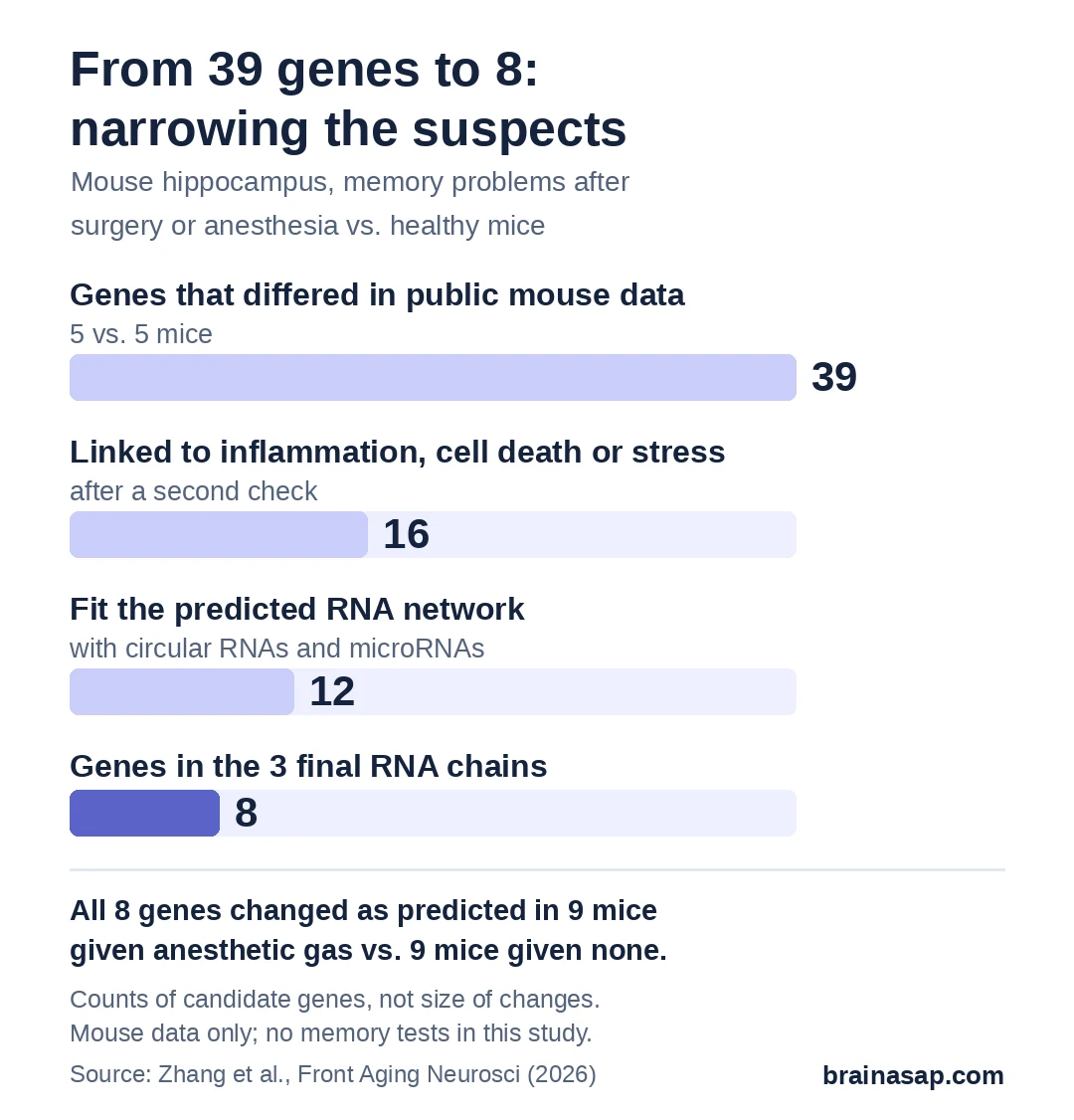
Narrowing 39 Genes Down to 8
First, the team pooled 5 public datasets from earlier mouse studies, each comparing the hippocampus of mouse models of postoperative cognitive dysfunction with healthy mice. Each dataset had 2 to 5 samples per group, or 5 or 6 after pooling by RNA type.
Those data flagged 39 genes that differed. Matching them against lists of genes tied to inflammation, cell death, immune activity and cell stress left 16.
Combining the genes with microRNAs and circular RNAs that also differed, plus online databases of which RNA binds which, produced a network of 4 circular RNAs, 14 microRNAs and 12 genes.
From that network came 3 tight chains built around 3 circular RNAs, involving 4 microRNAs and 8 genes.
Did Anesthesia Shift the Same Molecules?
Next came a test in living mice. Eighteen adult male mice were split into 2 groups of 9:
- Anesthetic gas mice: breathed 3% sevoflurane, an anesthetic widely used in surgery, for 2 hours a day on 3 days in a row.
- Comparison mice: breathed no anesthetic.
Hippocampal tissue was then checked for the 3 circular RNAs, 4 microRNAs and 8 genes.
The result? All 15 had moved in the direction the computer analysis predicted. Six genes rose and 2 fell, and protein tests showed the same pattern for all 8. Changes were statistically clear, though the paper shows their size only in figures.
One Chain Checked in Lab-Grown Cells
Moving together doesn’t prove that one molecule controls another. So the team tested one chain directly in mouse hippocampal cells grown in a dish.
That chain links a circular RNA called circRNA_009748, a microRNA called miR-337-3p, and a gene called PLA2G12B, which earlier research connects to inflammation. In cells:
- Binding confirmed: the microRNA latched onto both the circular RNA and the gene’s message.
- Less circular RNA, less gene activity: lowering the circular RNA cut PLA2G12B levels.
- Blocking the microRNA undid that: PLA2G12B came back up.
That fits the sponge idea: the circular RNA soaks up the microRNA and keeps the gene switched on. Neither of the other 2 chains was tested this way.
Big Gaps Between These Mice and Patients
- No memory tests: mice exposed to anesthetic gas in this study were not checked for memory problems.
- No surgery: only anesthesia, while patients usually have both.
- Tiny datasets: 2 to 5 samples per group in each public dataset, or 5 or 6 after pooling; the paper’s claim that these chains “diagnose” the condition comes from those small mouse samples, not patients.
- Young male mice only: 18-week-old males, while the problem mostly affects older adults.
- Cause not shown: nothing here shows that these molecules cause memory loss.
Would Blocking These Chains Protect Memory?
This study is a map of suspects, not a treatment. It points to 8 genes and 3 RNA chains in the memory center that shift after anesthesia in mice, and confirms how one of them works in cells.
What remains open is whether changing any of these chains in older mice, after real surgery, would change how well they remember, and whether the same molecules shift in people.
Citation: DOI: 10.3389/fnagi.2026.1733749. Zhang Y, Lu S, Yu Y, Yan Z, Qi Q. Comprehensive analysis of circRNA-miRNA-mRNA networks to reveal potential cell death, inflammation and oxidative stress-related targets for postoperative cognitive dysfunction. Front Aging Neurosci. 2026;18:1733749.
Study Design: Bioinformatics re-analysis of public mouse hippocampus datasets, plus expression checks in anesthetized mice and binding tests in cultured mouse hippocampal cells.
Sample Size: Public data: 5 vs. 5 (genes), 5 vs. 5 (microRNAs), 6 vs. 6 (circular RNAs); new experiment: 9 sevoflurane-exposed vs. 9 control mice.
Key Statistic: 39 differing genes narrowed to 8 in 3 predicted chains; all 15 chain molecules changed as predicted after sevoflurane.
Caveat: Mouse and cell work only; anesthesia without surgery; no memory testing; only 1 of 3 chains tested functionally.