TL;DR: In a study published in 2026 in China, 340 adults who had finished a hospital rehabilitation stay, mostly for back, neck or joint problems, filled in questionnaires on loneliness, social contact, anxiety and depression.
Nearly half had too little social contact or belonging, and about 1 in 3 felt lonely. A fear that something awful might happen, along with tiredness, was among the symptoms most connected to all the others.
Key Findings
- Social isolation was common: 47% of former rehab patients scored in the at-risk range for too little contact with family, friends and neighbors, or too little sense of belonging.
- Loneliness too: 36% scored above the questionnaire's loneliness cutoff.
- Fewer had marked mood symptoms: 12% had depression symptoms and 6% had anxiety symptoms at a level doctors usually follow up.
- Most connected symptoms: Fearing that something awful might happen, losing interest in things and feeling tired had the strongest links to the other symptoms.
- Links, not causes: All answers came from one survey, so the study can't show which symptom leads to which.
Source: Frontiers in Psychiatry (2026) | Li, Wang, Xu and Xu
Rehabilitation helps people get moving again after back pain, joint problems or a stroke. But weeks of treatment and limited mobility can also shrink a person's social world.
A 2026 study in Frontiers in Psychiatry, by researchers at Mianyang Hospital of Traditional Chinese Medicine in China, asked how loneliness and social isolation fit together with anxiety and depression after people leave rehab.
Who Took Part in the Survey?
Researchers surveyed 340 adults at follow-up visits between August 2024 and June 2025. All had already finished their inpatient rehab stay.
- Average age: 62
- Women: 55%
- Living in rural areas: 76%
- Main reasons for rehab: low back pain (26%), osteoarthritis (26%), neck problems from worn spinal discs (22%) and thinning bones (13%); only 2% had had a stroke
People with dementia-like memory problems, a diagnosed mental illness, cancer or another severe illness were left out.
Isolation and Loneliness Are Not the Same Thing
The study measured 2 related but separate ideas:
- Social isolation: how often people saw family, friends and neighbors, and whether they felt they belonged
- Loneliness: how often people felt alone or left out, whatever their actual contact
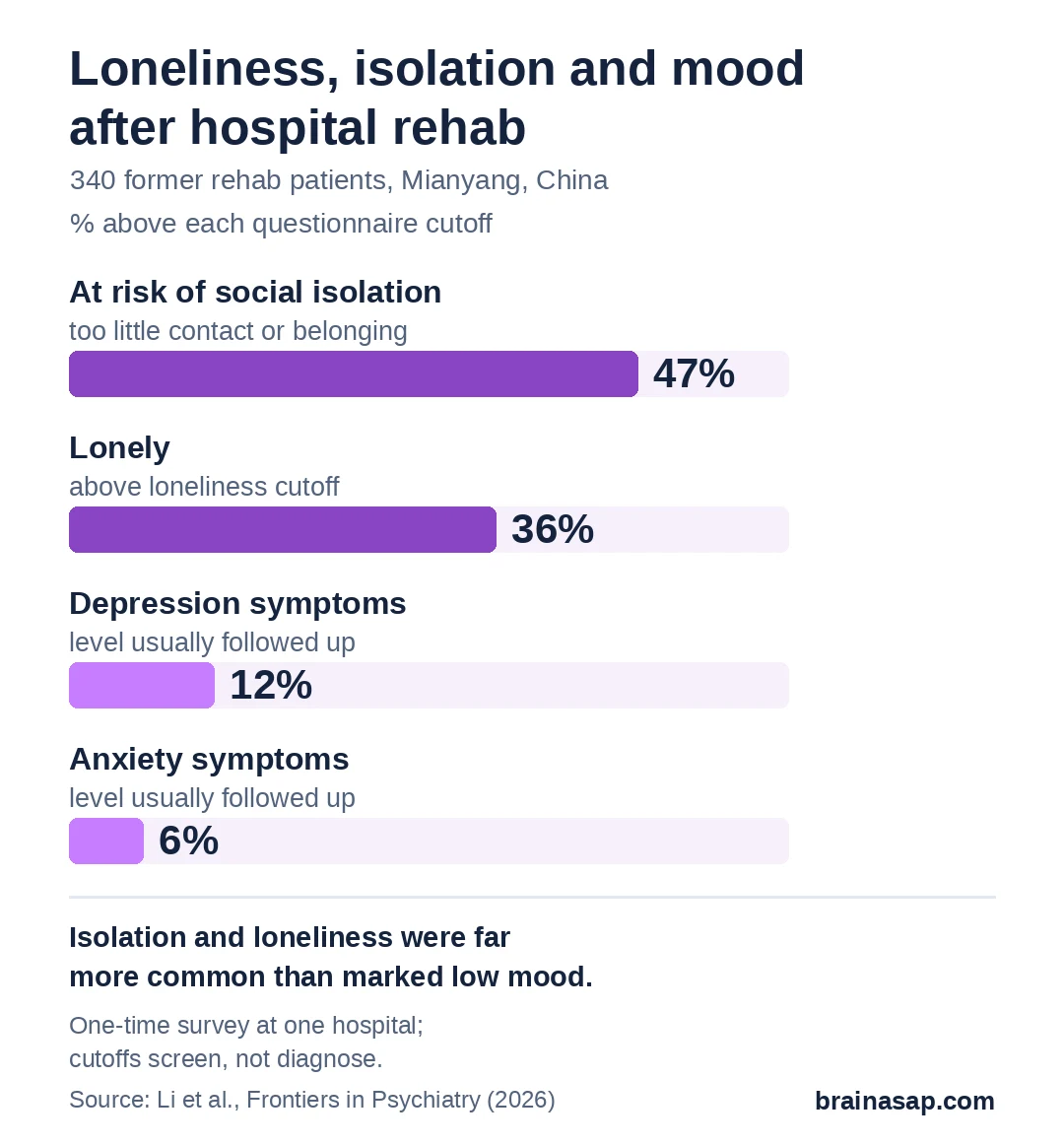
Isolation and loneliness were far more common than marked anxiety or depression. Average depression and anxiety scores were low: 3.9 out of 27 and 2.7 out of 21.
Not surprisingly, people with less social contact and belonging also tended to feel lonelier. That was the strongest single link in the whole analysis.
Which Symptoms Were Most Connected?
To map this, Li and colleagues used a method called network analysis. It treats each symptom, such as poor sleep or worry, as a point on a map, and draws a line wherever 2 symptoms tend to rise and fall together.
Symptoms with many strong lines are called central. In this group, the most central were:
- Fear that something awful might happen
- Losing interest or pleasure in doing things
- Feeling tired or having little energy
Loneliness and social isolation sat near the edge of the map, with fewer links. Symptoms that most often connected them to anxiety and depression were feeling slowed down or restless, fearing something awful and becoming easily annoyed.
A second type of analysis tried to guess the most likely order of symptoms. It placed tiredness and fear of awful events "upstream" and loneliness and isolation "downstream". Researchers stressed that this ordering comes from statistics on one survey, not proof that one symptom causes another.
What the Study Couldn't Show
- One-time survey: Can't tell whether fear and tiredness lead to loneliness, the reverse, or neither.
- Mostly back, neck and joint problems: Few stroke patients, so results may not apply to them.
- Tiredness has many sources: Pain, medicines or the illness itself could explain it, and these weren't measured.
- No adjustment for age, sex or diagnosis: These could shape the links.
- One hospital: A convenience sample from a single rehab department in Sichuan.
Will Easing Fear and Fatigue Reduce Loneliness After Rehab?
This study points to fear of awful events and tiredness as symptoms worth watching in people leaving rehab, alongside asking about their social contact. Whether treating those symptoms would make former patients feel less lonely is the open question that a follow-up or treatment trial would need to answer.
Citation: DOI: 10.3389/fpsyt.2026.1889828 Li Y, Wang D, Xu S, Xu J. Network analysis of social isolation, loneliness, depression and anxiety among post-discharge rehabilitation patients. Frontiers in Psychiatry. 2026;17:1889828.
Study Design: Cross-sectional survey; Social Isolation Scale, ULS-6 loneliness, PHQ-9, GAD-7; Graphical Gaussian Model (EBICglasso) and Directed Acyclic Graph (bnlearn hill-climbing, 10,000 bootstraps).
Sample Size: 340 adults (mean age 62.1; 55% women) at outpatient follow-up after inpatient rehabilitation, Mianyang Hospital of TCM, China (August 2024–June 2025).
Key Statistic: Social isolation risk 47.4% (161/340); loneliness 35.6% (121/340); PHQ-9 ≥10 12.1% (41); GAD-7 ≥10 6.2% (21). Strongest edge social isolation–loneliness (−0.461; lower SIS score means more isolated). Highest expected influence: fear of awful events, anhedonia, fatigue. CS-C 0.75 (EI), 0.68 (bridge EI).
Caveat: Cross-sectional self-report; single-center convenience sample dominated by musculoskeletal conditions; no covariates in network; DAG orientations are not causal; 14 incomplete questionnaires excluded without data on them.