TL;DR: In a survey published in 2026 in Abha, a city in southwestern Saudi Arabia, 400 high school students aged 15 to 18 filled in a standard questionnaire about recent feelings of depression, anxiety and stress.
Just over half reported at least mild anxiety symptoms, and about 4 in 10 reported depression or stress symptoms. Girls reported all 3 far more often than boys.
Key Findings
- Anxiety most common: 54% of students had at least mild anxiety symptoms, vs 39% for depression and 38% for stress.
- Not just mild: 18% had severe or extremely severe anxiety symptoms.
- Girls vs boys: 68% of girls had anxiety symptoms vs 39% of boys, a clear gap that held after accounting for family factors.
- Other links: Smoking, a long-term illness and a family history of mental illness went with higher odds of symptoms.
- Screening, not diagnosis: These are questionnaire scores from one point in time, not doctor-confirmed conditions.
Source: Frontiers in Psychiatry (2026) | Jabri et al.
Teen years bring exams, changing bodies and shifting friendships. For many teens they also bring worry and low mood that nobody notices.
A 2026 study in Frontiers in Psychiatry, led by Mohammed Jabri of the Saudi Ministry of Health, checked how common these feelings are among high school students in Abha, the capital of Saudi Arabia's Aseer Region. Earlier surveys there were more than a decade old and looked at boys or girls only.
Who Took Part and What Did They Answer?
Between October and December 2025, researchers randomly picked 2 boys' and 2 girls' public high schools in Abha (schools there are separated by sex), then 1 class from each grade in each school.
- Students: 400, aged 15 to 18; 200 boys and 200 girls; most were 16
- Left out: students already diagnosed with a mental health condition by a doctor
- Questionnaire: the Arabic version of a standard 42-item checklist, filled in anonymously in class
Each item asks how often a feeling applied over the past week, such as feeling down, feeling close to panic or finding it hard to relax. Scores are sorted into normal, mild, moderate, severe and extremely severe.
How Common Were the Symptoms?
Counting anything from mild upward:
- Anxiety: 53.5% of students; 18% in the severe or extremely severe range
- Depression: 39%; 11.5% severe or worse
- Stress: 38%; 9.5% severe or worse
For all 3, moderate was the most common symptom level. These rates were close to, and a little higher than, an earlier survey of boys in Abha that found 38% with depression symptoms and 49% with anxiety symptoms.
How Big Was the Gap Between Girls and Boys?
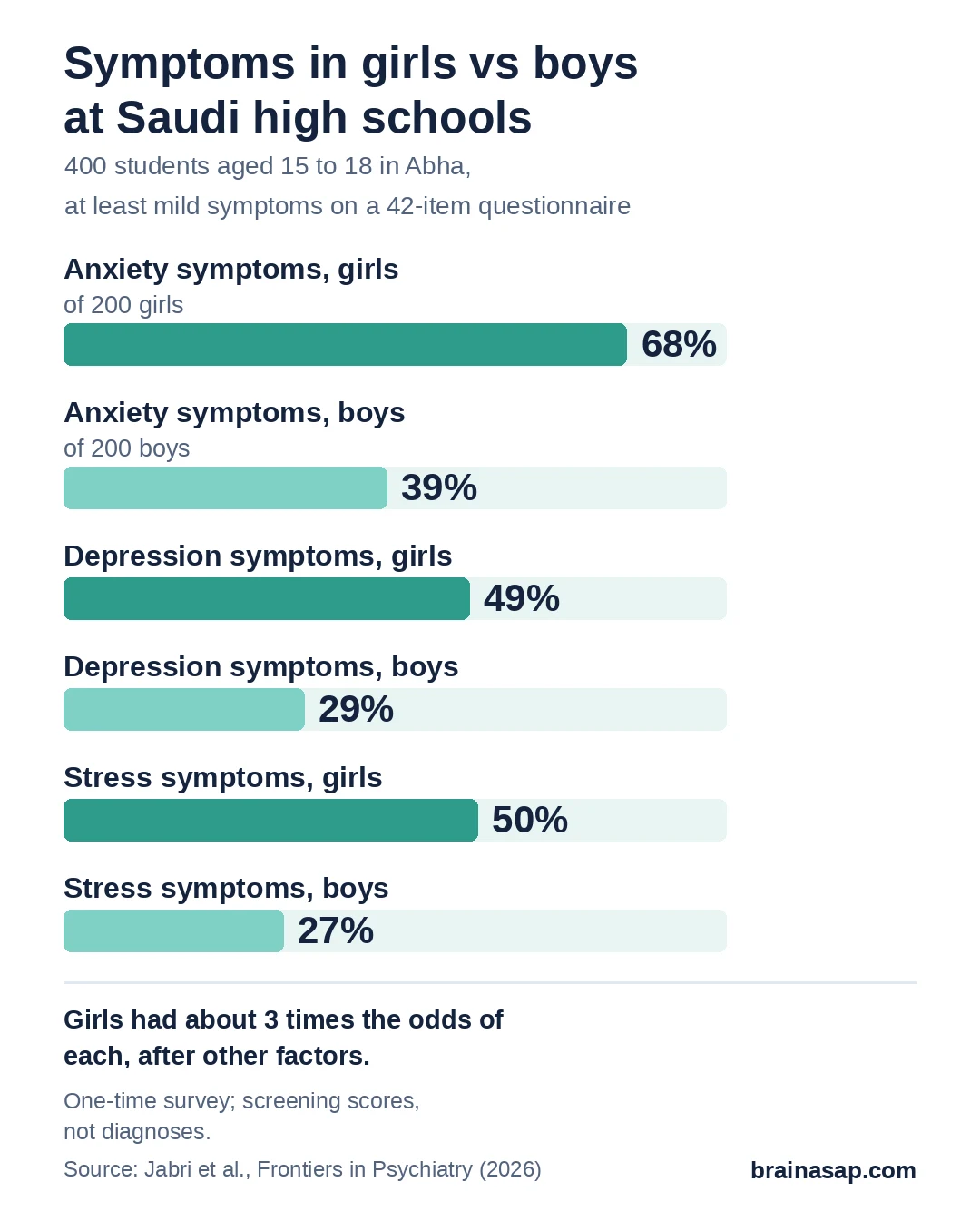
Girls reported every type of symptom more often. After accounting for other family and health factors, girls had about 3 times the odds of boys for each of the 3.
This survey did not test why. Jabri and colleagues pointed to hormonal changes, social expectations and girls being more likely to keep distress to themselves, but none of these was measured here.
What Else Went With More Symptoms?
Several factors stayed linked after the researchers accounted for the others:
- Smoking: about 3.5 to 4 times the odds of all 3, though only 23 students smoked
- A long-term illness: higher odds of depression and stress (22 students)
- Family history of mental illness: about 5 times the odds of depression and stress (22 students)
- Parents not living together (divorced or one parent had died): somewhat higher odds of depression
- Working mother: about twice the odds of anxiety, but no clear link with depression or stress
- Bigger family: lower odds of stress
Because so few students fell into some of these groups, those estimates are rough. Even the team flagged the smoking result as uncertain.
What Can a One-Time Survey Tell Us?
- No cause and effect: Students answered once, so the survey can't show whether smoking or family problems came before the symptoms.
- Self-reported: Answers may be shaped by memory or by wanting to look a certain way.
- Public schools in one city: Private school students and other regions were not included.
- Screening scores: The questionnaire flags symptoms; it does not diagnose depression or an anxiety disorder.
- Diagnosed students left out: Teens already known to have a mental health condition were not counted.
What Could Schools Do With This?
With more than half of students reporting anxiety symptoms, the team called for routine mental health screening in schools and extra support aimed at higher-risk students, such as girls and students who smoke. Whether school screening in Abha would lead to more teens getting help is the next thing to find out.
Citation: DOI: 10.3389/fpsyt.2026.1885953 Jabri MA, Elsubai I, Alshanqiti T, Alotaibi NM, Aljohani M, Alhazmi J, Mulla R, Alhejaili S, Althubyani S, Bin Jaber MN, Alharbi SA, Alahmadi AS. Prevalence and risk factors of depression, anxiety, and stress among secondary school students in Abha city, Saudi Arabia. Frontiers in Psychiatry. 2026;17:1885953.
Study Design: Cross-sectional survey with multistage stratified random sampling (2 boys' and 2 girls' governmental secondary schools, 1 class per grade); Arabic DASS-42; chi-square tests and multivariable logistic regression.
Sample Size: 400 students aged 15–18 (200 male, 200 female), Abha City, Aseer Region, October–December 2025; students with a physician-diagnosed psychiatric disorder excluded.
Key Statistic: Mild-or-worse symptoms: anxiety 53.5%, depression 39.0%, stress 38.3%; severe/extremely severe 18.0%, 11.5%, 9.5%. Female vs male: anxiety 68.0% vs 39.0%, depression 49.0% vs 29.0%, stress 50.0% vs 26.5%. Female AOR 3.60 (depression), 2.95 (anxiety), 3.08 (stress); smoking AOR 3.45–3.80.
Caveat: Cross-sectional; self-report screening tool, not diagnosis; governmental schools in one city only; small subgroups (23 smokers, 22 with chronic disease, 22 with family psychiatric history) give wide confidence intervals.