TL;DR: In group interviews, 19 psychiatric nurses at a large hospital in Riyadh, Saudi Arabia, said they would be willing to give people with schizophrenia a structured talk therapy. They also said unclear job rules, doctor-led care focused on medication and a lack of training would keep it from happening.
Key Findings
- Open to it: most of the 19 nurses called the proposed therapy plan helpful for people with schizophrenia, and none had formal training in it.
- No clear role: nurses said their jobs were mostly vital signs, watching patients and chores like opening doors, with no therapy in their job description.
- Medication comes first: nurses said psychiatrists mostly prescribed drugs and rarely referred patients for therapy.
- A telling contradiction: some nurses criticized drug-first care, while some also suggested that patients who refused medication might need to be restrained.
- What would help: backing from nursing managers, training with supervision, and involving families.
Source: Healthcare (2026) | Aljuhani, Lovell and Price
Cognitive behavioral therapy, or CBT, is a structured talk therapy. For schizophrenia, it helps people cope with symptoms such as voices and fixed false beliefs, and it is part of standard treatment guidelines in the UK.
In Saudi Arabia, few people with schizophrenia get it. There are not many psychologists or psychiatrists to deliver it, but there are many more psychiatric nurses. Could nurses fill the gap?
A Shortage of Therapists, but Plenty of Nurses
The workforce figures cited in a 2026 study in Healthcare show the problem. Saudi Arabia has about 1.3 psychiatrists and 2.0 psychologists per 100,000 people, compared with roughly 14.6 and 12.8 in the UK.
Mental health nurses are more common, at about 10.7 per 100,000. Trials elsewhere have shown that nurses can be trained to deliver CBT for schizophrenia.
Muteb Aljuhani, a Saudi mental health nurse and researcher at Imam Mohammad Ibn Saud Islamic University, worked with Karina Lovell and Owen Price at the University of Manchester to ask the nurses themselves.
Three Group Interviews at a Riyadh Hospital
Between December 2020 and February 2021, during the COVID-19 pandemic, Aljuhani ran 3 focus groups, guided discussions with 6 to 8 people each, at the Eradah Complex for Mental Health. It is a 625-bed hospital and the main referral center for mental health care in the Riyadh region.
Taking part were 19 nurses who work with people with schizophrenia:
- Experience: 2 to 18 years since qualifying, 10 years on average
- Mix: 10 women, 9 men; 14 staff nurses and 5 charge nurses
- Training: none had formal CBT training
Each group discussed the parts of a proposed CBT program adapted for Saudi culture, built from a review of how CBT is adjusted in other countries and from earlier interviews with Saudi patients and families. Nurses were asked what they thought of it and what would help or block it.
Discussions were held in Arabic, then translated into English and checked by an independent bilingual reviewer.
Nurses Liked the Plan, With a Few Tweaks
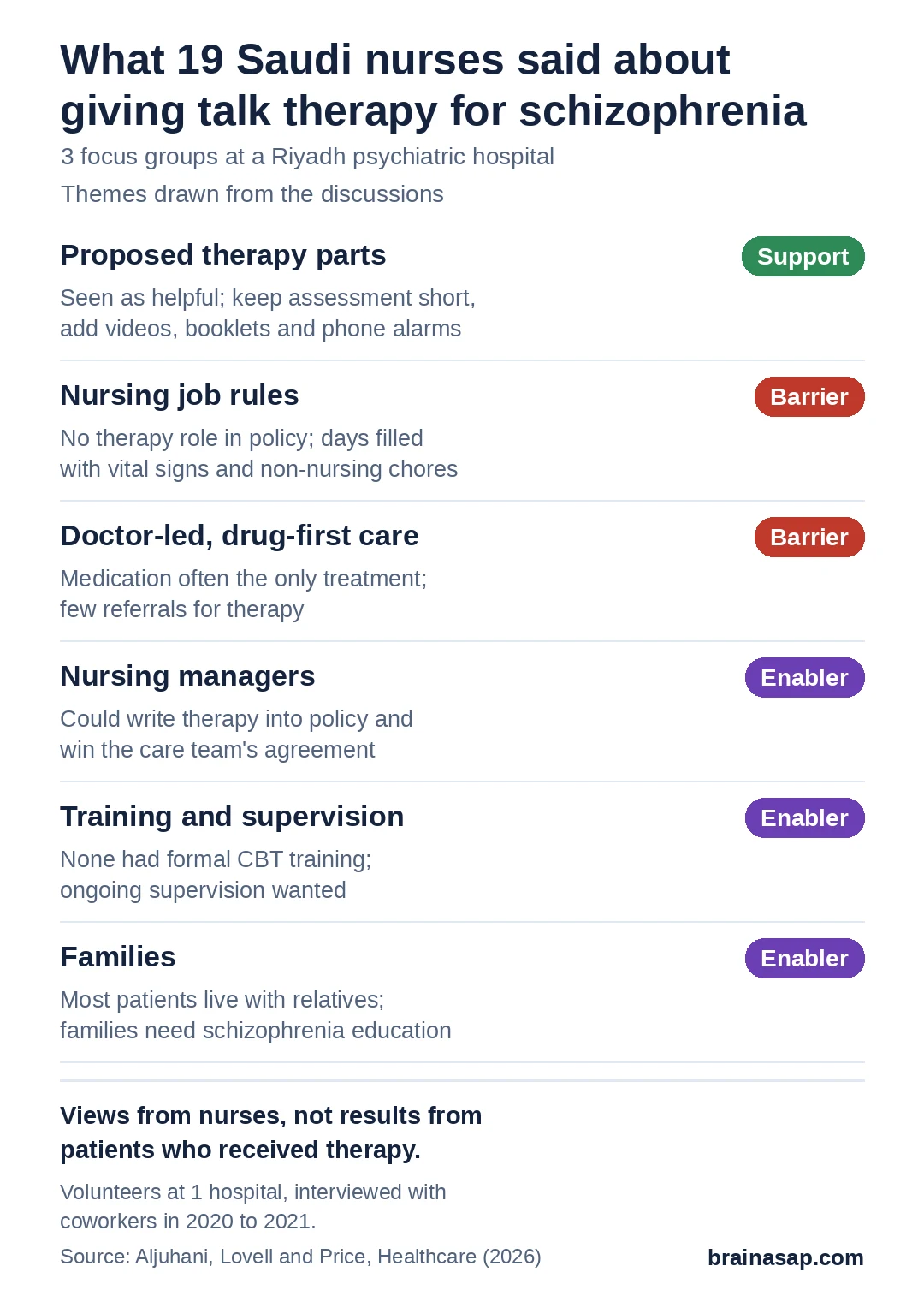
Most nurses saw the therapy's parts as useful. "These components, in my opinion, will help people who have schizophrenia deal with their symptoms," said one charge nurse.
Their suggestions were practical:
- Keep the first assessment short: long question sessions can lose patients' attention
- Use phone alarms: one nurse said a patient who kept forgetting doses was helped by setting one
- Add videos and colorful booklets: some patients find it hard to sit through spoken explanations
Aljuhani and colleagues described this support as real but conditional. Nurses wanted to help, but many weren't sure therapy was part of their job.
What Stood in the Way?
Biggest of all was the job itself. Nurses said their days were filled with vital signs, watching patient behavior, helping with hygiene and making beds, plus duties they saw as belonging to security staff or social workers.
"If CBT isn't an essential part of the job description, I'm not obliged to do it, which means I don't have the authorization to do it," one outpatient nurse said. Another, working on a ward, put it bluntly: even with CBT training, "I guarantee that I will not implement it because I am too busy."
Nurses also described care led by psychiatrists that centered on medication. In outpatient clinics, they said, drugs were often the only treatment offered and referrals to psychologists were rare.
Here the study turned up a contradiction. The discussions also emphasized keeping patients on medication, and some nurses said patients who refused medication might need to be physically restrained.
Aljuhani and colleagues flagged this as a clash with CBT, which depends on trust and on respecting patients' own goals.
What Nurses Said Would Help
- Nursing managers: they have the authority to write CBT into nursing policy, pick who delivers it and get the wider care team to agree
- Training plus supervision: "We are ready, but we lack the tools," one nurse said; another wanted to learn how to handle a patient whose paranoid beliefs focus on the nurse
- Families: most patients live with relatives who come to appointments, but nurses said many families see schizophrenia as "madness" and need education too
Some nurses suggested training should go first to colleagues who actually want to do it.
Views From One Hospital, Collected 5 Years Ago
- One urban hospital: smaller, rural or private services may differ
- Volunteers: nurses who chose to take part may have been more interested in CBT
- Colleagues in the room: people may have held back criticism in front of coworkers
- Opinions, not outcomes: no patients received therapy, and nurses' skills were not tested
- Older data: discussions took place in 2020 and 2021, so hospital practices may have changed since
Willing Nurses Still Need a Mandate
The nurses' message was consistent: they are willing, but willingness alone won't change practice. Training without a defined role, a reduced workload and support from psychiatrists is unlikely to stick.
Next, the team plans to write a training manual for nurses and then test whether the adapted CBT program can actually be delivered at the hospital. Whether nurse-delivered CBT helps Saudi patients with schizophrenia is a question for that next step.
Citation: DOI: 10.3390/healthcare14172852. Aljuhani M, Lovell K, Price O. Mental Health Nurses' Perspectives on Cognitive Behavioural Therapy for Individuals Diagnosed with Schizophrenia in Saudi Arabia: A Qualitative Study. Healthcare. 2026;14:2852.
Study Design: Qualitative focus-group study within the development phase of the Medical Research Council framework for complex interventions; framework analysis of translated Arabic transcripts.
Sample Size: 19 registered mental health nurses in 3 focus groups (6 to 8 each), Eradah Complex for Mental Health, Riyadh, December 2020 to February 2021.
Key Statistic: 3 themes (acceptability, challenges, enablers) and 6 subthemes; participants 10 women and 9 men, mean 9.5 years since qualification; none with formal CBT training. Workforce context cited by the paper: 1.32 psychiatrists, 2.03 psychologists and 10.66 mental health nurses per 100,000 in Saudi Arabia.
Caveat: Single hospital, convenience sample of volunteers, colleagues interviewed together, and views rather than measured outcomes; data collected in 2020 to 2021. Full published article reviewed.