TL;DR: Researchers compared genetic data from tens of thousands of people with schizophrenia or lupus, an autoimmune disease, and found a modest overlap in the genetic risk for the 2 conditions. Their clearest shared spot affected genes differently in brain cells and immune cells, so shared genes did not mean one shared disease process.
Key Findings
- Modest overall overlap: genetic correlation of 0.25 between schizophrenia and lupus, on a scale where 0 means no correlation and 1 means perfectly aligned genetic effects.
- 26 candidate DNA regions: 17 with estimated genetic effects in the same direction and 9 in opposite directions.
- 1 strong shared spot: a region near the FURIN and FES genes had an 87% estimated chance that a single variant drove both diseases. Most other regions scored far lower.
- Different effects by cell type: the risk version of that variant lowered FURIN activity in brain and immune cells but raised FES activity only in immune cells.
- No common pathway: genes in the shared regions did not cluster into one biological process.
Source: Human Molecular Genetics (2026) | Gong, Morris, Vyse and colleagues
Schizophrenia is a psychiatric illness. Lupus is an autoimmune disease, where the immune system attacks the body's own tissues, sometimes including the brain.
Yet the 2 turn up together in the same people more often than chance would predict. Could they share some of the same genetic roots?
Pooling DNA Data From Tens of Thousands of People
A 2026 study in Human Molecular Genetics, led by Chen Gong with David Morris and Timothy Vyse at King's College London, set out to measure that overlap.
Gong and colleagues used results from large genetic studies that scan the whole genome for small DNA differences linked to a disease. Everyone included was of European ancestry:
- Schizophrenia: 35,476 people with the illness and 46,839 without it
- Lupus: more than 10,000 people with lupus and 30,000 without it, pooled from 5 datasets, including 1 not published before
No one was examined in person. Instead, the analysis compared summary statistics, the published tallies of how strongly each DNA variant was linked to each disease.
A dense stretch of immune genes on chromosome 6, called the MHC, was left out of the genome-wide estimate because its complex structure can distort it.
How Much Genetic Risk Do Schizophrenia and Lupus Share?
Across the genome outside the MHC, the genetic correlation was 0.25. A value of 0 means no correlation, and 1 would mean the estimated genetic effects align perfectly. The estimate of 0.25 points to a modest overlap.
That figure describes the 2 diseases across a population. It is not a 25% chance that a person with one condition will develop the other.
Zooming in, 16 stretches of the genome showed a clear local overlap: 11 where risk ran in the same direction and 5 where it ran in opposite directions.
2 of the opposite-direction stretches sat inside the MHC, matching earlier work on an immune gene there, C4, where extra copies raise schizophrenia risk but lower lupus risk.
A combined analysis of both diseases then flagged 26 candidate regions:
- 17 aligned: the tested variants were associated with risk in the same direction for both diseases
- 9 opposing: the tested variants were associated with higher risk for one disease and lower risk for the other
Most Shared Regions Weren't Truly Shared
Two diseases can light up the same region for 2 different reasons. Either one DNA variant affects both, or 2 different variants that happen to sit close together each affect one disease.
To tell these apart, Gong and colleagues estimated, for each candidate region, the probability that a single variant explained both diseases' signals.
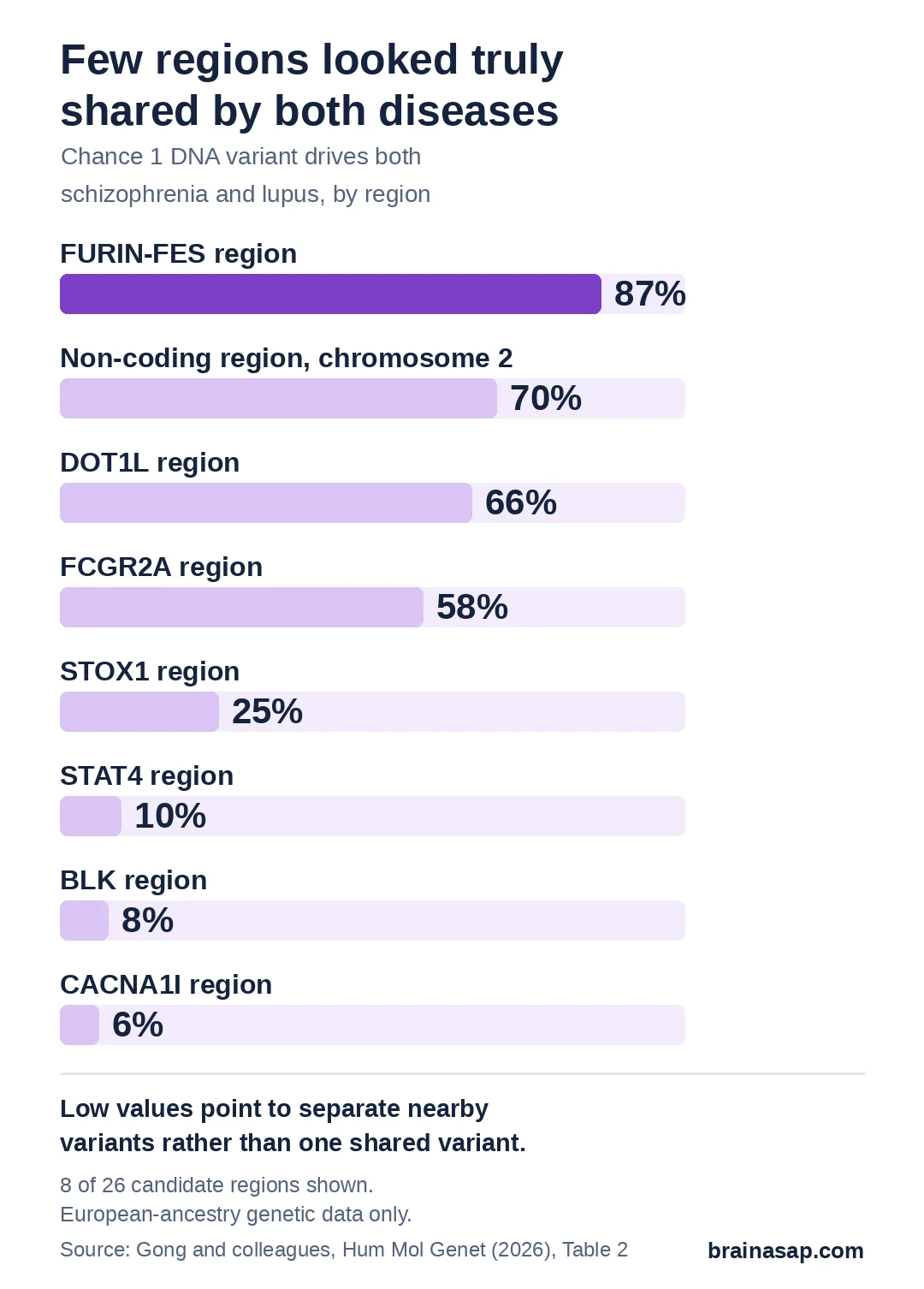
Only a handful of regions looked truly shared. A region near the FURIN and FES genes on chromosome 15 stood out at 87%, and one variant there, called rs4702, was the likely culprit. 3 more regions gave moderate support, between 58% and 70%.
Many others, including well-known lupus genes such as STAT4 and BLK, scored under 10%. For most of the overlap, schizophrenia and lupus seem to be pointing at neighboring variants, not the same one.
One Variant, Different Jobs in Brain and Immune Cells
The FURIN-FES spot was already known for schizophrenia. This study newly links it to lupus.
Using databases that show how DNA variants change gene activity in different tissues, the researchers found the risk version of rs4702 did 2 separate things:
- FURIN: lower activity in brain cells and immune cells. FURIN makes an enzyme that cuts other proteins into their working forms.
- FES: higher activity in immune cells only. FES makes a protein involved in early immune signaling.
A further analysis, called Mendelian randomization, uses people's genes as a natural experiment. It suggested that higher levels of FES protein in blood may raise the risk of both diseases, while FURIN protein levels showed no such link.
One possible reading is that this region feeds into schizophrenia mainly through FURIN in the brain, and into lupus through immune cells. Another is that it reflects lupus's own effects on the brain. This study could not settle which.
Why These Results Stop Short of a Shared Cause
- European ancestry only: results may differ in other populations
- Statistics, not experiments: the gene-activity and Mendelian randomization results point to possible causes, but the paper stresses they do not prove them
- Little brain protein data: no clear protein effects were detected in brain or spinal fluid, which may reflect weak measuring tools rather than no effect
- No single pathway: genes in the shared regions mixed immune and brain biology without pointing to one common process
- No drug target yet: the team judged FURIN a poor drug target because it acts on so many proteins
The lupus link at rs4702 did show up again in UK Biobank data for lupus affecting the skin, and the team noted a supporting result from an East Asian–European lupus analysis communicated privately.
Shared Genes Don't Always Mean Shared Biology
The study's clearest message is a caution. Two diseases can share genetic risk on paper while running through different cells and different processes.
What remains open is whether FES protein, the one result linked to both diseases, turns out to matter in lab tests of immune and brain cells, or whether the overlap between schizophrenia and lupus is a set of separate stories that happen to share an address.
Citation: DOI: 10.1093/hmg/ddag099. Gong C, Dand N, Butler AW, Amar A, Liu L, Triantafyllou PM, Morris DL, Vyse TJ. Shared genetic architecture of schizophrenia and lupus identifies pleiotropic loci with distinct downstream mechanisms. Human Molecular Genetics. 2026;35(20):ddag099.
Study Design: Cross-trait analysis of genome-wide association summary statistics: genome-wide genetic correlation (LD score regression, MHC excluded), local genetic correlation (rho-HESS), cross-trait meta-analysis, colocalisation, eQTL/pQTL annotation and Mendelian randomisation.
Sample Size: Schizophrenia, 35,476 cases and 46,839 controls; lupus, over 10,000 cases and 30,000 controls from 4 GWAS and 1 Immunochip dataset; all European ancestry.
Key Statistic: Genetic correlation rg = 0.25 (SE 0.074, p = 9.0 x 10^-4); 16 local regions (11 positive, 5 negative); 26 candidate loci (17 aligned, 9 opposing); FURIN-FES colocalisation probability 86.6% (rs4702); Mendelian randomisation odds ratios for FES protein 1.80 (schizophrenia) and 2.61 (lupus).
Caveat: European-ancestry summary data only; colocalisation and Mendelian randomisation suggest but do not establish causation; most candidate regions lacked evidence of a shared causal variant. Full published article reviewed; supplementary material not reviewed.