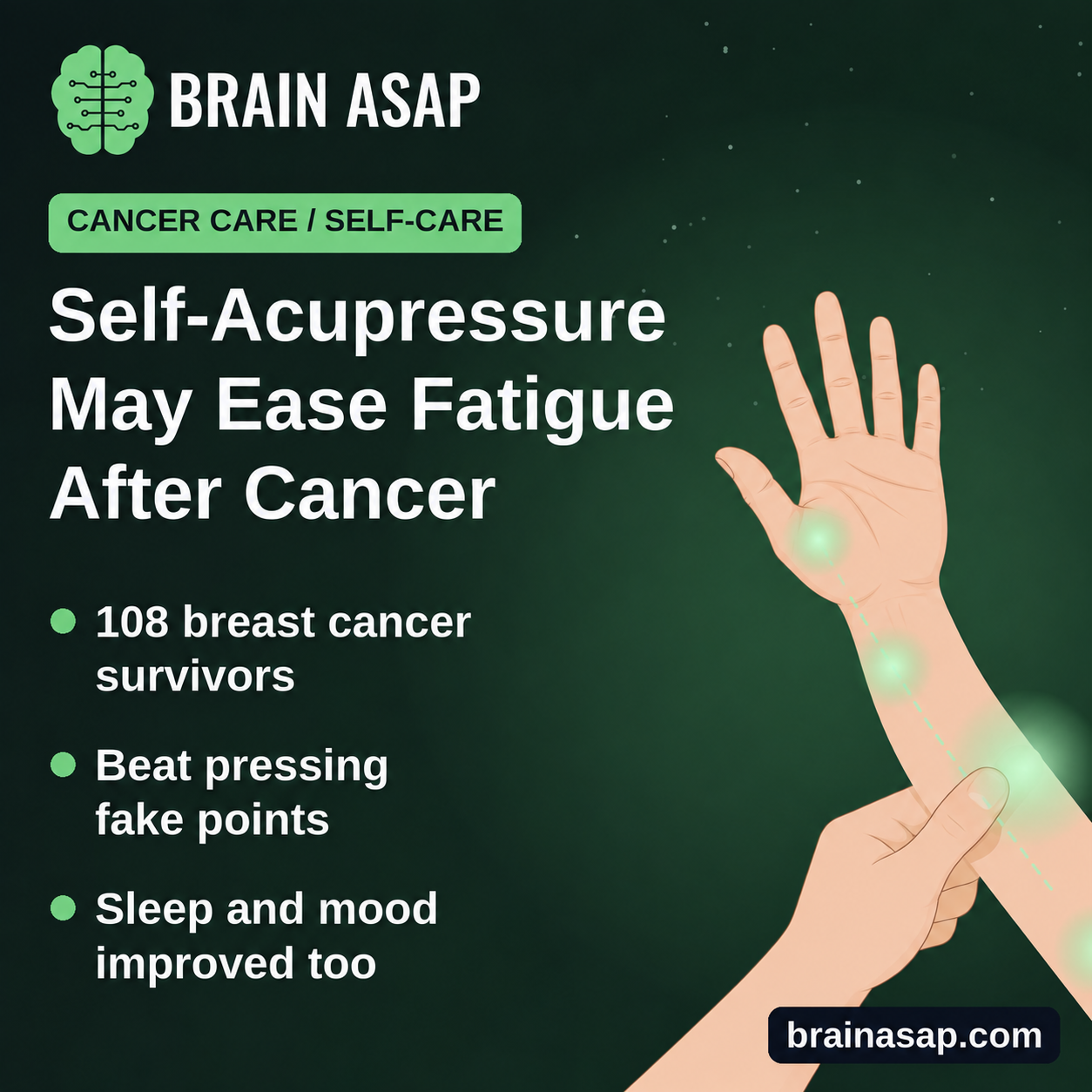
TL;DR: In a Chinese trial of 108 breast cancer survivors, 7 weeks of daily self-acupressure eased a combined score for fatigue, poor sleep and low mood more than pressing fake points or usual care. The gains held 12 weeks later, though all results were self-reported.
Key Findings
- 108 survivors, 3 groups: Real acupressure, fake-point pressing or usual care; 93 finished.
- Combined symptom score: Fell from about 5.9 to 3.3 of 10 with real acupressure.
- Beat fake points: For sleep and mood at both check-ins; for fatigue only at week 19.
- Fake points helped too: Better than usual care, but less than real points.
- No side effects reported.
Source: Supportive Care in Cancer (2026) | Li et al.
Finishing breast cancer treatment does not always end the symptoms. Many survivors are left with a trio of symptoms that feed one another: exhaustion, poor sleep and low mood.
Acupressure, pressing on specific points on the body, is something people can learn once and do at home. This phase III trial in Zunyi, China, tested whether it helps with all three at once.
3 Groups: Real Acupressure, Fake-Point Pressing or Usual Care
The researchers enrolled 108 women, averaging 49 years old, with early-stage breast cancer who had finished chemotherapy 1 month to 3 years earlier. All had at least moderate fatigue, sleep trouble and low mood. Everyone got an education booklet and usual care, then was randomly assigned to one of three groups:
- Real acupressure: Pressing 11 traditional points, such as between the thumb and index finger and below the knee, for 2 minutes each. Seven points were pressed on both sides of the body.
- Fake-point pressing: Light pressure on 11 spots 1 to 3 cm away from those points.
- Usual care: The booklet and routine follow-up only.
Both pressing groups practiced 36 minutes a day for 7 weeks, with in-person training, videos, daily WeChat reminders and weekly follow-ups. They did not know whether their points were real or fake.
Real Acupressure Lowered the Symptom Score Most
The main measure combined three 0 to 10 ratings for fatigue, sleep disturbance and depression into one average score.
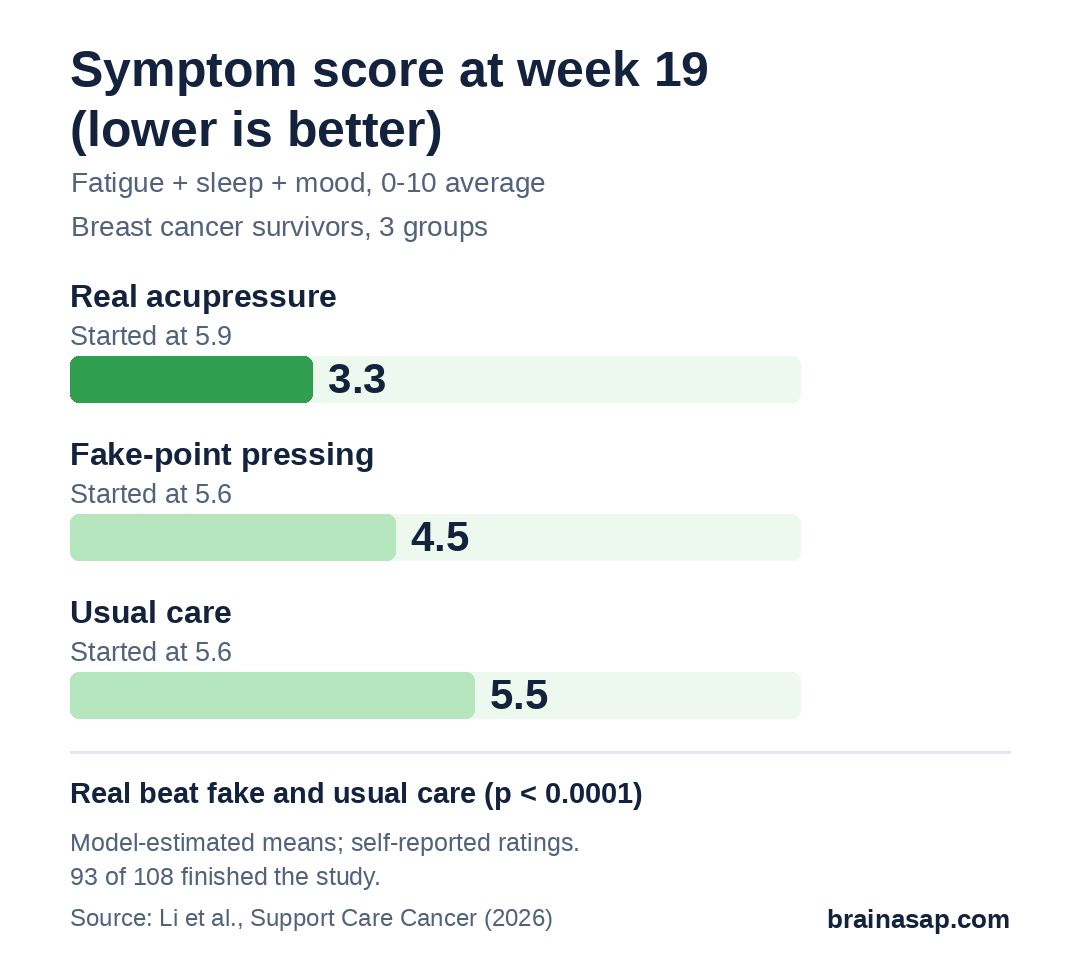
- Real acupressure: 5.9 at the start, 3.9 at week 7, 3.3 at week 19.
- Fake-point pressing: 5.6, then 4.7, then 4.5.
- Usual care: 5.6, then 5.5, then 5.5.
On the separate symptom questionnaires, real acupressure beat both other groups for sleep quality and depression at weeks 7 and 19. For fatigue it beat usual care at both times, but only pulled clearly ahead of fake-point pressing by week 19. Quality of life followed a similar pattern.
Why Fake Points Still Helped
The fake-point group also improved more than usual care. Daily self-care routines, attention and expectation can all ease symptoms, which is exactly why a sham group matters.
The extra gain supports the real-acupressure program, but point location and pressure differed. The trial cannot isolate their separate effects.
What Could Tilt the Results
- Self-reported: Clinical symptom and quality-of-life ratings came from questionnaires answered by participants.
- Partial blinding: Usual-care patients knew they got no acupressure, and the sham used lighter pressure.
- Missing follow-up data: The paper reports 15 dropouts and 25 missing week-19 assessments, without clearly explaining their overlap. Its models used available ratings.
- Homemade score: The combined symptom score is not a validated tool.
- Costs: Only two people used extra health care, too few to judge savings.
An Easy, Low-Risk Option to Try
For breast cancer survivors struggling with tiredness, sleep and mood, self-acupressure may be a safe, low-cost habit, especially with good initial training. It is not a replacement for treating depression or sleep disorders when they are severe.
The open question is whether the benefit shows up on objective measures, like activity trackers, and in settings outside China.
Citation: DOI: 10.1007/s00520-026-11155-2. Li M, Kwok WH, Wang T, et al. Effects of self-acupressure on the fatigue-sleep disturbance-depression symptom cluster in breast cancer survivors: a phase III randomised controlled trial. Support Care Cancer. 2026;34:981.
Study Design: Three-arm, partially blinded, sham-controlled phase III randomized trial (NCT06412107).
Sample Size: 108 randomized (36 per group); 93 completed.
Key Statistic: Symptom-cluster score at week 19: 3.32 (true) vs 4.45 (sham) vs 5.53 (usual care); p < 0.0001 for true vs each.
Caveat: Self-reported outcomes; partial blinding; unvalidated composite score; single region in China.