TL;DR: Researchers edited SETD1A in common marmosets and tested whether a founder could pass an altered copy to an offspring. Rare changes that disrupt this gene are linked to higher schizophrenia risk in people.
Eight of nine newborns carried a SETD1A edit. One male passed a disruptive version to one offspring. The researchers did not test behavior in this study.
Key Findings
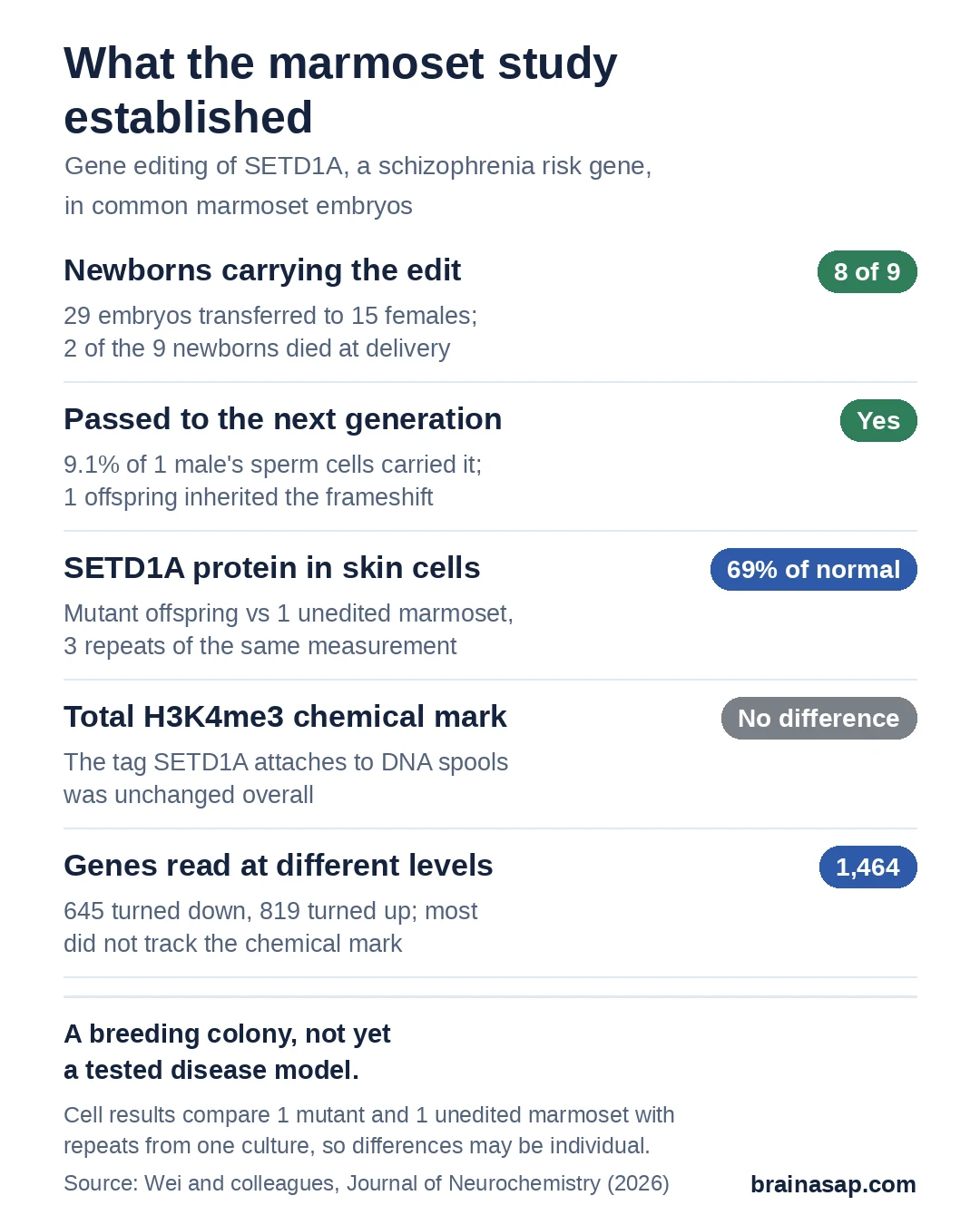
- Edit took in most newborns: 8 of 9 marmosets born after embryo editing carried a change in SETD1A, and 3 of them carried the same single-letter insertion that breaks the gene's instructions.
- It reached the next generation: 9.1% of sperm cells from one mutant male carried the broken version, and mating him with unedited females produced 1 offspring that inherited it.
- Less of the protein, as expected: skin cells from that offspring held 69% as much SETD1A protein as skin cells from an unedited marmoset.
- Chemical mark barely moved overall: total levels of the histone tag SETD1A places were no different between the 2 animals, though 346 individual genes carried more or less of it.
- Gene activity differed more broadly: 1,464 genes were read at different levels in the mutant monkey's skin cells, but most of those shifts did not line up with a change in the chemical mark.
Source: Journal of Neurochemistry (2026) | Zefeng Wei, Atsu Aiba and colleagues
Rare changes that disrupt a gene called SETD1A are strongly linked to schizophrenia and other neurodevelopmental conditions.
Mice carrying the same kind of fault do show memory and social problems. But a mouse has limited room to model a condition defined by thought, speech and social life.
A 2026 study in the Journal of Neurochemistry takes the obvious next step and a controversial one: build the fault into a monkey, and breed it.
Why a Marmoset?
Common marmosets are small South American monkeys, roughly squirrel-sized, that breed fast for a primate and usually have twins. That matters for a colony: a lineage can be established in years rather than decades.
Most previous monkey models of schizophrenia were made by giving healthy animals drugs that temporarily produce psychosis-like effects. A genetic model works differently, carrying the risk factor from conception, the way patients do.
How the Lineage Was Built
Wei and colleagues edited SETD1A in marmoset embryos and checked which variants the newborns carried.
From 29 manipulated embryos across 15 females, 9 pregnancies produced 9 newborns. Two died at delivery, apparently from breech presentation.
Eight of the 9 carried an edit. Only 3 carried a frameshift, a single extra DNA letter that scrambles everything downstream and is the kind of change seen in patients.
Other changes removed or replaced parts of the gene without shifting how the remaining instructions were read. The researchers followed one of the frameshift variants in the breeding study.
Did the Fault Pass to the Next Generation?
An edited founder animal is a patchwork: some cells carry the change, others don't. A lineage only exists if sperm or eggs carry it.
Sperm cells from male #495 were genotyped one by one, and 1 of 11 carried the broken version, about 9%. Mated with unedited females, he produced an offspring, #630, with the frameshift inherited cleanly.
That inheritance is the paper's real result. Weight gain over #630's first 31 weeks looked similar to that of 8 unedited males, and sequencing found no variants overlapping protein-coding regions at the 1,882 candidate off-target sites the authors checked.
What Did the Mutant Monkey's Cells Show?
SETD1A's day job is attaching a chemical tag, H3K4me3, to the spools that DNA wraps around, near the start of genes that should be switched on. Skin cells grown from tail biopsies let the team compare that machinery in #630 against an unedited marmoset.
SETD1A protein came in at 69% of the unedited level, in this two-animal comparison. The study found no clear difference in total H3K4me3.
Looking gene by gene told a slightly different story. Of more than 15,000 tagged spots in the genome, 346 genes differed: 229 with less of the tag, 117 with more.
Gene activity differed more widely, with 1,464 genes read at different levels (645 down, 819 up). Most of that did not follow the tag at all. Only 4.7% of the turned-down genes had lost tag, and 7.2% of the turned-up genes had gained it.
Among turned-down genes with no tag change, cell division and DNA repair came up repeatedly, which fits reports that SETD1A also does work unrelated to tagging histones.
Why These Cell Numbers Cannot Be Trusted Yet
- One animal versus one animal: every molecular comparison is 1 mutant marmoset against 1 unedited marmoset, so a difference may simply be 2 individuals differing
- Repeats were technical, not biological: the repeats came from the same cell populations. They capture technical variation and do not establish how much results vary across animals
- Skin cells, not brain cells: fibroblasts from a tail biopsy are convenient and are not neurons
- No behavior yet: nothing here tests memory, social behavior or anything resembling a schizophrenia symptom in these monkeys
- Thin lineage: 1 inheriting offspring from 1 founder male; the colony has to grow before anything can be replicated
What Would Make This Colony Worth the Trouble
Primate research of this kind carries real ethical weight, and the justification has to be evidence a mouse cannot give. On that test, this paper is infrastructure rather than a finding: a gene change introduced and inherited, with lower protein levels observed in skin cells from the one offspring compared.
Whether marmosets carrying the fault develop measurable differences in cognition, vocal communication or social behavior as they grow is the question it sets up. That answer needs more animals and years of watching them.
Citation: DOI: 10.1111/jnc.70546. Wei Z, Nakao H, Hiraoka Y, Harbers M, Abe Y, Goto M, Tamano M, Saeki M, Kishi Y, Aiba A. Establishment of a Common Marmoset Lineage Carrying a Frameshift Mutation in SETD1A, a Schizophrenia Risk Gene. Journal of Neurochemistry 2026;170:e70546.
Study Design: CRISPR/Cas9 editing of exon 6 of SETD1A in common marmoset embryos with autologous embryo transfer, genotyping of founders and sperm, breeding to establish germline transmission, then Western blot, CUT&Tag H3K4me3 profiling and RNA sequencing in tail-derived fibroblasts from the F1 mutant and 1 wild-type marmoset.
Sample Size: 29 manipulated embryos from 15 females; 9 pregnancies, 9 newborns, 8 carrying edits, 3 with the frameshift; 1 F1 mutant offspring. Molecular work: 1 mutant and 1 wild-type animal, 3 technical replicates each.
Key Statistic: SETD1A protein in mutant fibroblasts was 69% of wild-type (p = 0.016); total H3K4me3 did not differ (p = 0.59); 346 genes showed differential H3K4me3 deposition (229 loss, 117 gain) and 1,464 genes were differentially expressed (645 down, 819 up), with only 4.7% and 7.2% of those overlapping tag loss and gain.
Caveat: Peer-reviewed and open access, but every molecular comparison rests on 1 mutant and 1 wild-type marmoset with technical rather than biological replicates, as the authors state; reported p-values therefore reflect measurement variation, not a validated difference between mutant and normal animals. Fibroblasts are not neurons, and no cognitive, social or behavioral testing has been done in this lineage.