TL;DR: Chemicals in the breath of people with sleep apnea differ from those of people without it, and early studies suggest a breath test might one day help screen for it. The best result so far correctly sorted about 3 in 4 people, which is not yet good enough to replace a sleep study.
Key Findings
- Breath changes are real but early: Studies found shifts in compounds such as acetone, aldehydes and isoprene.
- Best accuracy so far: A set of confirmed breath markers reached AUC 0.80 and 77% accuracy in a second group.
- Another validation was weaker: A different marker set reached AUC 0.66.
- Small studies: Clinical groups ranged from 44 to 89 people, mostly at single centers.
- Inflammation may be the link: Repeated oxygen drops at night may change body chemistry that shows up in breath.
Source: Nature and Science of Sleep (2026) | Wang and Pan
Nearly a billion people worldwide may have obstructive sleep apnea, and many never get tested. The standard diagnosis is an overnight sleep study, which is costly and can involve long waits.
What if a simple breath sample could flag who needs one? Two researchers in Xi'an, China, reviewed what is known about the chemicals in apnea patients' breath and why they might change.
Why Sleep Apnea Might Leave a Trace in Breath
In obstructive sleep apnea, the throat repeatedly narrows or closes during sleep. Oxygen levels dip and recover again and again through the night. The review describes how this cycle may:
- Raise oxidative stress: Damaging molecules break down fats in cell membranes, releasing gases such as aldehydes and alkanes.
- Switch on inflammation: Signals such as NF-κB, HIF-1α and the NLRP3 inflammasome become more active.
- Shift metabolism: Changes in how the body burns sugar and fat can alter breath acetone.
- Inflame the airway itself: Repeated vibration and collapse stress the throat lining.
These volatile organic compounds, or VOCs, can be measured in exhaled breath with sensitive lab instruments.
How Well Breath Tests Have Done So Far
The review highlights six clinical studies:
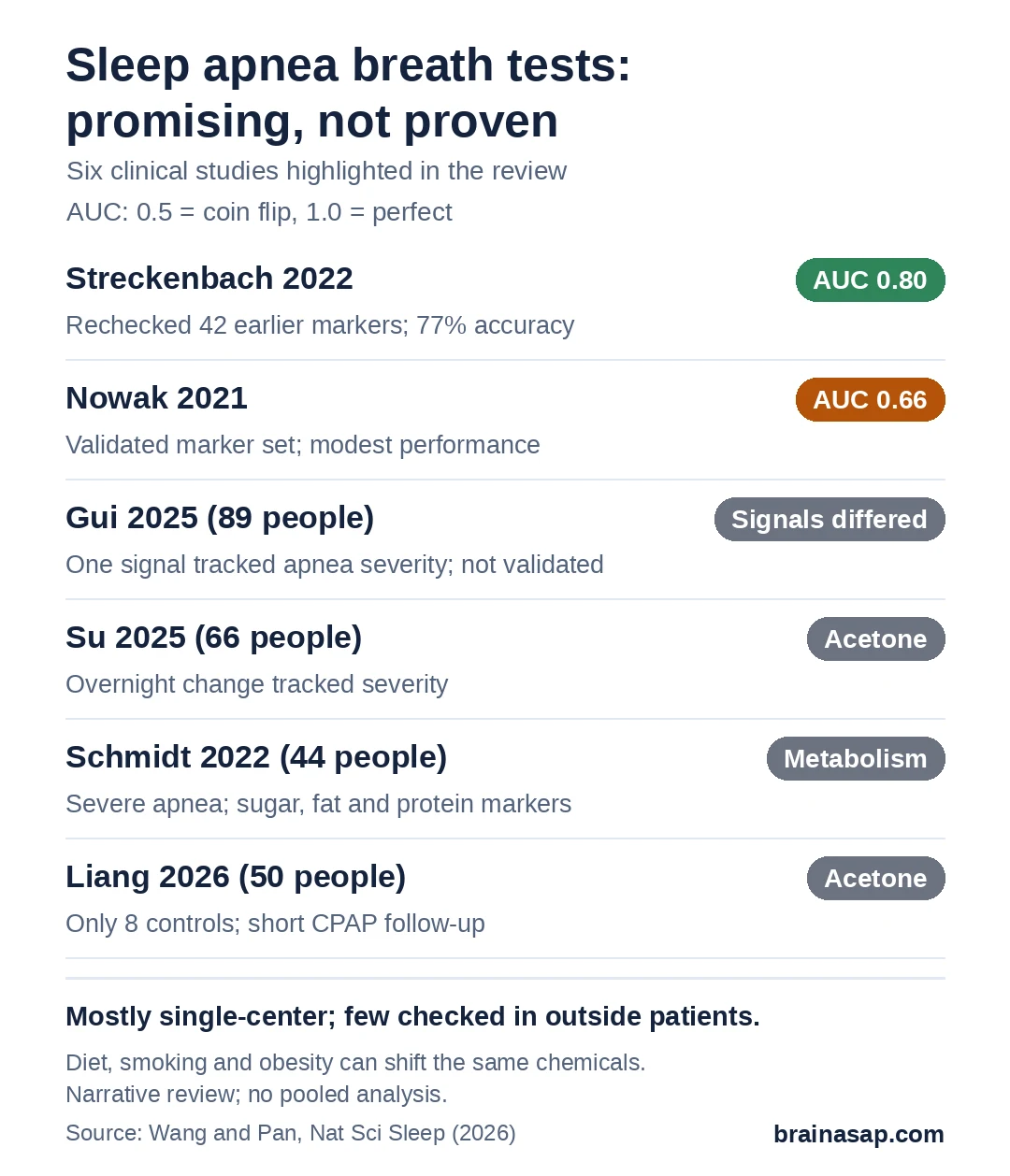
The strongest result came from a 2022 study that rechecked 42 previously reported breath markers in a new group. A prediction based on those markers reached an AUC of 0.80 with 77% accuracy. A separate validation effort reached only 0.66.
Other studies linked specific breath signals, including one thought to be acetaldehyde and overnight changes in acetone, to apnea severity. Some markers moved after CPAP treatment, hinting that breath tests might also track whether therapy is working.
Diet, Smoking and Lab Methods Muddy the Picture
- Not specific: Obesity, diabetes, diet, medicines and smoking can shift the same chemicals.
- Poor agreement: Different studies found different marker compounds.
- Small, single-center groups: Few studies were checked in outside patients.
- Uncertain identities: Some breath signals were not definitively matched to a compound.
- Mechanism is proposed: The inflammation-to-breath chain is a model built from separate studies, not proven step by step.
- Narrative review: No systematic search or pooled analysis.
A Sleep Study Is Still the Test to Get
For now, anyone with loud snoring, gasping at night or heavy daytime sleepiness should still be assessed with a sleep study or a home sleep test. Breath analysis is a research tool.
The authors call for standardized breath sampling, confirmed compound identities and large studies checked in separate patient groups. The question is whether a breath test can reach the accuracy needed for reliable screening once those pieces are in place.
Citation: DOI: 10.2147/NSS.S637656. Wang Y, Pan L. Intermittent hypoxia-induced inflammation and the formation of exhaled volatile organic compound profiles in obstructive sleep apnea-hypopnea syndrome: a narrative review. Nat Sci Sleep. 2026;18:637656.
Study Design: Narrative review of mechanistic and clinical studies of exhaled VOCs in obstructive sleep apnea.
Sample Size: Not applicable (review); highlighted clinical studies included 44 to 89 participants.
Key Statistic: Best externally confirmed breath-marker model: AUC 0.80, accuracy 77%.
Caveat: Small single-center studies; markers not specific; no pooled analysis.