TL;DR: In UK Biobank data, people who slept either less than about 6 or more than about 8 hours tended to look biologically older across several organs, and both groups had higher death rates. The "youngest" clocks lined up with roughly 6 to 8 hours of sleep, but this was observational and based on self-reported sleep.
Key Findings
- 23 aging clocks tested: From brain scans, blood proteins and blood metabolites.
- U-shaped pattern in 9: Too little and too much sleep both linked to older biological age.
- Lowest points: Approximately 6 to 8 hours, varying by organ and sex.
- Death from any cause: 50% higher under 6 hours, 40% higher over 8 hours.
- Depression pathways differed: Long sleep partly through older-looking organs; short sleep more directly.
Source: Nature (2026) | O'Toole et al.
We are told to get seven or eight hours of sleep, but not why the number matters for how our bodies age. And while short sleep gets the most attention, long sleep has also been linked to poor health.
This large study, led from Columbia University, used "aging clocks" to ask how sleep length tracks with the biological age of different organs.
Aging Clocks for Nine Body Systems
An aging clock estimates how old a body system looks based on measurements, then compares that with a person's actual age. The gap between the two is the biological age gap: positive means older than expected.
The researchers used 23 clocks built from UK Biobank data on adults aged 37 to 84:
- 7 from MRI scans: Including brain, fat tissue and pancreas.
- 11 from blood proteins: Including brain, lung, liver, immune system and skin.
- 5 from blood metabolites: Including the hormone system.
They compared these gaps with how long people said they usually slept, without assuming any particular shape for the relationship.
A U-Shaped Link, With Organ-by-Organ Sweet Spots
Nine of the 23 clocks showed a clear U-shape: people with the shortest and longest sleep looked biologically older than those in the middle. The strongest was the brain protein clock.
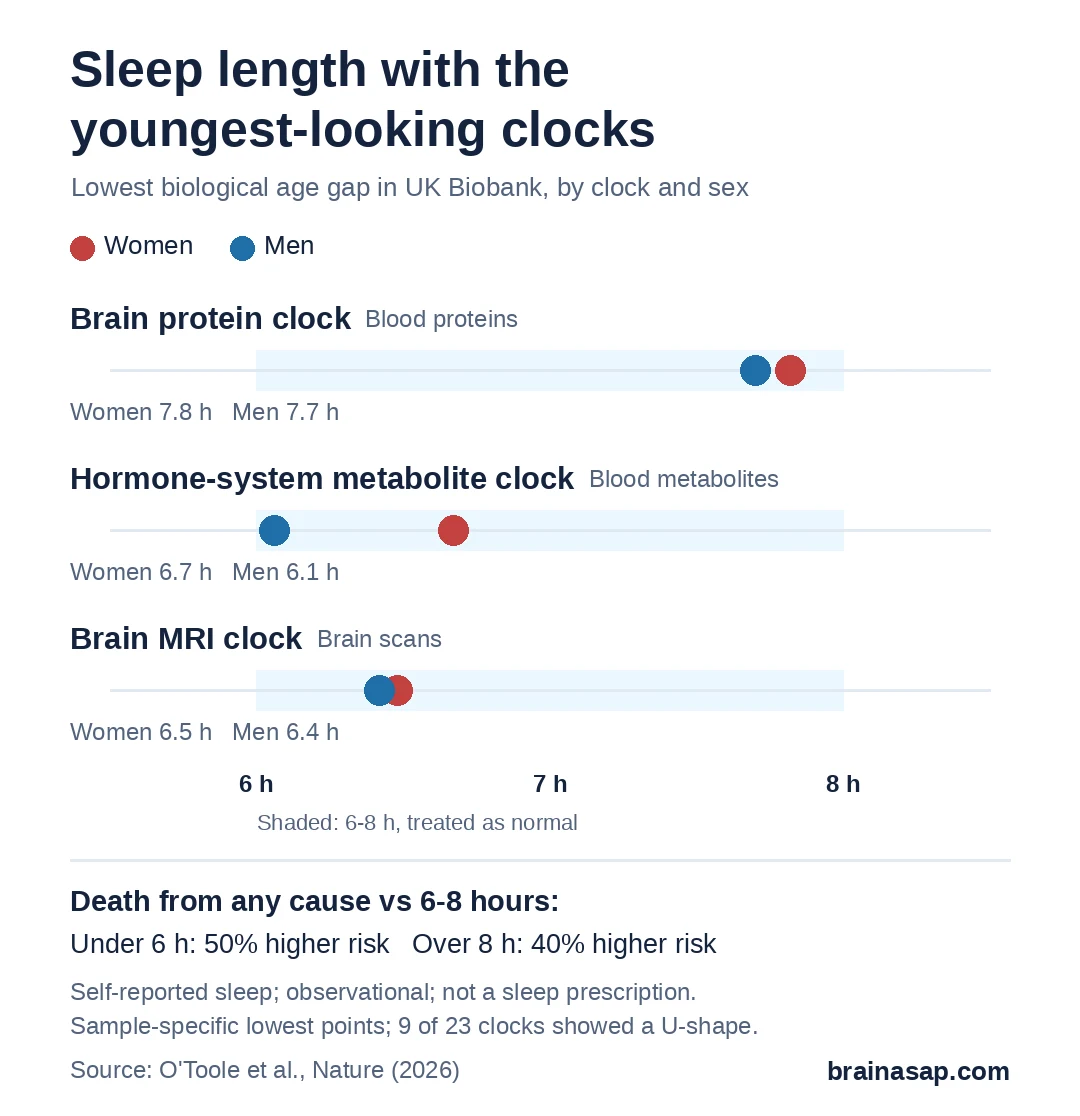
The lowest point differed by organ and sex. Across the nine clocks it fell roughly between 6 and 8 hours. The brain MRI clock bottomed out near 6.5 hours, while the brain protein clock bottomed out near 7.8.
Short and Long Sleep Tracked With Disease and Death
Using these results, the team grouped sleep into short (under 6 hours), normal (6 to 8) and long (over 8). Compared with normal sleepers:
- Short sleepers: 50% higher risk of death from any cause.
- Long sleepers: 40% higher risk.
- Many diseases: Links with conditions across the body, more often for short sleep, including depression and diabetes.
For late-life depression, the routes looked different. Long sleep's link ran partly through older-looking organs, especially the brain. Short sleep's link was more direct.
What Can't Be Concluded
- Self-reported sleep: A single questionnaire answer, not a sleep tracker.
- Observational: Illness can cause long sleep, not just the reverse. Genetic tests did not show widespread reverse effects but could not rule them out.
- Subsamples: Each clock used a different, smaller group with scans or blood tests.
- Mostly one population: Replication groups were small (385 and 573 people) and older.
A Middle Ground Seems Best for Many Organs
For adults in midlife and beyond, this adds to evidence that both too little and too much sleep are worth paying attention to. A long-sleep habit in particular could be a sign worth raising with a doctor, since it may reflect an underlying problem.
The open question is cause and effect: whether changing sleep length actually slows biological aging, which would take trials with measured sleep.
Citation: DOI: 10.1038/s41586-026-10524-5. The MULTI Consortium, O'Toole CK, Song Z, et al., Wen J. Sleep chart of biological ageing clocks in middle and late life. Nature. 2026. Published online May 13, 2026.
Study Design: Observational analysis of UK Biobank self-reported sleep duration vs 23 multi-organ aging clocks (MRI, proteomics, metabolomics), with survival, genetic correlation, mediation and Mendelian randomization analyses.
Sample Size: UK Biobank (~500,000); clock-specific subsamples vary.
Key Statistic: All-cause mortality HR 1.50 (95% CI 1.44 to 1.55) for short and 1.40 (1.36 to 1.44) for long vs 6-8 h sleep.
Caveat: Self-reported sleep; observational; reverse causation possible.