TL;DR: In a 2026 study from Copenhagen, 103 adults recently home from a hospital stay for depression rated their symptoms each morning and evening for 4 weeks and logged when they slept.
Mornings tended to feel a little better after about 8 hours of sleep, an earlier bedtime and fewer wake-ups. Those differences were small, and this kind of tracking can't show that sleep caused them.
Key Findings
- About 8 hours looked best: Morning depression ratings were slightly better after around 8 hours of sleep than after 4 or 12 hours.
- Late sleep, worse mornings: When the middle of a person's sleep fell later in the night, the next morning's rating was a bit worse.
- Wake-ups counted: Each time someone woke during the night, the morning rating dipped slightly.
- Mood swung day to day: Evenings felt better than mornings on 39% of days, worse on 22% and the same on the rest.
Source: npj Biological Timing and Sleep (2026) | Aggestrup et al.
Many people with depression say mornings are the hardest part of the day. Doctors have long suspected that sleep, and especially when it happens, plays a part.
A 2026 study in npj Biological Timing and Sleep, by Anne Sofie Aggestrup, Klaus Martiny and colleagues at Mental Health Center Copenhagen, tracked that link night by night in people with severe depression.
Who Kept the Daily Diary?
Between 2016 and 2020, the Copenhagen team enrolled 103 adults who were leaving a psychiatric ward in Copenhagen after treatment for a major depressive episode.
- Age: median about 42
- Women: about 57%
- Severity: about 3 in 5 had melancholic depression, a severe form
- Treatment: almost all took an antidepressant; about 1 in 4 had electroconvulsive therapy during the hospital stay
For the next 28 days, each person used an iPad app to log 2 depression ratings a day: one within 30 minutes of waking and one shortly before bed.
Each rating ran from 0 to 10, where 10 meant no depression at all, so a higher number meant feeling better. People also logged when they fell asleep, when they woke up, how often they woke in the night and any daytime naps.
Records were filled in on 97% of mornings and 90% of evenings.
Half of the group also got coaching on keeping regular daily rhythms, as part of a trial reported earlier. The assigned groups showed no clear difference in morning-to-evening variation or its changes between adjoining days, so the researchers pooled all 103 people for analysis.
Did Mornings Always Feel Worse?
Not reliably. On average, evening ratings were only 0.33 points better than morning ratings.
Day to day, the pattern kept flipping:
- Better by evening: 39% of days
- No change: 39% of days
- Worse by evening: 22% of days
Five participants lacked enough paired ratings to calculate this variation. Among the remaining 98, 93 switched between these patterns during the 4 weeks. In other words, one day's mood swing says little about the next.
How Did Sleep Line Up With the Next Morning?
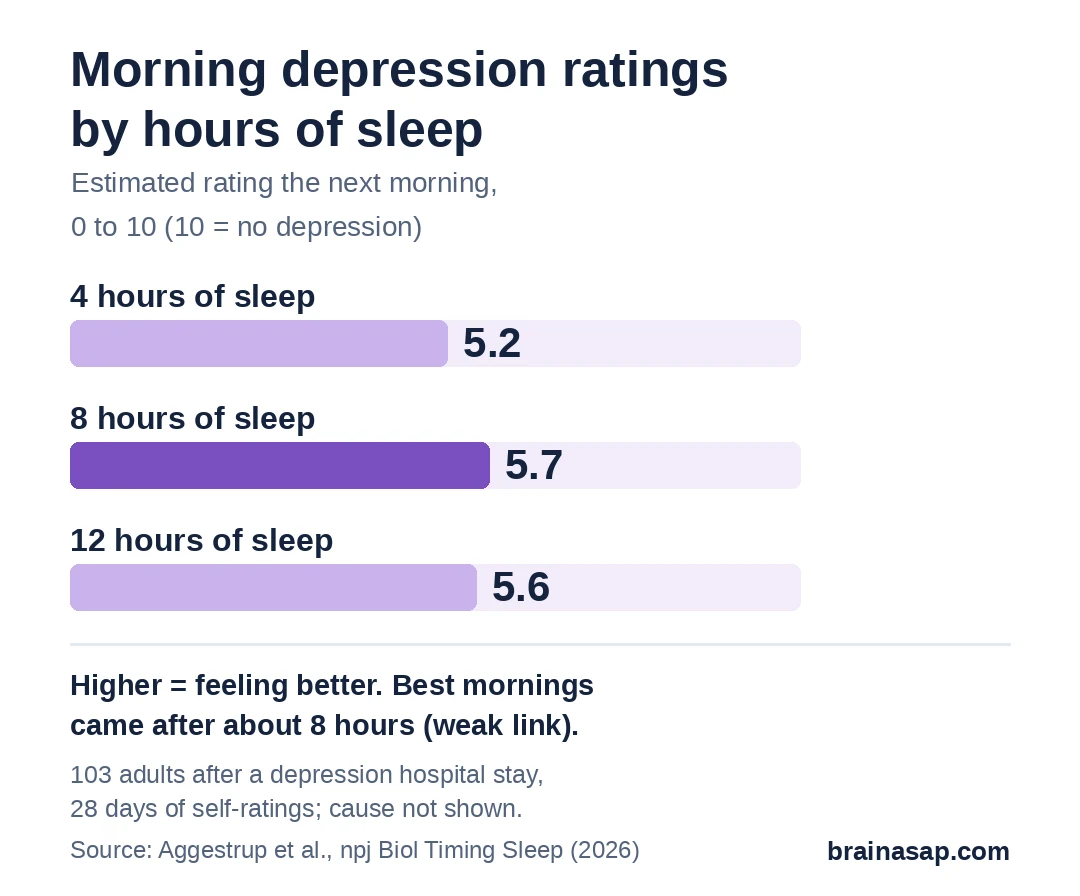
Each morning's rating was compared with the sleep logged the night before. Several sleep features lined up with slightly worse mornings:
- Too short or too long: estimated ratings were 5.2 after 4 hours, 5.7 after 8 hours and 5.6 after 12 hours. This link was weak.
- Later sleep timing: shifting the midpoint of sleep 2 hours later went with a rating about 0.6 points worse. Sleeping in by 2 hours made up part of that, leaving a net drop of about 0.2.
- Going to bed later than the night before: each hour later went with a drop of 0.06 points, which Aggestrup and colleagues called small.
- Waking in the night: each wake-up went with a drop of about 0.1 points.
- Naps: no clear link with the next morning.
Put together, the best mornings came after roughly 8 hours of sleep that started fairly early and wasn't broken up.
Why Small Differences Still Interest Sleep Researchers
None of these gaps is large on a 10-point scale. But Martiny's team pointed to a pattern clinicians see often: people who feel better in the evening may stay up later to enjoy it, which may make the next morning worse.
Repeated over many nights, small shifts like this could add up. In the earlier trial, people coached to keep regular rhythms fell asleep earlier, slept longer and improved more than those receiving usual care.
What This Study Couldn't Show
- Cause unknown: A bad morning mood could follow a bad night, or the depression could disrupt sleep. This kind of tracking can't separate the two.
- Exploratory: These analyses came after the trial's main result and include many comparisons, raising the chance of a fluke.
- Self-reported: Sleep times and ratings were entered by patients, some of them severely ill, with no sleep lab checks.
- One group: Adults leaving psychiatric wards in Copenhagen; results may differ for milder depression.
Testing Earlier, Steadier Sleep in Depression
The next step is a randomized trial that shifts sleep earlier on purpose, for example with insomnia-focused cognitive behavioral therapy, and checks whether mornings actually improve.
These observations offer a pattern to test in people recovering from severe depression; they do not establish an ideal sleep schedule for each person.
Citation: DOI: 10.1038/s44323-026-00100-5 Aggestrup AS, Svendsen SD, Nørregaard L, Løventoft P, Knorr U, Frøkjær E, Hageman I, Faurholt-Jepsen M, Kessing LV, Skovgaard LT, Martiny K. Electronic self-monitored morning depression scores are related to sleep timing and sleep length in depressed patients. npj Biological Timing and Sleep. 2026;3:40.
Study Design: Exploratory analysis of daily electronic self-monitoring data from a randomized trial (Circadian Reinforcement Therapy vs treatment as usual; NCT02679768), pooled across groups; mixed models for repeated measures.
Sample Size: 103 adults with a major depressive episode, followed for 28 days after discharge from inpatient wards in Copenhagen (2016–2020).
Key Statistic: Mean diurnal variation 0.33 points (SE 0.10). Estimated morning score (0–10, 10 = no depression) 5.17 at 4 h sleep, 5.74 at 8 h, 5.56 at 12 h (p = 0.04). Sleep midpoint −0.30 per hour; wake-ups −0.11 each; sleep-onset delay −0.06 per hour.
Caveat: Observational, exploratory and self-reported; causality cannot be established.