TL;DR: Across 27 trials in older adults with mild memory and thinking problems, tai chi and qigong classes lifted overall thinking scores by a moderate amount compared with no exercise. More weekly minutes were not always better, and the dosing patterns still need testing.
Key Findings
- 27 randomized trials, 2,034 people: All aged 60+ with mild cognitive impairment; nearly all trials from China.
- Overall thinking improved: Moderate effect on tests like the MoCA, backed by moderate-certainty evidence.
- Processing speed improved too: Smaller effect, also moderate certainty.
- Memory looked good but shaky: Rated very low certainty; shrank after correcting for missing studies.
- No clear benefit for impulse control.
- Dose pattern was U-shaped: Weakest estimated gains near 240 minutes a week; the model suggested clear gains after 11+ weeks.
Source: PLOS One (2026) | Peng et al.
If you have been told you have mild cognitive impairment, the next question is usually what you can do about it. Exercise is one of the few answers with real trial evidence behind it, and slow, flowing practices like tai chi keep coming up near the top.
This review pooled the randomized trials of those practices and asked two things: which thinking skills improve, and how much practice it takes.
Tai Chi, Qigong and No-Exercise Comparison Groups
Mild cognitive impairment (MCI) means memory or thinking problems that show up on tests but do not yet interfere much with daily life. People with MCI face a higher risk of dementia, though some return to normal.
The researchers searched eight databases through September 2025 and kept 27 randomized trials of people aged 60 or older with diagnosed MCI. The exercise groups did mind-body exercise: mostly tai chi or Baduanjin, a set of eight slow qigong movements, with a few virtual-reality versions. The comparison groups did no regular exercise. They carried on with usual activities, got routine care, or attended health-education sessions.
- Typical program: About 180 minutes a week for 24 weeks.
- Range: 90 to 450 minutes a week, for 12 weeks to a year.
- Setting: All but one trial in mainland China or Taiwan; one in Thailand.
Overall Thinking Scores Rose by a Moderate Amount
Results are reported as Hedges’ g, a standard way of comparing effects measured on different tests. Around 0.2 is small, 0.5 moderate and 0.8 large.
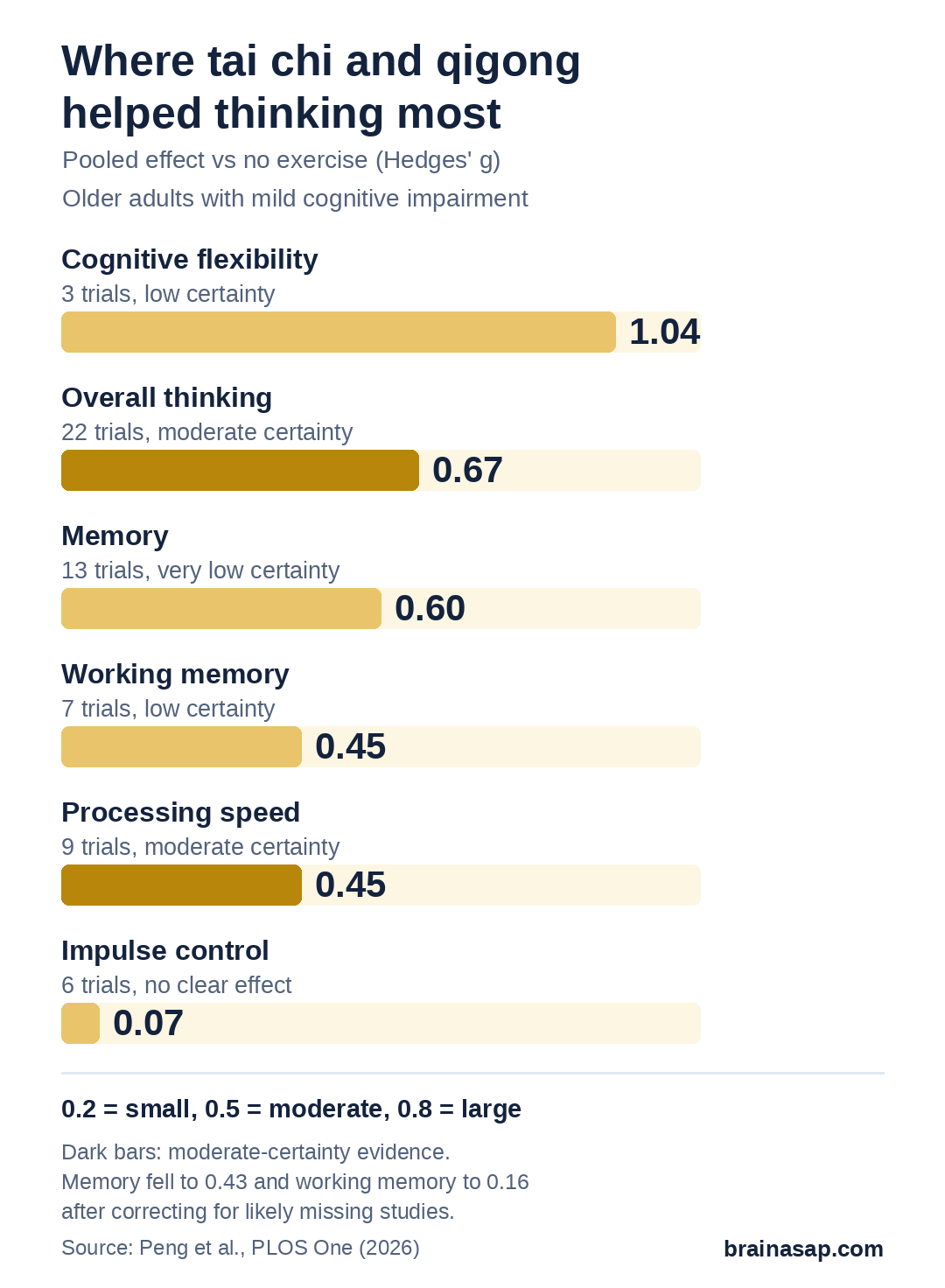
For overall thinking, measured mainly with the Montreal Cognitive Assessment (MoCA), the pooled effect was 0.67 across 22 trials. Processing speed, how quickly people work through simple tasks, improved by 0.45 across 9 trials. The researchers rated both as moderate-certainty evidence.
Other skills were less clear:
- Cognitive flexibility: Largest effect (1.04), but only 3 trials. Low certainty.
- Memory: 0.60 across 13 trials, but very low certainty. Correcting for likely unpublished studies cut it to 0.43.
- Working memory: 0.45, low certainty. After the same correction it fell to 0.16 and was no longer significant.
- Impulse control: 0.07, no clear effect.
More Minutes Did Not Always Mean More Benefit
The new part of this review is the dose analysis. The researchers fitted curves linking weekly minutes of practice to the size of the gain in each trial.
For overall thinking, the curve was U-shaped. Gains were smallest around 240 minutes a week (effect 0.37, still significant) and larger at both lower and higher amounts. The model linked longer programs with stronger effects at any weekly dose. At 240 minutes a week, its estimates became significant after about 11 weeks. For eight weeks at 220 to 270 minutes a week, it estimated no clear gain.
Memory followed a similar U-shape. For processing speed, the lowest point came at about 3,400 total minutes of practice.
That 240-minute figure is the bottom of the curve, not a recommended target. The authors themselves say these are trial-level patterns that need to be tested prospectively before anyone uses them to prescribe exercise.
Why the Dose Curves Need Caution
- No blinding: Participants always knew if they were exercising. All trials rated high risk of bias on this point.
- Unclear allocation: 14 of 27 trials did not describe how group assignment was concealed.
- Clustered doses: Most programs used 150 to 180 minutes a week, so the ends of the curves rest on few trials.
- Trial-level patterns: Curves compare programs, not individual people.
- Frequency vs. session length: Weekly minutes cannot separate more sessions from longer ones.
- Test scores only: The review did not look at dementia diagnoses or everyday function.
- One region: Almost all trials came from China, where these practices are familiar.
A Reasonable Option While Dosing Gets Sorted Out
For an older adult with MCI, a tai chi or qigong class looks like a reasonable way to support thinking skills. The strongest evidence is for overall thinking and processing speed, over programs that ran about three to six months. Whether the gains last, or lower dementia risk, is not something these trials tested.
The open question is dose. A trial that randomly assigns people to different weekly amounts, run long enough, would show whether the U-shaped pattern is real.
Citation: DOI: 10.1371/journal.pone.0350867. Peng Y-F, Chen X, Zhu G-Q, Qu G-C. Nonlinear dose-response of mind-body exercise in older adults with mild cognitive impairment: A systematic review and meta-analysis. PLoS One. 2026;21(9):e0350867.
Study Design: Systematic review and meta-analysis of randomized controlled trials with restricted cubic spline dose-response modeling (PROSPERO CRD42024562301).
Sample Size: 27 RCTs; 2,034 participants analyzed.
Key Statistic: Overall thinking Hedges’ g 0.67 (95% CI 0.49 to 0.78), moderate certainty.
Caveat: Participants could not be blinded; dose curves are study-level and exploratory; memory evidence very low certainty; nearly all trials from China.