TL;DR: In two year-long trials of adults with obesity and moderate to severe sleep apnea, the weight-loss drug tirzepatide eased apnea more than placebo in every group checked, whether split by age, sex, weight, neck size or apnea severity. This is a drugmaker-funded reanalysis meant to raise questions, not settle them.
Key Findings
- 469 adults, 52 weeks: Tirzepatide or placebo; one trial without CPAP, one with.
- Milder apnea category: 68% and 79% on tirzepatide vs about 1 in 4 on placebo.
- Benefit in every subgroup: Younger and older, women and men, lower and higher weight.
- Biggest drops in the most severe: Up to 52 fewer breathing events per hour.
- Blood pressure fell in all subgroups.
- No formal subgroup tests: Differences between groups may be chance.
Source: Journal of Clinical Sleep Medicine (2026) | Falcon et al.
Tirzepatide, sold as Zepbound for weight loss, is now approved in some countries to treat obstructive sleep apnea in people with obesity. That approval rests on the SURMOUNT-OSA trials.
A reasonable follow-up question is whether the drug works as well for everyone. Would an older woman with moderate apnea see the same benefit as a younger man with very severe apnea? This reanalysis of the trials took a first look.
Two Trials, With and Without CPAP
Obstructive sleep apnea means the airway keeps collapsing during sleep, causing breathing pauses and drops in oxygen. Severity is measured by the apnea-hypopnea index (AHI): the number of pauses or shallow breaths per hour. Fifteen or more counts as moderate, 30 or more as severe.
SURMOUNT-OSA ran two randomized, double-blind trials in adults with obesity and an AHI of 15 or more:
- Study 1: 234 people not using a CPAP machine.
- Study 2: 235 people using CPAP, who paused it for about a week before each sleep test.
Participants got weekly injections of tirzepatide at the highest dose they tolerated (10 or 15 mg) or a placebo for 52 weeks. Sleep was measured in a lab at the start and end.
Most People on Tirzepatide Moved to a Milder Category
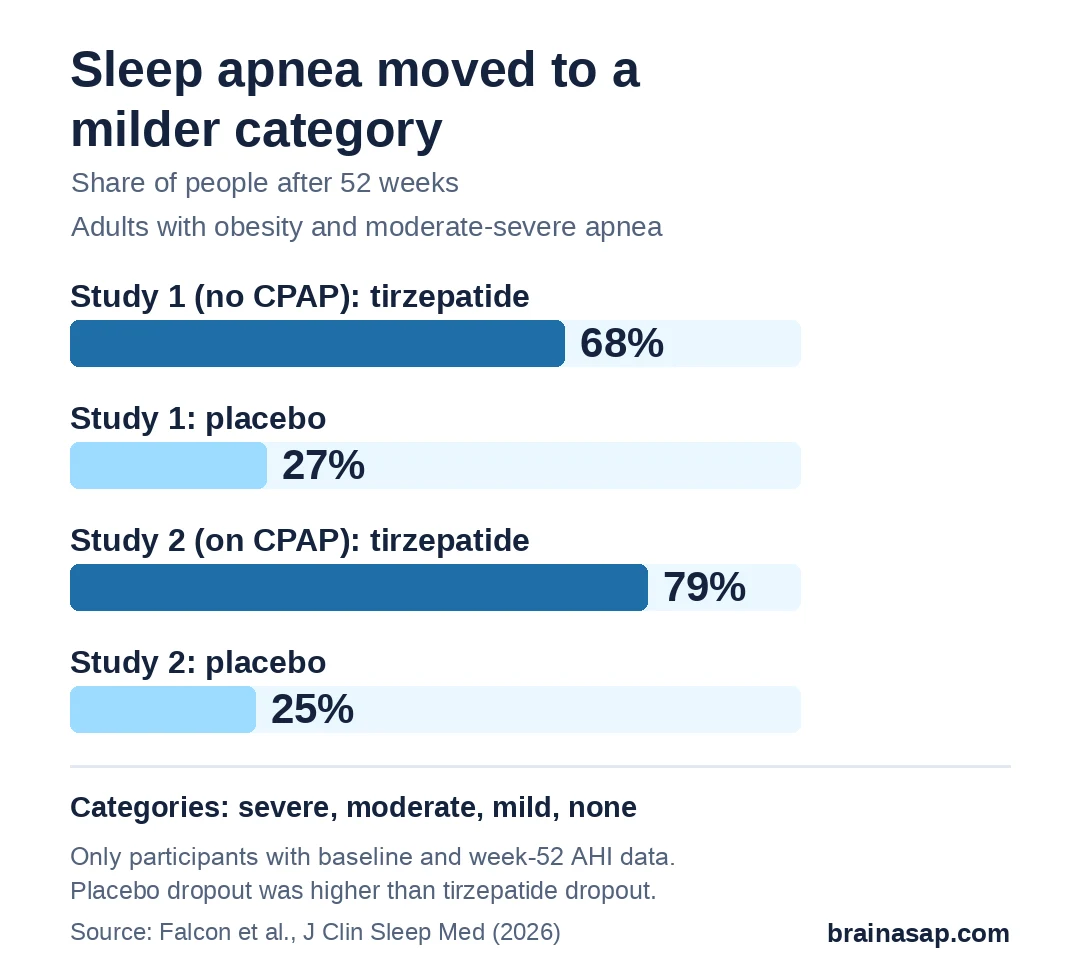
Among participants with both baseline and week-52 apnea-hypopnea index (AHI) data, far more people on tirzepatide dropped to a less severe apnea category:
- Study 1 (no CPAP): 68% on tirzepatide vs 27% on placebo.
- Study 2 (on CPAP): 79% vs 25%.
The Benefit Showed Up in Every Subgroup
The researchers then split participants by age, sex, AHI, body mass index (BMI) and neck size. In every subgroup, in both trials, tirzepatide cut AHI, oxygen-drop burden and weight more than placebo.
- Sex: AHI fell by 20 to 25 events per hour in women and 31 to 33 in men. Men started with higher AHI.
- Severity: Drops of about 12 events per hour in moderate apnea, and 43 to 52 in the most severe group (70+ per hour).
- Weight: AHI drops were similar across BMI groups, 25 to 34 events per hour, even at BMI 40 and above.
- Blood pressure: Systolic pressure fell 6.7 to 10.2 mmHg across subgroups.
People with the most severe apnea (70+ events per hour) were least likely to change category, since they started so far above the line: 32% vs 8% on placebo in Study 1, and 65% vs 9% in Study 2. Still, more than half of them on tirzepatide cut their AHI by at least 50% (51% in Study 1, 71% in Study 2).
A Company-Run Reanalysis With Real Limits
- Post hoc: Subgroups were examined after the trials, not tested for differences.
- Small subgroups: Not powered to detect real differences between groups.
- Uneven dropout: 85% to 90% finished on tirzepatide vs 70% to 74% on placebo; data after stopping were excluded, which could inflate the benefit.
- Side effects not reported by subgroup.
- One year only.
- Industry ties: Funded by Eli Lilly, which makes tirzepatide; several authors are Lilly employees.
Weight and Age Did Not Seem to Block the Benefit
For people with obesity and moderate to severe sleep apnea, these results suggest a higher starting weight, older age or very severe apnea does not rule out a meaningful response. Moving to a milder category could also open up gentler options, like oral appliances, for people who struggle with CPAP.
Whether some groups truly respond better than others is still open. That needs studies designed to test it, with side effects and longer follow-up included.
Citation: DOI: 10.1007/s44470-026-00162-z. Falcon B, Xie CC, Redline S, et al. Association of tirzepatide with changes in OSA-related measures based on baseline characteristics – post hoc analyses of SURMOUNT-OSA. J Clin Sleep Med. 2026;22:155.
Study Design: Descriptive post hoc subgroup analyses of two 52-week, phase 3, randomized, double-blind, placebo-controlled trials (NCT05412004).
Sample Size: 469 randomized (Study 1: 234; Study 2: 235).
Key Statistic: AHI severity category improved in 67.7% vs 26.8% (Study 1) and 79.0% vs 25.3% (Study 2), tirzepatide vs placebo.
Caveat: Hypothesis-generating; no interaction testing; higher placebo dropout; sponsor-funded.