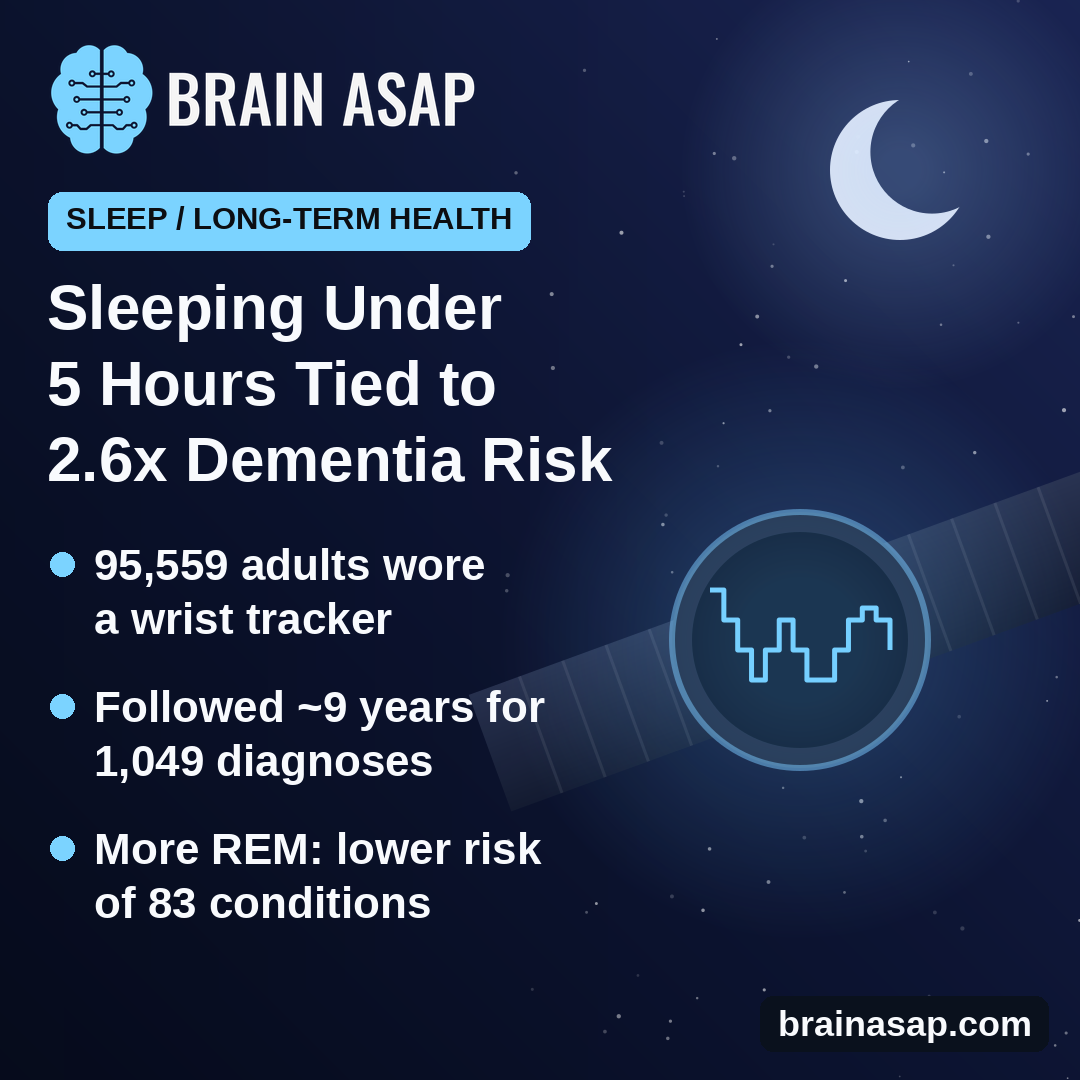
TL;DR: Researchers used wrist trackers to estimate the sleep stages of 95,559 British adults, then followed their hospital records for about 9 years. Adults who spent more time in REM sleep had lower risk of 83 different diagnoses, and adults sleeping under 5 hours a night had higher risk of many conditions than those sleeping 6 to 8 hours. This is an observational study, so it shows patterns, not that sleep causes the differences.
Key Findings
- More REM sleep, fewer diagnoses: Each extra 48 minutes of estimated REM sleep went with lower risk of 83 conditions, including dementias (46% lower risk) and heart failure (26% lower).
- Deep sleep showed fewer links: More deep sleep was linked to lower risk of only 7 conditions, including type 2 diabetes and major depression.
- Very short sleep stood out: Under 5 hours a night went with higher risk in 37 of the 41 links flagged in the most detailed comparison.
- Most risk floors fell at 6 to 8 hours: For 69 of 86 conditions with a curved sleep-risk pattern, the lowest-risk point fell in that window.
- Irregular nights mattered too: More night-to-night swings in sleep length went with higher risk of depression, anxiety, and abdominal pain.
Source: PLOS Medicine (2026) | Luo et al.
Most sleep advice boils down to a number of hours. But sleep is not one thing. Over a night you cycle through light sleep, deep sleep, and REM (the stage tied to vivid dreams), and doctors have long suspected the mix matters as much as the total.
Testing that at scale is hard. The gold-standard sleep lab records brain waves, and nobody can put 95,000 people through one. This study took a shortcut: it estimated sleep stages from a wristband that measures movement.
How the Study Worked
The data come from the UK Biobank, a large research project that recruited adults aged 40 to 69 across Britain. A subset wore a movement-tracking wristband for seven days in 2013 to 2015. The team ran those recordings through a deep-learning algorithm called SleepNet, which estimates the minutes spent in each stage, total sleep time, and how often someone was awake after first falling asleep.
The final sample was 95,559 people, averaging 56 years old, and 56% were women. A typical night in the group lasted about 6.5 hours (392 minutes), including about 82 minutes of REM sleep.
The researchers then followed each person’s hospital records for about 9 years (median follow-up: 8.9 years). They looked at 1,049 different diagnoses, asking whether each one was more or less common in people with different sleep patterns. They adjusted for age, sex, weight, smoking, alcohol, physical activity, deprivation, education, noise, and air pollution, and excluded diagnoses made in the first 6 months to reduce the chance that illness was causing the sleep pattern.
The Measuring Stick Matters
A wristband cannot see the brain. It infers sleep stages from movement, and that is the big caveat here. Compared with a lab recording, the algorithm’s accuracy was described as moderate, and on average it overestimated total sleep by about 48 minutes and underestimated REM by about 17 minutes.
The authors argue those errors are similar across people, so the ranking of who sleeps more REM should still hold. But treat the stage numbers as estimates, not lab measurements.
What They Found
REM sleep stood out. Every extra 48 minutes of estimated REM was linked to lower risk of 83 diagnoses across 12 disease categories. Examples included:
- Dementias: 46% lower risk (hazard ratio 0.54).
- Heart failure: 26% lower risk (0.74).
- Multiple sclerosis: 52% lower risk (0.48).
- Atrial fibrillation: 17% lower risk (0.83).
Parkinsonism showed the largest drop, 80% lower (0.20), but that estimate comes with a wide range of uncertainty (0.11 to 0.39).
Deep sleep was tied to lower risk of just 7 conditions. Each extra 48 minutes went with lower risk of type 2 diabetes (11% lower), major depression (14% lower), and sleep apnea (22% lower).
Sleeping more irregularly and waking more at night pointed the other way. Wider swings in nightly sleep length went with higher risk of major depression (26% higher), anxiety (23% higher), and abdominal pain. More time awake after falling asleep was linked to higher risk of substance dependence and alcohol abuse.
How Many Hours?
Next the team looked at total sleep time. For 86 conditions the pattern was curved rather than a straight line, and for 69 of them, risk bottomed out somewhere between 6 and 8 hours. Examples of the lowest-risk point were about 7.3 hours for type 2 diabetes and about 7.5 hours for dementias.
The clearest signal came at the short end. Compared with people sleeping 6 to 8 hours, people sleeping under 5 hours had higher risk on 37 of the 41 associations that survived a strict statistical filter. The chart shows a few of them.
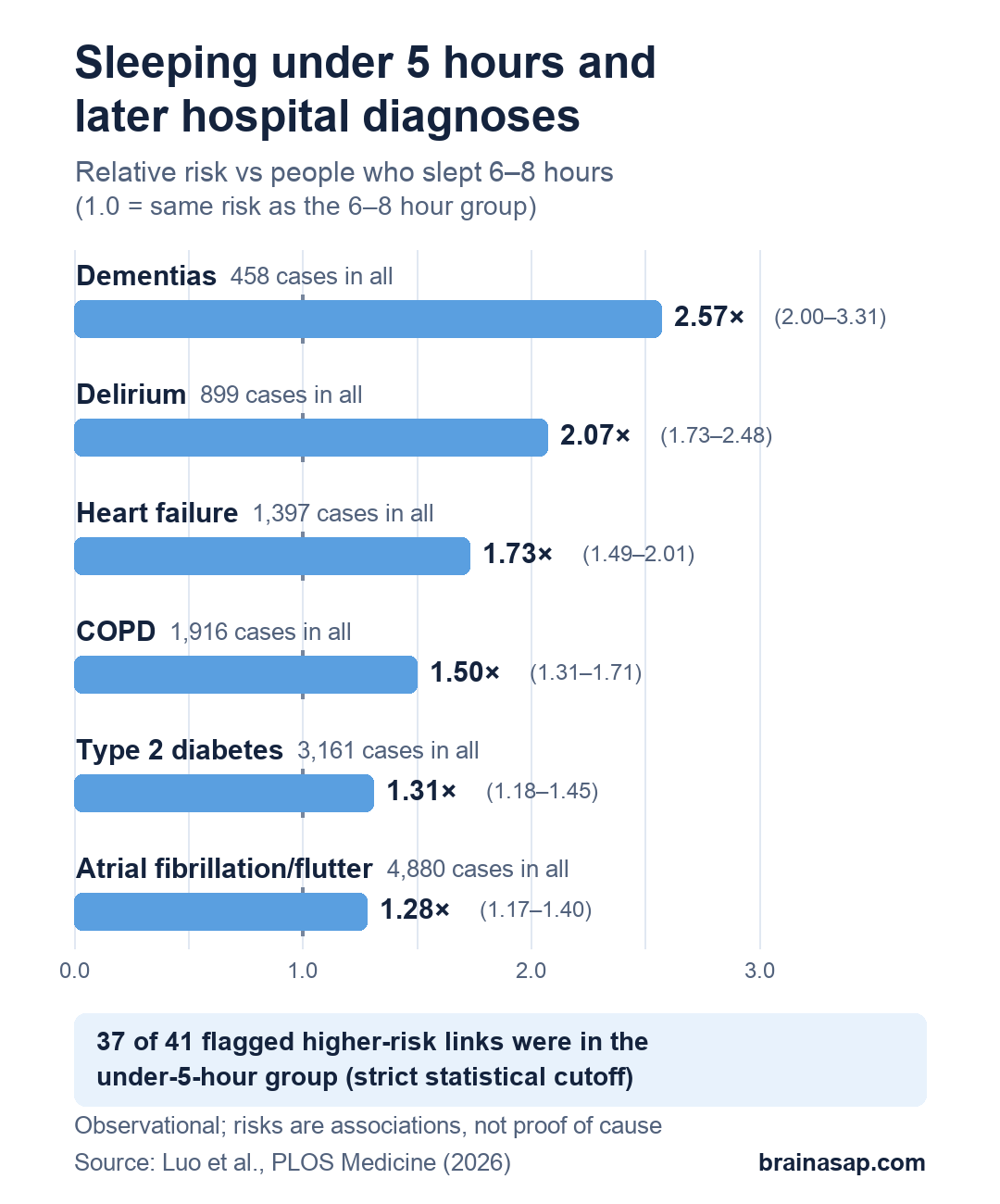
Long sleep looked different. Sleeping 8 to 9 hours was tied to higher risk of major depression (55% higher), but few other diagnoses stood out. Sleeping more than 9 hours showed a very high estimate for bipolar I disorder, but that rested on only 23 cases and a very wide range, so it is not a reliable number.
What This Study Can’t Tell Us
- Association, not cause: Early illness can shorten or fragment sleep. The 6-month exclusion helps, but cannot remove that risk entirely.
- Estimated stages: The algorithm infers stages from wrist movement, and agreement with lab recordings was only moderate.
- One week of sleep: Seven nights in 2013 to 2015 stand in for years of sleep, and habits change.
- Exploratory scan: Testing 1,049 diagnoses is a search for leads. The authors describe it as hypothesis-generating and did not pre-register a plan, and some analyses were added during peer review.
- Who was studied: About 97% of participants identified as White, and UK Biobank volunteers tend to be healthier than the general population.
- Hospital records only: Diagnoses came from inpatient records, so milder conditions treated outside the hospital are missed.
Why It Matters
The study does not tell you to chase more REM sleep, and consumer trackers are not the same as the algorithm used here. What it adds is a big, objective dataset showing that how you sleep, not just how long, lines up with a wide range of later diagnoses. REM was the standout, and very short sleep was the clearest warning sign.
The 6-to-8-hour window that came up across so many conditions echoes standard sleep guidance. The next step is testing whether changing sleep actually changes those risks.
Citation: DOI: 10.1371/journal.pmed.1005213. Luo J, Liu R, Yin J, Cao W, Sun S, Chen R. Accelerometer-derived real-world sleep stages and risk of incident diseases: a UK Biobank cohort study and phenome-wide association analysis. PLOS Medicine. 2026;23(9):e1005213.
Study Design: Prospective cohort study with a phenome-wide association analysis of 1,049 diagnoses; Cox models adjusted for demographic, lifestyle, and environmental factors; sleep stages estimated from 7-day wrist accelerometry with the SleepNet algorithm.
Sample Size: 95,559 UK Biobank participants (mean age 56.2; 56.3% women), median follow-up 8.9 years.
Key Statistic: Each interquartile-range increase in REM sleep (47.6 minutes) was associated with lower risk of 83 diagnoses, for example dementias (HR 0.54, 95% CI 0.47–0.62) and heart failure (HR 0.74, 0.68–0.80).
Caveat: Observational; movement-based sleep-stage estimates with moderate accuracy; one week of sleep data; exploratory analysis without a prospectively registered plan.