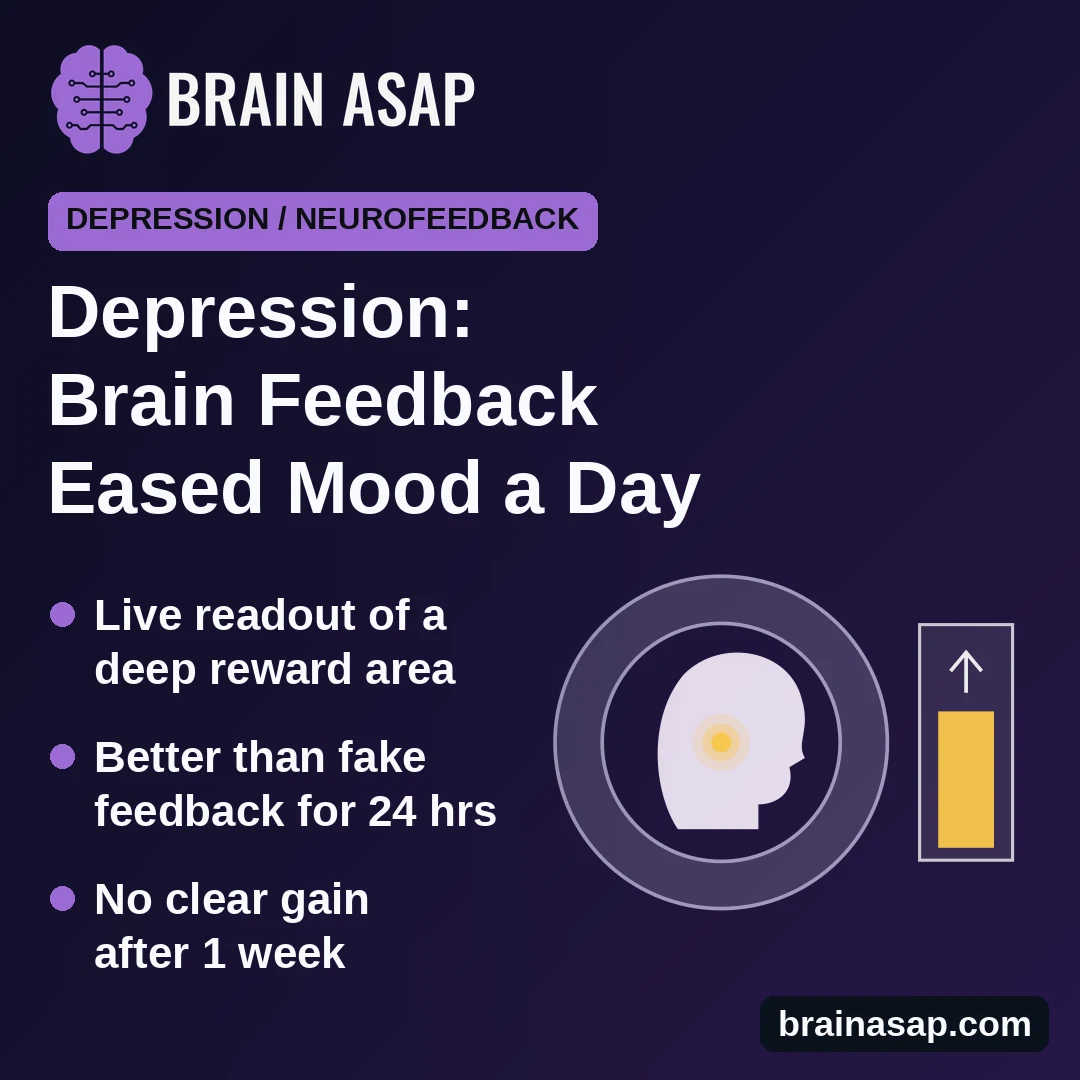
TL;DR: In a small trial, adults with depression lay in a powerful brain scanner and tried to raise activity in a reward-related part of their brain while watching a live readout of it. Compared with people shown a fake readout, they improved more on a combined symptom measure right after training and at 24 hours. The difference was no longer statistically clear at 7 or 30 days.
Key Findings
- Short-lived benefit: Adults with depression who got real brain feedback improved more on an overall symptom score than those who got fake feedback, right after training and 24 hours later.
- No clear difference by a week: At 7 days and 30 days, the 2 depression groups no longer clearly differed.
- Which feelings changed: Low mood and negative feelings improved most; positive feelings, such as joy or interest, did not clearly change.
Source: Molecular Psychiatry (2026) | Morris et al.
Could people with depression learn to turn up a part of their own brain, just by watching it?
That is the idea behind brain feedback training, sometimes called neurofeedback. A small trial tested it on a deep brain region involved in motivation, using one of the strongest scanners available for research.
Watching Your Own Brain Activity
A 2026 study in Molecular Psychiatry, led by Laurel Morris at the Icahn School of Medicine at Mount Sinai in New York, targeted the ventral tegmental area (VTA), a small area deep in the midbrain. This area makes dopamine, a brain chemical linked to motivation and reward, which are often dulled in depression.
Participants lay inside a high-field 7-Tesla MRI scanner. While inside, they saw a live display of activity in their VTA and tried to push it up using their own thoughts.
Morris's team enrolled 62 people who were not taking medication: some had major depression and some did not. Each was randomly assigned to 1 of 2 versions:
- Real feedback: the display showed their actual VTA activity
- Fake feedback: the display did not reflect their VTA activity (a sham)
Symptoms were checked before training and up to 30 days afterward.
Did Real Feedback Ease Depression?
Changes on several symptom measures were combined into 1 overall improvement score. Morris's team then compared people with depression who got real feedback with people with depression who got fake feedback.
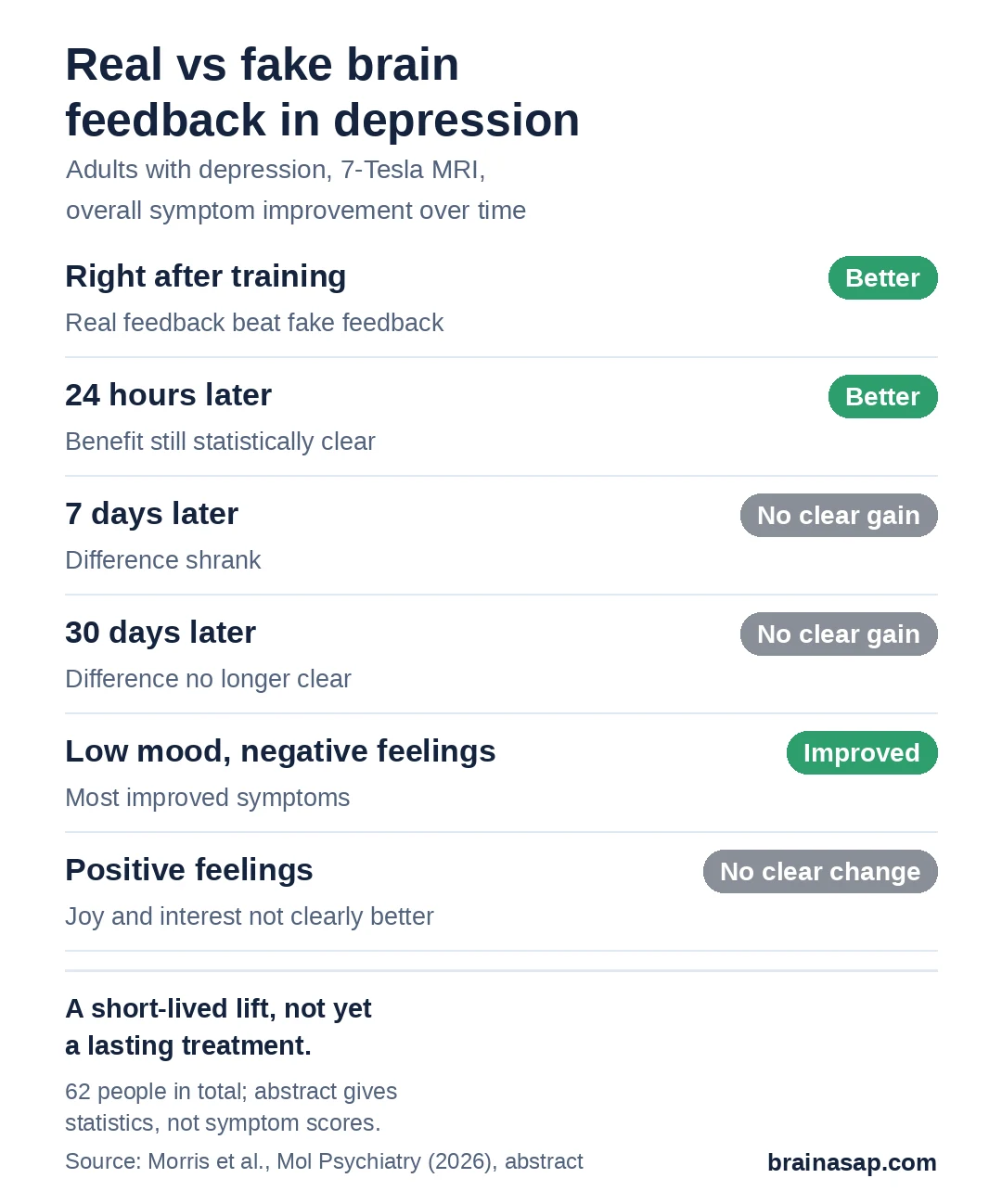
The clearest difference in the combined symptom measure appeared at the first two checks.
- Right after training: better improvement with real feedback
- 24 hours later: still better
- 7 days and 30 days later: smaller difference, no longer statistically clear
Looking at specific symptoms, depressed mood and negative feelings improved most. The study did not find a clear improvement in positive feelings, such as enjoyment and interest.
Signs the Training Reached Its Target
In people with depression who got real feedback, activity in the VTA became more closely linked over time with activity in the outer part of the frontal lobe.
People who were better at raising their VTA activity also tended to improve more. That link was modest, though, and does not prove the training caused the improvement.
Why This Is Only a First Step
- Small trial: 62 people in total, split across depression and comparison groups
- Later checks: No clear difference at 7 or 30 days
- Size of change unclear: The abstract gives statistics, not symptom scores, so how much people felt better is unknown
- Rare equipment: 7-Tesla scanners are found mainly at research centers
- Abstract only: This summary is based on the published abstract; the full paper was not reviewed
Morris and colleagues called it a proof-of-principle trial: a test of whether the approach can work at all, not of whether it is ready as a treatment.
Can the Effect Be Made to Last?
The trial found a short-term change in a combined symptom measure. The abstract does not establish how much better participants felt in everyday life.
Next comes the harder question: can repeated sessions, or practice outside the scanner, turn a 1-day lift into lasting relief?
Citation: DOI: 10.1038/s41380-026-03911-x · Morris LS, Beltrán JM, Kvamme TL, Chowdhury A, Butler G, Adams A, Patel T, Obie E, Fontaine S, Corniquel M, Mehta MM, Smith DA, Fleysher L, Balchandani P, Jacob Y, Murrough JW. Targeting the dopaminergic midbrain with precision 7-Tesla biofeedback training in depression: A proof-of-principle randomized controlled trial. Molecular Psychiatry. 2026.
Study Design: Randomized, sham-controlled, proof-of-principle trial of 7-Tesla functional MRI biofeedback targeting the ventral tegmental area (VTA).
Sample Size: 62 unmedicated participants (major depressive disorder and healthy controls).
Key Statistic: Clinical improvement factor, active vs sham in MDD: immediately post-training β = 15.85, p = 0.03; 24 hours β = 22.84, p = 0.02; not significant at 7 and 30 days. Depressed mood F = 5.04, p = 0.029; negative affect F = 5.21, p = 0.027.
Caveat: Small sample. The difference was no longer statistically clear at 7 or 30 days. The published abstract does not give raw symptom score changes and was the evidence available for this summary.