TL;DR: In a 2026 study, researchers fed brain wave recordings from 121 children, taken while they counted cartoon characters on a screen, into computer programs that learned to tell children with attention-deficit/hyperactivity disorder (ADHD) from those without it. Of the programs tried, one sorted about 4 in 5 children correctly, a promising but not diagnosis-ready result.
Key Findings
- About 4 in 5 children sorted correctly: the best program correctly labeled 81% of children as having ADHD or not, when tested on children it had never seen.
- Mistakes went both ways: it correctly flagged 51 of 61 children with ADHD and correctly cleared 47 of 60 children without ADHD.
- 3 programs did about equally well: 3 of the 4 programs tested scored 77% to 81%, differences too small to call one the winner.
- Front of the head mattered most: sensors over the forehead and top front of the head gave the program its most useful information.
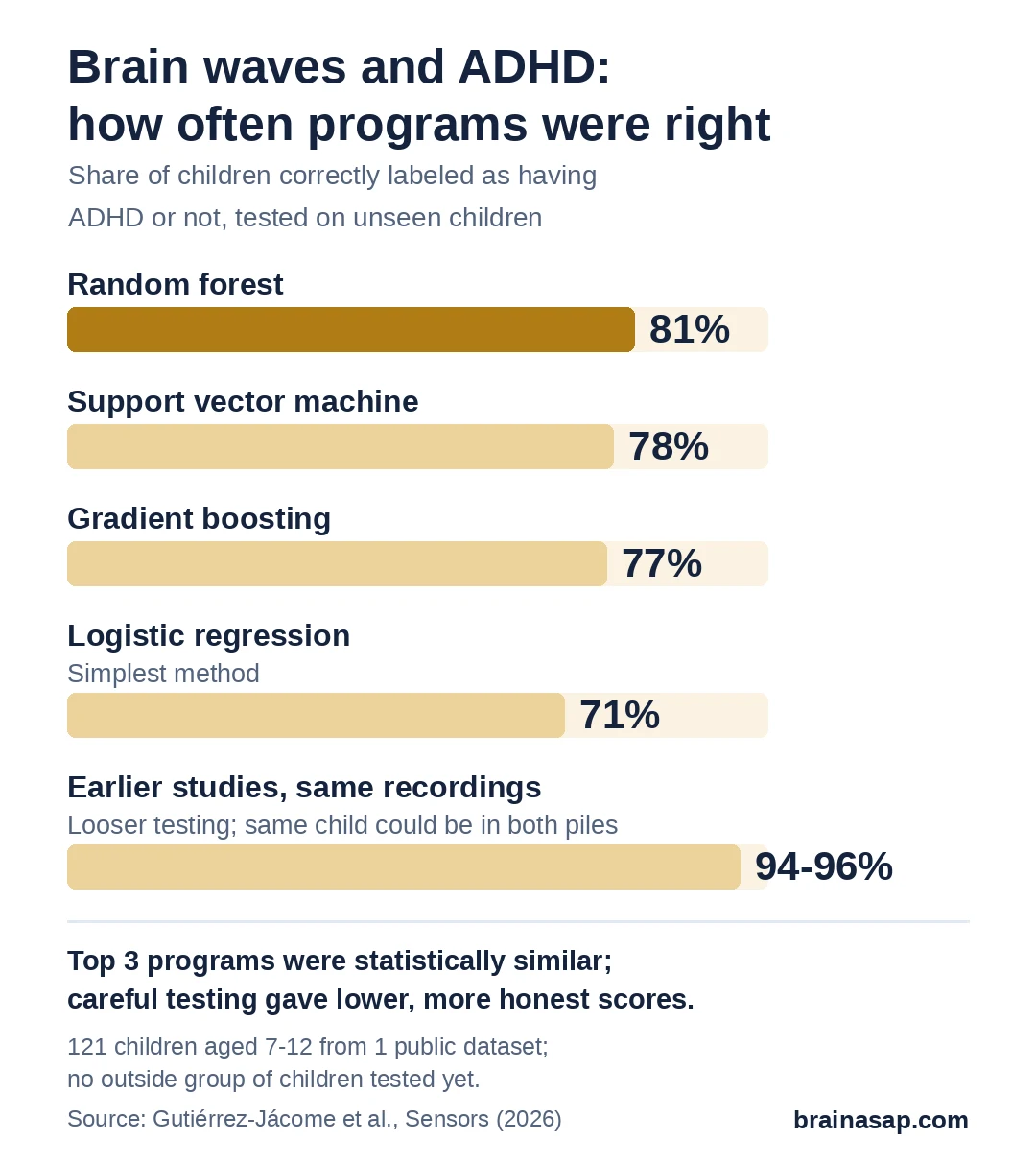
- Lower than earlier claims: past studies of the same recordings reported 94% to 96%, but they checked their programs in looser ways.
Source: Sensors (2026) | Gutiérrez-Jácome et al.
Doctors diagnose ADHD by talking with families, using rating scales filled out by parents and teachers, and checking symptoms against a list. There's no blood test or brain scan for it.
That has made brain wave recordings, called EEG, an appealing target. If a computer could spot ADHD patterns in a child's brain waves, it might add an objective piece to the puzzle.
A 2026 study in Sensors, by researchers in Ecuador, Colombia and Spain, tested how well that works when the computer is checked carefully.
What Did the Children Do While Their Brain Waves Were Recorded?
Gutiérrez-Jácome and colleagues didn't record anyone new. They used a free public collection of brain wave recordings from 121 children aged about 7 to 12:
- Children with ADHD: 61 children diagnosed by an experienced psychiatrist, all of whom had taken the ADHD drug Ritalin for up to 6 months
- Children without ADHD: 60 children with no history of psychiatric disorders or epilepsy
Each child wore 19 sensors on the scalp while counting cartoon characters shown on a screen. These sensors pick up tiny electrical signals from brain cells working together.
Each recording was cut into 4-second pieces. For each piece, the team measured simple features, such as how strong the slow, medium and faster brain waves were at each sensor.
Why Does the Way You Test the Program Matter So Much?
Computer programs learn by studying examples, then get tested on examples they haven't seen. A common shortcut is to mix all the 4-second pieces from all children, then split them randomly into a learning pile and a test pile.
What goes wrong? Pieces from the same child end up in both piles. A program can learn to recognize each child, not ADHD, and then look far more accurate than it really is.
This study kept every child's pieces together. Each program was always tested on children whose recordings it had never seen.
How Well Did the Programs Sort the Children?
Four common types of programs were tried. Here's how often each one labeled a child correctly:
- Random forest (many decision trees voting): 81%
- Support vector machine: 78%
- Gradient boosting: 77%
- Logistic regression (a simpler, straight-line method): 71%
The top 3 were statistically similar. Only the simplest method did clearly worse than the top 2.
For the best program, the errors were split between both groups. It missed 10 of 61 children with ADHD and wrongly flagged 13 of 60 children without ADHD.
Which Parts of the Head Helped Most?
Sensors at the front and top front of the head, especially one in the middle of the forehead area, gave the best program its most useful information. These areas sit over brain regions often linked to attention and self-control.
But a sensor's usefulness to a computer program is not the same as proof that brain activity there is different in ADHD. Authors cautioned that this pattern is not a validated marker of the disorder.
Tuning the brain wave bands to each child's own natural rhythm didn't help: accuracy dropped to 74% or lower.
Why This Isn't a Brain Wave Test for ADHD Yet
- One small, old collection: 121 children from one public dataset, diagnosed with an older rulebook (DSM-IV). No outside group of children was tested.
- Medication may matter: children with ADHD had been taking Ritalin, which can change brain waves.
- Possible noise: no advanced cleaning was done for eye blinks or muscle signals, which are strongest at the front of the head, where the most useful sensors were.
- Missing details: the dataset doesn't report how many boys and girls were in each group.
- 1 in 5 still wrong: about 19% of children were mislabeled, too many for a diagnosis.
Testing the Program on New Children Is the Next Step
The useful lesson here may be less about ADHD than about honesty in testing. When this program was kept from "seeing" the same child twice, its accuracy settled around 81%, well below the 94% to 96% that looser studies of the same recordings reported.
Whether brain wave patterns can reliably support an ADHD diagnosis will depend on testing them in new, larger groups of children, recorded in different clinics, before and without medication.
Citation: DOI: 10.3390/s26175684. Gutiérrez-Jácome DB, Campos-Ortuño RA, Pardo-Valenzuela JE, Gómez-Morales ÓW. Neurophysiological Characterization of ADHD in Children Using EEG Signals: A Machine Learning Approach to Executive Function Networks. Sensors. 2026;26:5684.
Study Design: Secondary machine learning analysis of a public 19-channel EEG dataset recorded during a visual counting task; 4-s windows with 50% overlap; mean, SD, theta, alpha and beta power features; RF, SVM, gradient boosting and logistic regression with subject-wise Stratified Group 5-fold cross-validation, bootstrap CIs and Friedman/Wilcoxon tests.
Sample Size: 121 children aged 7–12 (61 ADHD, 60 controls).
Key Statistic: Random forest accuracy 0.8099 (bootstrap 95% CI 0.7355–0.8760), sensitivity 0.8361, specificity 0.7833; SVM ROC-AUC 0.8527; RF vs SVM P = 0.25; RF vs LR P = 0.0047.
Caveat: Single public dataset with DSM-IV diagnoses and Ritalin exposure; no external validation; no ICA artifact removal; channel importance is model-derived, not a biomarker.