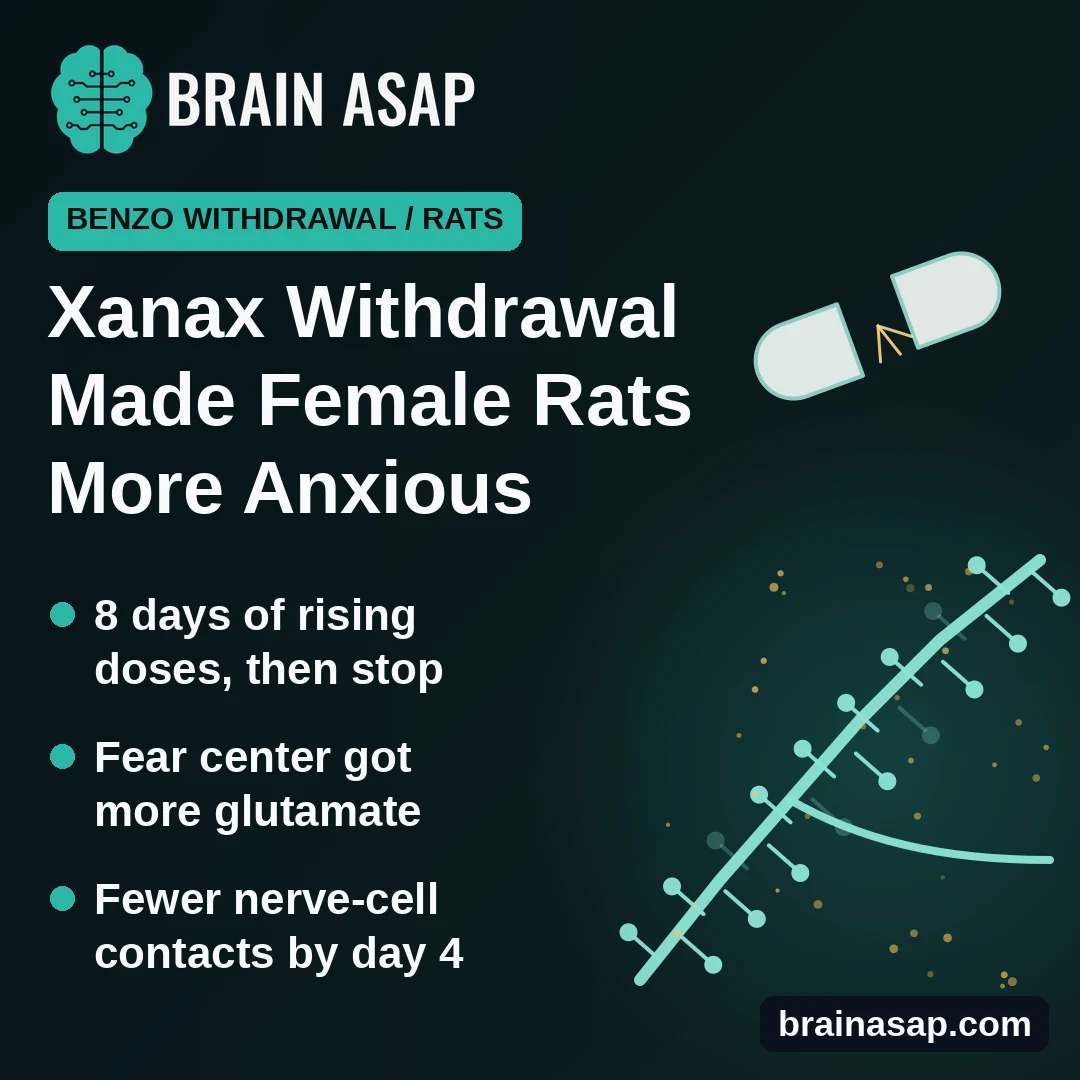
TL;DR: Female rats taken off alprazolam (Xanax) after 8 days of rising doses moved less and avoided the open middle of a test arena, signs of anxiety. Their amygdala, a fear center, showed more excitatory signaling and fewer connection points on nerve cells.
Key Findings
- More anxious behavior 36 hours after stopping: Fewer trips to the arena center, more time in corners, more freezing.
- Less movement overall: Shorter distance and slower speed than drug-free rats.
- More glutamate in the amygdala: The brain's main "go" signal rose, along with several of its receptors.
- Calming system reshuffled, not simply weaker: Some GABA parts rose, one fell.
- Fewer connection points by 96 hours: In a small sample of 4 rats per group.
Source: Pharmaceuticals (2026) | Radukic et al.
Benzodiazepines like alprazolam (Xanax) calm anxiety fast, but stopping them after regular use can bring a rebound of anxiety, irritability and poor sleep. Women are prescribed these drugs more often than men, yet most lab research on withdrawal has used male animals.
A team in Belgrade, Serbia, looked at what happens in the female brain's fear center when alprazolam is suddenly stopped.
Eight Days of Rising Doses, Then Nothing
The researchers used 130 adult female rats. Some got alprazolam injections twice a day for 8 days, with the dose stepped up every 2 days from 3 to 9 mg/kg. The comparison rats got injections of the same liquid without the drug.
Then the drug simply stopped. The team studied the rats at two points:
- 36 hours after the last dose: Behavior tests and brain chemistry.
- 96 hours (4 days) after: Brain chemistry and nerve-cell structure only.
The doses are not meant to match human doses pound for pound; rats clear the drug differently.
Withdrawn Rats Stayed in the Corners
The behavior test was an open field, a large empty box. Rats that feel safe wander into the exposed center; anxious rats hug the walls. The test included 35 withdrawn rats and 32 comparison rats.
At 36 hours, rats coming off alprazolam:
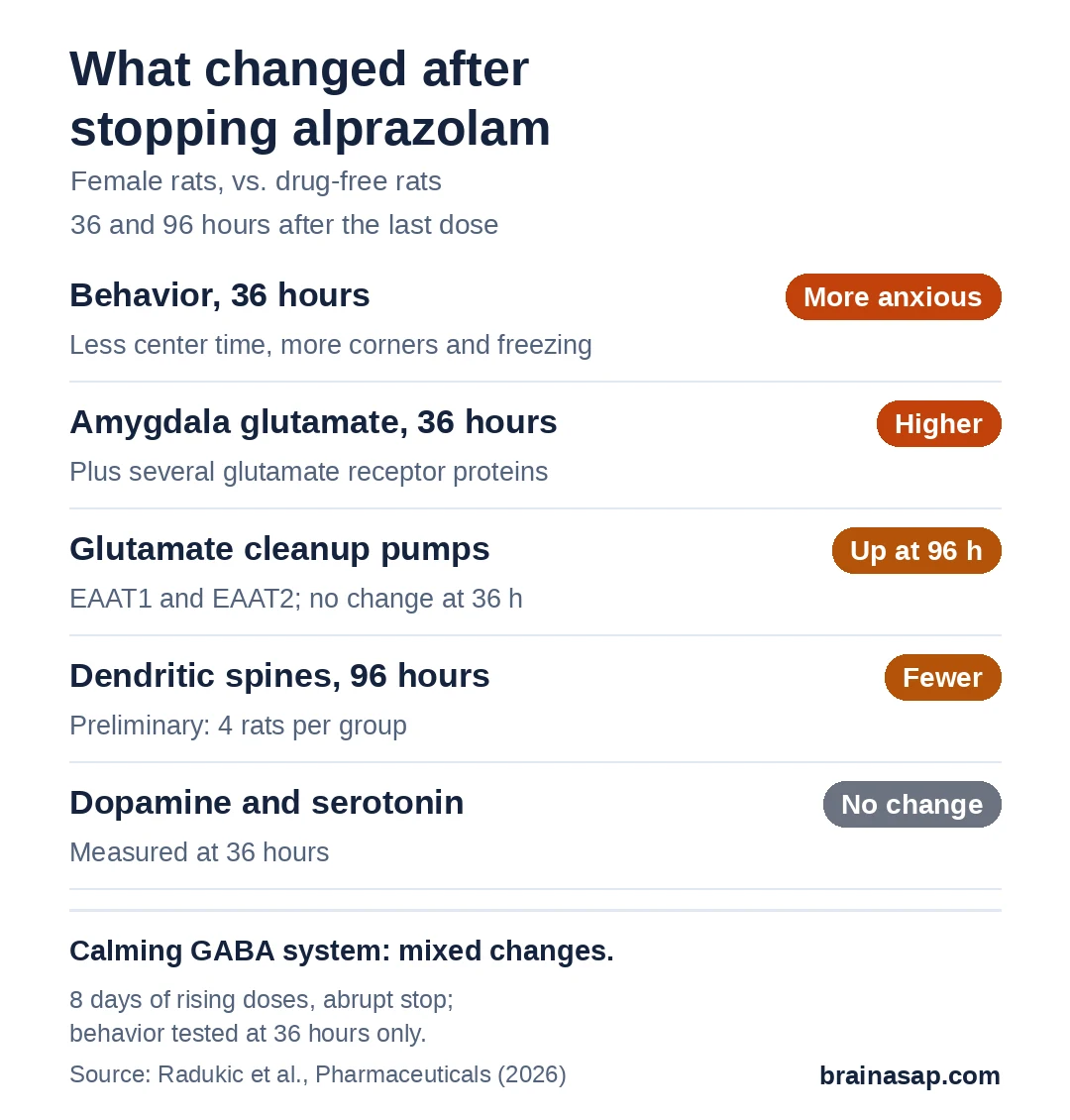
- Went into the center less often and spent less time there
- Spent more time in corners
- Froze more often and for longer
- Moved less overall, covering less ground at a slower speed
The center result held even after accounting for the rats moving less overall. When withdrawn rats did cross the center, they moved through it faster, which the authors read as hurrying across rather than exploring.
The Fear Center Turned Up Its "Go" Signals
In the amygdala, glutamate levels were higher 36 hours after stopping. Several proteins that send and receive glutamate signals also rose, and most stayed high at 96 hours. By 96 hours, two pumps that clear glutamate away (EAAT1 and EAAT2) had also increased, possibly as the brain tried to rebalance.
The calming GABA system, which alprazolam boosts, did not simply weaken. Some parts rose, including an enzyme that makes GABA and one type of GABA receptor, while a protein that loads GABA for release fell. Dopamine and serotonin levels did not change.
Fewer Connection Points by Day Four
Nerve cells receive signals through tiny bumps called dendritic spines. In the amygdala, branched spines dropped soon after stopping and stayed low. Thin, immature spines briefly rose at 36 hours. By 96 hours, the total number of spines had fallen.
These counts came from only 4 rats per group, and the authors call them preliminary.
What a Rat Study Can and Can't Say About Quitting Xanax
- Short exposure: 8 days of high, rising doses, not months of typical use.
- Abrupt stop: Doctors usually taper benzodiazepines slowly.
- No 96-hour comparison group: Some later changes could reflect time, not withdrawal.
- No nerve-signal recordings: Protein and structure changes may not equal function changes.
- Females only, cycle not tracked.
The study adds a female-focused picture of what sudden alprazolam withdrawal may do to the brain's fear circuitry: more excitation and rewiring, not just a loss of calming signals. Anyone wanting to stop a benzodiazepine should do it with a doctor's tapering plan. The next question is whether a slow taper prevents these amygdala changes.
Citation: DOI: 10.3390/ph19091433. Radukic T, Martinovic J, Dragic M, et al. Synaptic adaptations in the amygdala during alprazolam withdrawal: insights from a female rat model of benzodiazepine withdrawal. Pharmaceuticals. 2026;19:1433.
Study Design: Randomized female rat study; escalating alprazolam for 8 days, then abrupt withdrawal; tests at 36 and 96 hours.
Sample Size: 130 female Wistar rats in total; open field 35 withdrawn vs. 32 controls; protein tests 5 to 7 per group; spines 4 per group.
Key Statistic: Center entries reduced (p = 0.0027) and corner time increased (p = 0.0003) at 36 hours of withdrawal.
Caveat: Short, high-dose exposure and abrupt stop in rats; small samples for structure; no time-matched 96-hour control.