TL;DR: In a study published in 2026, 385 adults getting cancer treatment at a hospital in Lahore, Pakistan, answered questionnaires about their daily well-being, anxiety and depression.
About 1 in 4 had high depression scores and about 1 in 7 had high anxiety scores. Patients with more of either symptom reported clearly lower quality of life, and almost none had received emotional support.
Key Findings
- High depression scores: 23% of cancer patients scored in the range that suggests likely depression, and another 21% were borderline.
- High anxiety scores: 15% scored in the likely-anxiety range, and 25% were borderline.
- Linked to quality of life: Patients with higher anxiety or depression scores rated their physical, social, emotional and daily-function well-being lower.
- Physical well-being hit hardest: It was the lowest-rated part of quality of life, at a typical 14 out of 28.
- Little support: 96% had received no psychological or emotional support, and 69% said they had no support system at all during treatment.
Source: Medical Science Monitor (2026) | Ijaz et al.
Cancer treatment takes a toll on the body, but it also weighs on the mind. In Pakistan, where most cancer care is paid out of pocket and mental health support is rarely built into cancer clinics, that second burden can go unnoticed.
A 2026 study in Medical Science Monitor, by pharmacy and nursing researchers from Pakistan, Malaysia, Saudi Arabia and elsewhere, measured both in patients at a large cancer hospital in Lahore.
Who Was Surveyed?
Between February and May 2024, the team interviewed 385 adults at INMOL Cancer Hospital who were in the middle of cancer treatment.
- Women: 70%
- Most common cancers: breast (40%) and ovarian (10%)
- Treatment: most were getting chemotherapy alone; others had chemotherapy combined with surgery or radiation
- Recently diagnosed: 68% within the past year
- Monthly income: 79% earned less than 50,000 rupees
Each patient answered 2 standard questionnaires:
- Quality of life, covering physical, social, emotional and day-to-day functioning, with a total score from 0 to 108
- Anxiety and depression, sorted into normal, borderline and high (the range that suggests a likely clinical problem)
How Common Were Anxiety and Depression?
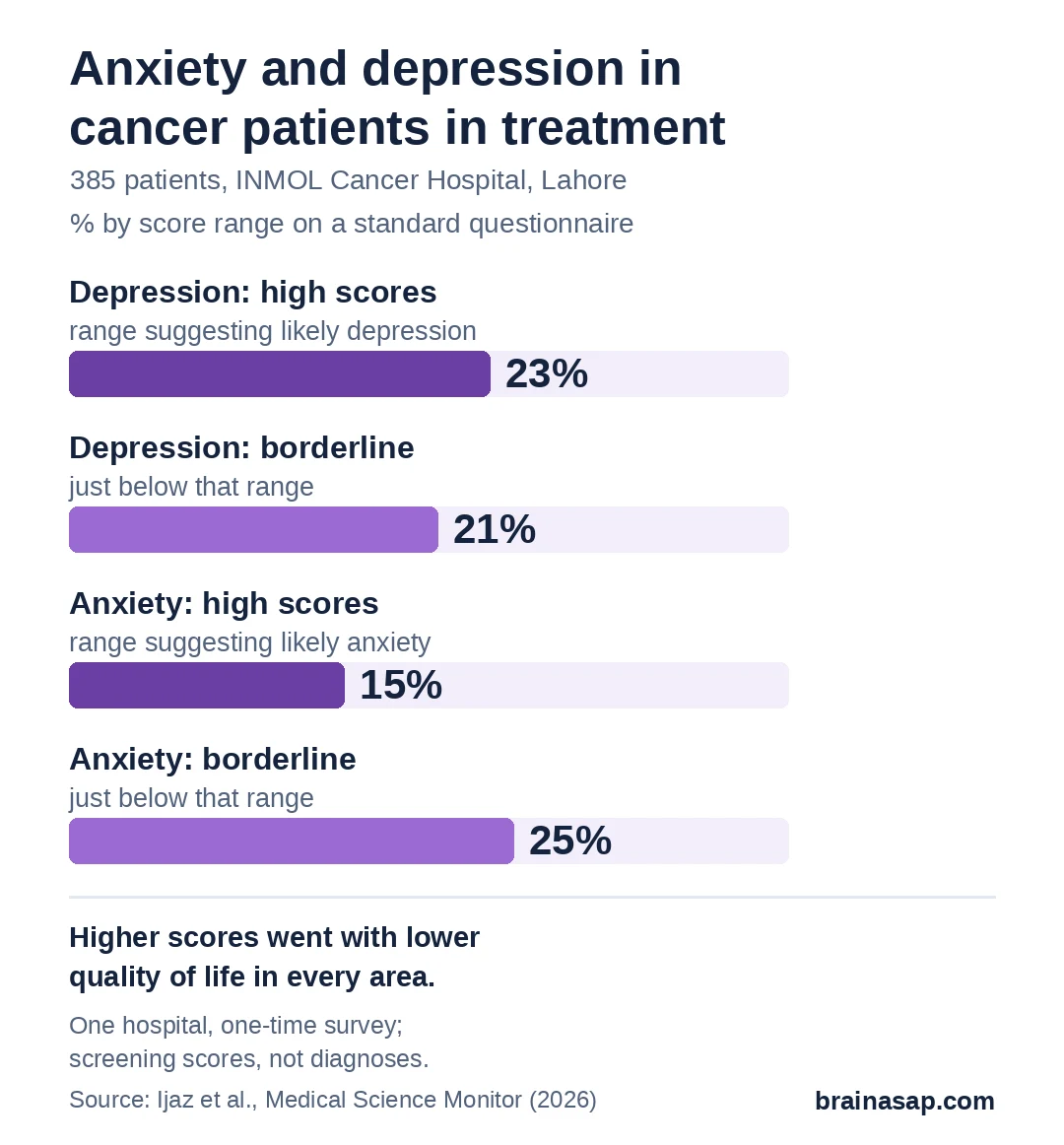
Fewer than 6 in 10 patients had normal scores on either measure. Depression was more common than anxiety: 23% vs 15% scored in the high range.
Women were more likely than men to score high: 27% vs 16% for depression and 17% vs 11% for anxiety. Patients with more education were more likely to have normal scores.
More Distress Went With Lower Quality of Life
Overall, a typical patient scored 68 out of 108 on quality of life, which Ijaz and colleagues described as moderate. Scores ranged widely, from 19 to 102.
Patients with high anxiety or depression scores had the lowest quality of life in every area. Patients with normal scores had the highest. Both anxiety and depression scores showed a moderate link with overall quality of life: the higher the distress, the lower the rating.
Men tended to rate their physical, social and emotional well-being higher than women did.
Gaps in This Study
- One hospital, convenience sample: May not reflect cancer patients elsewhere in Pakistan.
- One-time survey: Can't show whether distress lowers quality of life or the reverse.
- Simple comparisons only: Factors such as sex, income and cancer type weren't adjusted for each other.
- No cancer stage recorded: More advanced cancer could drive both distress and poor well-being.
- Screening scores, not diagnoses: Cutoffs were set in other countries and may not fit local patients perfectly.
Would Routine Mood Checks Help Cancer Patients in Pakistan?
With nearly half of patients at borderline or high depression levels and almost none receiving emotional support, the team called for routine anxiety and depression screening during cancer treatment. Whether adding that support would raise patients' quality of life still needs to be tested.
Citation: DOI: 10.12659/MSM.952446 Ijaz M, Aslam A, Fatima M, Anwar M, Akhtar SS, Jamshed S, Iqbal A, Syed W, Alqahtani N. Quality of Life and Symptoms of Anxiety and Depression Among Patients With Cancer: Insights From a Tertiary Care Hospital. Medical Science Monitor. 2026;32:e952446.
Study Design: Cross-sectional interview survey with convenience sampling; FACT-G (quality of life) and HADS (anxiety and depression; normal 0–7, borderline 8–10, abnormal ≥11); Kruskal-Wallis, Mann-Whitney, chi-square and Spearman correlation.
Sample Size: 385 adults receiving anticancer treatment, INMOL Cancer Hospital, Lahore, Pakistan (February–May 2024); 69.6% women; 40.3% breast cancer.
Key Statistic: FACT-G median 68 (IQR 56–80); physical well-being median 14 (lowest). HADS depression abnormal 23.4%, borderline 20.5%; anxiety abnormal 15.3%, borderline 24.7%. Spearman with overall QoL: anxiety rs = −0.491, depression rs = −0.450 (both P < 0.001). Abnormal depression 26.6% women vs 16.1% men (P = 0.024).
Caveat: Single center; convenience sample; cross-sectional; mainly bivariate analyses; cancer stage not collected; on-treatment patients only; international HADS cutoffs.