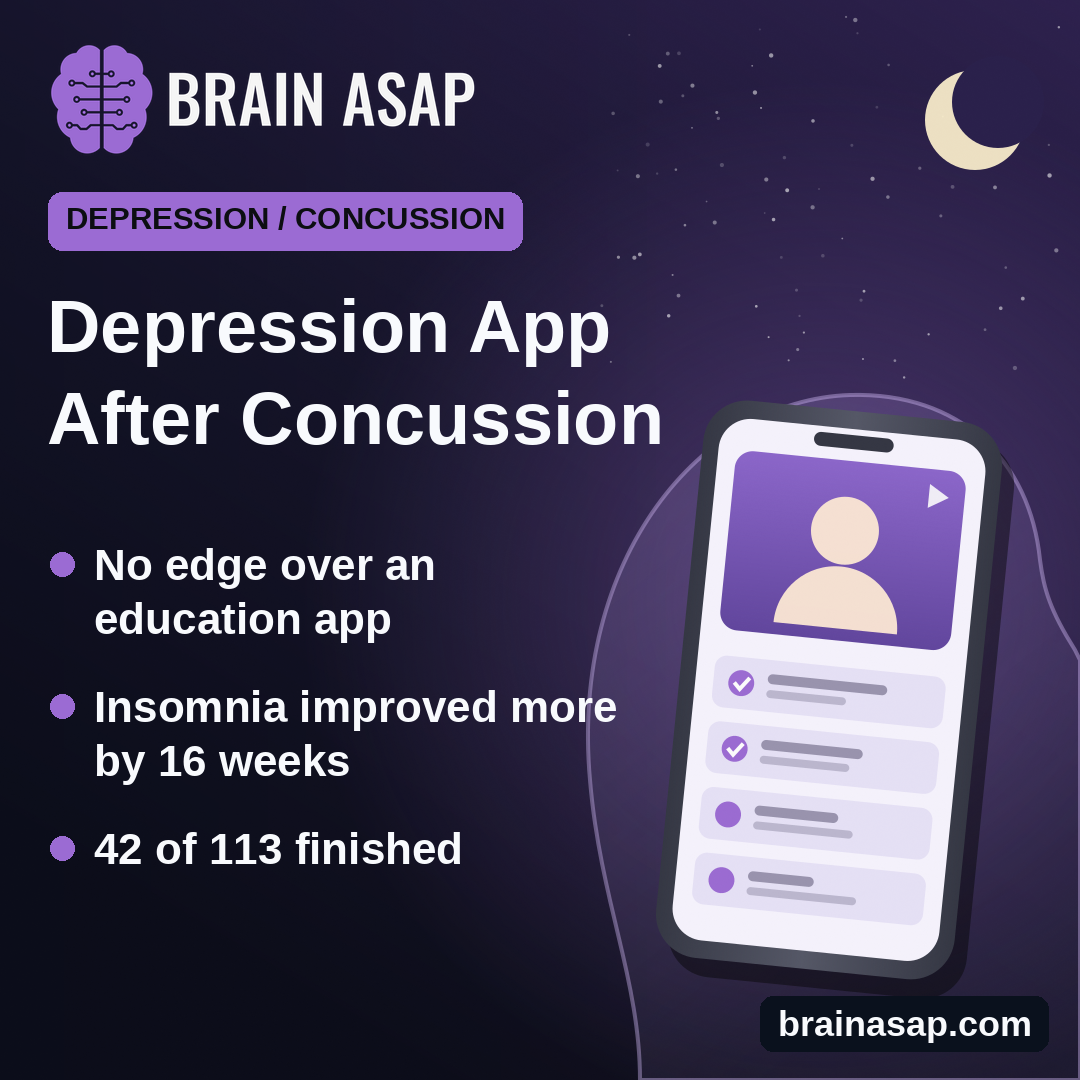
TL;DR: A therapy app did not reduce depression scores more than a look-alike education app in a trial of adults with past concussions. Insomnia scores improved more with the therapy app, but only 42 of 113 participants completed the main 12-week check-in.
Key Findings
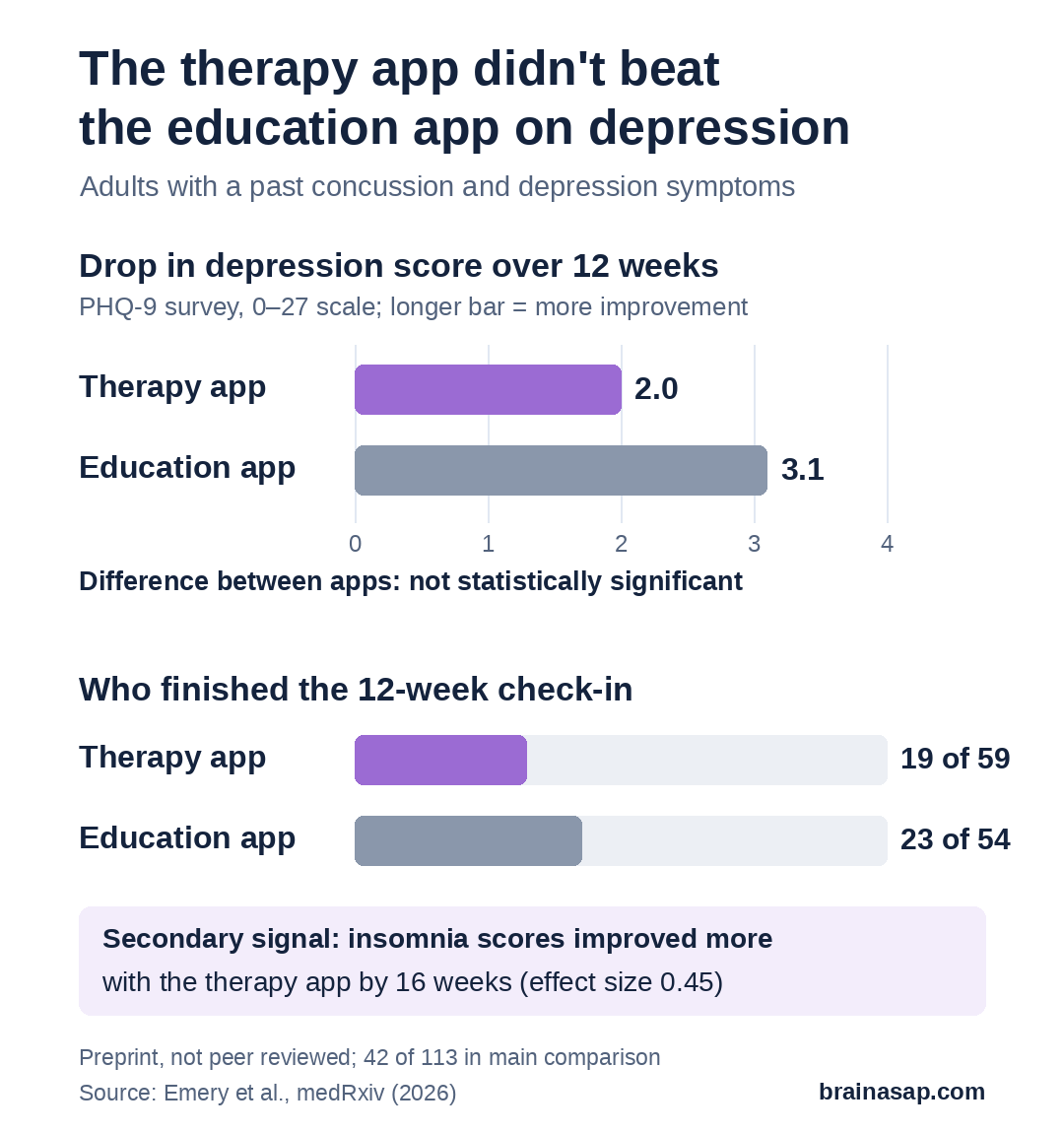
- No edge on depression: Over 12 weeks, depression scores fell 2.0 points with the therapy app and 3.1 points with the education app, on a 0–27 scale. That gap wasn’t statistically meaningful.
- Both groups improved: Scores came down in both groups, a sign that something besides the therapy lessons was at work.
- Sleep was the bright spot: By 16 weeks, insomnia scores had improved more in the therapy app group. This was a secondary result, not the trial’s main question.
- Most people didn’t finish: 19 of 59 therapy app users and 23 of 54 education app users completed the 12-week check-in.
- People preferred the therapy app: Finishers rated it higher for engagement and connection, though engagement averaged about 3 out of 5.
Source: medRxiv preprint (2026) | Emery et al.
Depression is one of the most common problems that follow a traumatic brain injury, including the mild kind most people call a concussion. It’s especially common in military service members and veterans, where head injuries often come bundled with PTSD, disrupted sleep, and a reluctance to seek mental health care.
Cognitive behavioral therapy, or CBT, is one of the best-studied treatments for depression. The trouble is access.
Therapy costs money and time, and there aren’t enough trained therapists to go around. A smartphone app could reach many people with phones at a low cost per person.
A US military research team built a CBT app for people with a concussion history and depression symptoms, then tested it against a carefully matched comparison app.
Two Apps, Built to Look Alike
The therapy app (called ACDC, short for Mobile Application to Combat Depression and Concussion) delivered 12 weekly CBT lessons. Each lesson ran 15 to 20 minutes, shorter than a typical therapy session, because concussion can affect attention and memory. The lessons worked through classic CBT skills:
- Tracking mood
- Scheduling pleasant activities and small “personal experiments”
- Noticing negative thinking and learning to balance those thoughts
- Building a self-care plan for the long run
Each week also came with 1 to 2 hours of homework. Lessons were guided by video “coaches,” played by actors, whose stories were based on composites of real service members and veterans who had worked through depression.
The education app used the same interface and design. It taught people about concussion and depression but left out the active parts of CBT: no skill practice, no homework challenges.
Comparing an app against nothing at all tends to flatter it. A look-alike app is a stricter, fairer test.
113 Adults Joined; 42 Finished the Main Check-In
The trial ran fully remotely. To join, people needed:
- Head injury: at least one mild traumatic brain injury, by their own report, at least 6 months earlier
- Depression symptoms: at least mild symptoms on a standard questionnaire
- Other requirements: a smartphone, and no recent changes to any depression treatment
The trial was meant for service members and veterans. Enrollment was slow, though, so partway through the team opened it to civilians and raised the age limit from 65 to 70.
Between August 2022 and June 2024, 113 adults were randomly assigned: 59 to the therapy app and 54 to the education app. Among those who finished, the average age was in the late 40s and about half were women. Nearly half of the therapy app finishers (9 of 19) were civilians.
The main measure was the PHQ-9, a widely used nine-question depression survey scored from 0 to 27, where higher means worse. The researchers compared how much scores changed from the start to the end of the 12 weeks.
The Main Result: No Difference on Depression
The therapy app did not outperform the education app. Among people who completed the 12-week check-in, depression scores fell by 2.0 points in the therapy app group and 3.1 points in the education app group. The difference between groups wasn’t statistically significant.
The picture didn’t change at the 16-week follow-up, one month after the lessons ended, or on any of the nine individual questions.
Both groups did improve. Across everyone who finished, depression scores dropped about 2 points by the end of the lessons and about 3 points by 16 weeks. The authors offer three possible reasons:
- Natural ups and downs: Depression waxes and wanes. People may sign up for a study when they feel at their worst, and then drift back toward their usual level.
- A helpful comparison app: Learning about concussion and depression may have done more good than expected, making both apps “active.”
- A placebo-like effect: Simply taking part, with regular check-ins, may have helped, and the therapy app may not have added anything on top.
This trial can’t tell those apart.
Sleep Moved More Than Mood
The researchers also tracked three secondary outcomes: insomnia, PTSD symptoms, and quality of life after brain injury.
Insomnia scores showed the clearest difference between apps. Both groups started with sleep problems ranging from borderline to moderate on the Insomnia Severity Index (0 to 28).
The education app group barely changed. The therapy app group improved enough that, on average, they had moved into the borderline range by 16 weeks.
The difference between groups was small to moderate in size (an effect size of 0.45) and held up under a strict correction for testing several outcomes at once.
Still, it was a secondary outcome, measured in the 16 therapy app users and 21 education app users still in the study. It’s a lead, not a proven benefit.
The other two outcomes were less clear:
- PTSD symptoms fell faster in the therapy app group. But that group started with higher scores, and by 12 and 16 weeks the two groups were at similar levels. So this isn’t a clear advantage.
- Quality of life after brain injury showed no difference between groups.
Patterns Worth Testing, Not Conclusions
In the therapy app group only, people whose depression improved more also tended to improve more in insomnia and PTSD symptoms, and to rate the app more highly. The education app group showed no such links.
These are exploratory patterns in a small group, and they can’t show cause and effect. People who were already feeling better might simply have liked the app more.
Overall, the therapy app scored higher than the education app for engagement, overall quality, and the sense of connection it offered, but not for how well it worked, how it looked, or the quality of its information.
Two other details stand out:
- Engagement was middling: It averaged around 3 out of 5. Some users said they had expected something more interactive, like an AI chat agent, rather than mostly fixed content.
- Few realized they had the therapy: Only 6 of 19 therapy app users guessed they’d been given the therapy app. The authors suggest it may not have felt like the active treatment people expected.
Safety and Study Limits
The team followed up on every report of suicidal thoughts or severe depression; reports didn’t differ significantly between groups. There were no deaths, suicide attempts, psychiatric hospitalizations, or other serious adverse events that the team knew of.
Why the Depression Result Is Uncertain
A trial that finds no difference is only as convincing as its ability to find one. This one had real limits.
- Heavy dropout: 40 of 59 therapy app users and 31 of 54 education app users didn’t complete the 12-week check-in, mostly because they couldn’t be reached. Missing results weren’t filled in statistically, so the findings describe those who finished. Black and Hispanic participants were far less likely to finish, which limits how widely the results apply.
- Too small to rule out a modest benefit: The plan was 200 people. The sponsor stopped the trial at 113 when its funding period ended. By the authors’ own calculation, it had only about a 1 in 4 chance of detecting the 3-point difference it was designed to find.
- Self-reported outcomes only: No clinician rated anyone, and the study didn’t track lesson use or other treatment.
- A mixed group: The app was built for military service members and veterans, but nearly half of therapy app finishers were civilians. It’s unknown whether that changed the results.
- Developers tested their own app: Two authors designed the app content and wrote the coach scripts. The study was funded by the US Department of Defense, and the authors declared no competing interests.
The Trial Was Too Small to Rule Out a Modest Depression Benefit
This study doesn’t show that this CBT app helps depression after a concussion more than a well-made education app does. That’s a useful answer in its own right; plenty of mental health apps never face a fair comparison like this.
The sleep result is the part most worth following up. Its size was similar to the authors’ earlier trial of online CBT for insomnia in people with brain injuries. They also point to the VA’s free CBT-I Coach app, which offers similar insomnia-focused content.
The authors still see app-based help as worth pursuing, perhaps with short lessons delivered more often and more interactive coaching. If you’re dealing with depression or poor sleep after a head injury, those are good things to raise with a doctor or therapist. In the US, you can call or text 988 anytime to reach the Suicide & Crisis Lifeline.
Citation: DOI: 10.64898/2026.09.24.26363933. Emery et al. Novel Cognitive Behavioral Therapy App for Depression in Mild Traumatic Brain Injury: A Randomized Controlled Trial. medRxiv preprint. 2026. ClinicalTrials.gov NCT05147506.
Study Design: Fully remote, parallel-group randomized controlled trial comparing a 12-week CBT-for-depression smartphone app with a look-alike concussion and depression education app, with a 16-week follow-up.
Sample Size: 113 adults with a history of mild traumatic brain injury and depression symptoms were randomized (59 therapy app, 54 education app); 42 completed the 12-week primary assessment (19 and 23).
Key Statistic: PHQ-9 depression scores fell 2.0 points with the therapy app vs 3.1 with the education app (no significant difference); insomnia improved more with the therapy app at 16 weeks (Cohen’s d = 0.45, p = 0.0064).
Caveat: Preprint posted 27 September 2026 and not peer reviewed. Heavy dropout, early stop at about half the planned size, self-reported outcomes, and evaluation by the app’s developers limit the conclusions.