TL;DR: A therapy app did not reduce depression scores more than a look-alike education app in a trial of adults with past concussions. Insomnia scores improved more with the therapy app, but only 42 of 113 participants completed the main 12-week check-in. Key…
Read article ↗
TL;DR: Women who reported 10+ brain injuries from a partner performed on a speed test like someone about 21 years older than their actual age. They scored about 11 years “older” than survivors with no brain injury; the study of 207 women found a link, not proo…
Read article ↗
TL;DR: Portable electroencephalography (EEG) recordings tracked perinatal anxiety most consistently in a preliminary medRxiv preprint, with delta power carrying the clearest longitudinal marker and alpha power appearing in visit-specific anxiety analyses. Key…
Read article ↗
TL;DR: A 2026 preprint in medRxiv linked a higher 24-hour urinary sodium-to-potassium ratio with deep white matter lesions on brain MRI in older Japanese adults, with the association appearing to depend more on lower potassium excretion than on sodium alone. K…
Read article ↗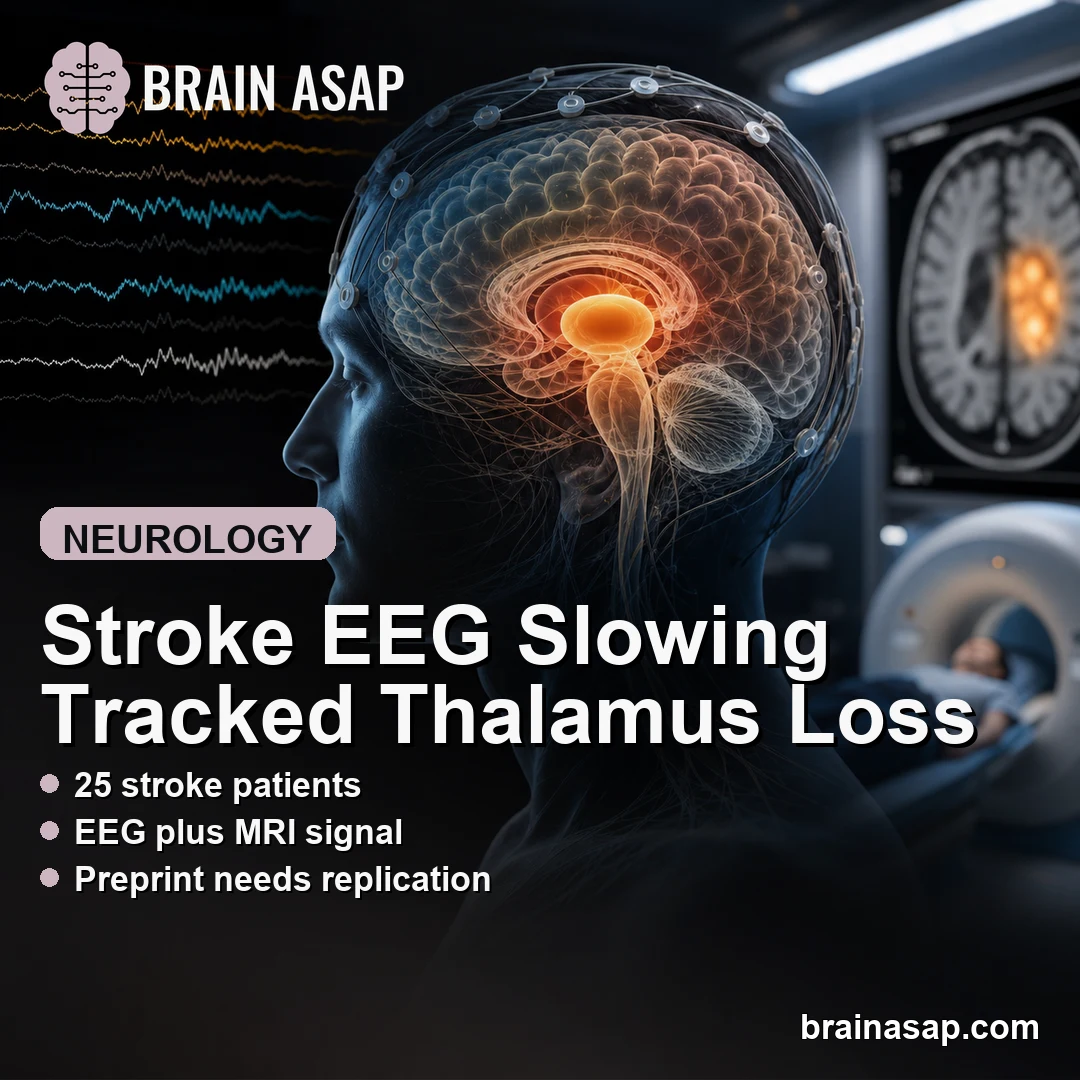
TL;DR: A 2026 preprint posted on medRxiv reported that resting-state electroencephalography (EEG) neural slowing after stroke tracked secondary thalamic degeneration measured on structural MRI, even though the sampled patients did not have direct thalamic lesi…
Read article ↗
TL;DR: A 2026 preprint posted on medRxiv reported that larger choroid plexus volume on brain MRI was associated with greater disability in multiple sclerosis and with higher white-matter myo-inositol in progressive MS, but the work has not yet been peer review…
Read article ↗
TL;DR: A 2026 preprint in medRxiv using ABCD Study data found that childhood poverty strengthened the link between early-life adversity and later behavioral problems, while inhibitory-control brain and temperament profiles separated higher- and lower-risk patt…
Read article ↗
TL;DR: A 2026 preprint in medRxiv found that under-mattress sleep sensors associated lower nighttime respiratory rate and more unstable nighttime movement with higher odds of next-day agitation in dementia, while the same features did not predict how severe ag…
Read article ↗
TL;DR: A 2026 preprint in medRxiv reported that SenseCheQ, a home quantitative sensory testing device, produced reliable vibration and temperature-threshold measurements in 30 healthy adults and tracked early sensory changes in 3 breast cancer patients receivi…
Read article ↗