TL;DR: Four weeks of being kept awake about 20 hours a day damaged memory and brain-cell connections in middle-aged mice. An experimental compound called D30, given during the sleep loss, partly protected them.
Key Findings
- Three kinds of memory got worse: Recognizing objects, remembering a scary place and finding a hidden platform.
- Fewer connection points: Dendritic spines dropped after 6 days and more after 28.
- Support cells slowed down: Microglia and astrocytes became simpler in shape, not inflamed.
- Body chemistry shifted: Blood showed changes in energy and fat handling.
- D30 partly protected: Better memory scores and more spines than untreated sleep-deprived mice.
Source: CNS Neuroscience & Therapeutics (2026) | Liu et al.
Poor sleep becomes more common in middle age, and studies in people link it to a higher risk of memory decline later. But it is hard to tell in humans whether lost sleep itself harms the brain, or what changes inside it.
Researchers at Fujian Medical University in China kept middle-aged mice awake for days and weeks, then looked at their memory, their brain cells and their blood. They also tested whether an experimental compound could limit the damage.
Six Days Versus Four Weeks Without Proper Sleep
The mice were 12 months old, roughly middle-aged in mouse terms, and all male. Sleep was disrupted with a slowly rotating pole in the cage that turned on for 6 seconds every 30 seconds, plus a dim light at night.
- Short-term: 6 days of disruption.
- Long-term: 28 days, about 20 hours a day, with a 4-hour morning break.
- D30: A new lab compound, 20 mg/kg by mouth daily, given during the sleep loss. Some groups got a dummy liquid instead.
Behavior tests used 10 mice per group, with an 18-hour recovery break before each test.
Memory Slipped on Three Different Tests
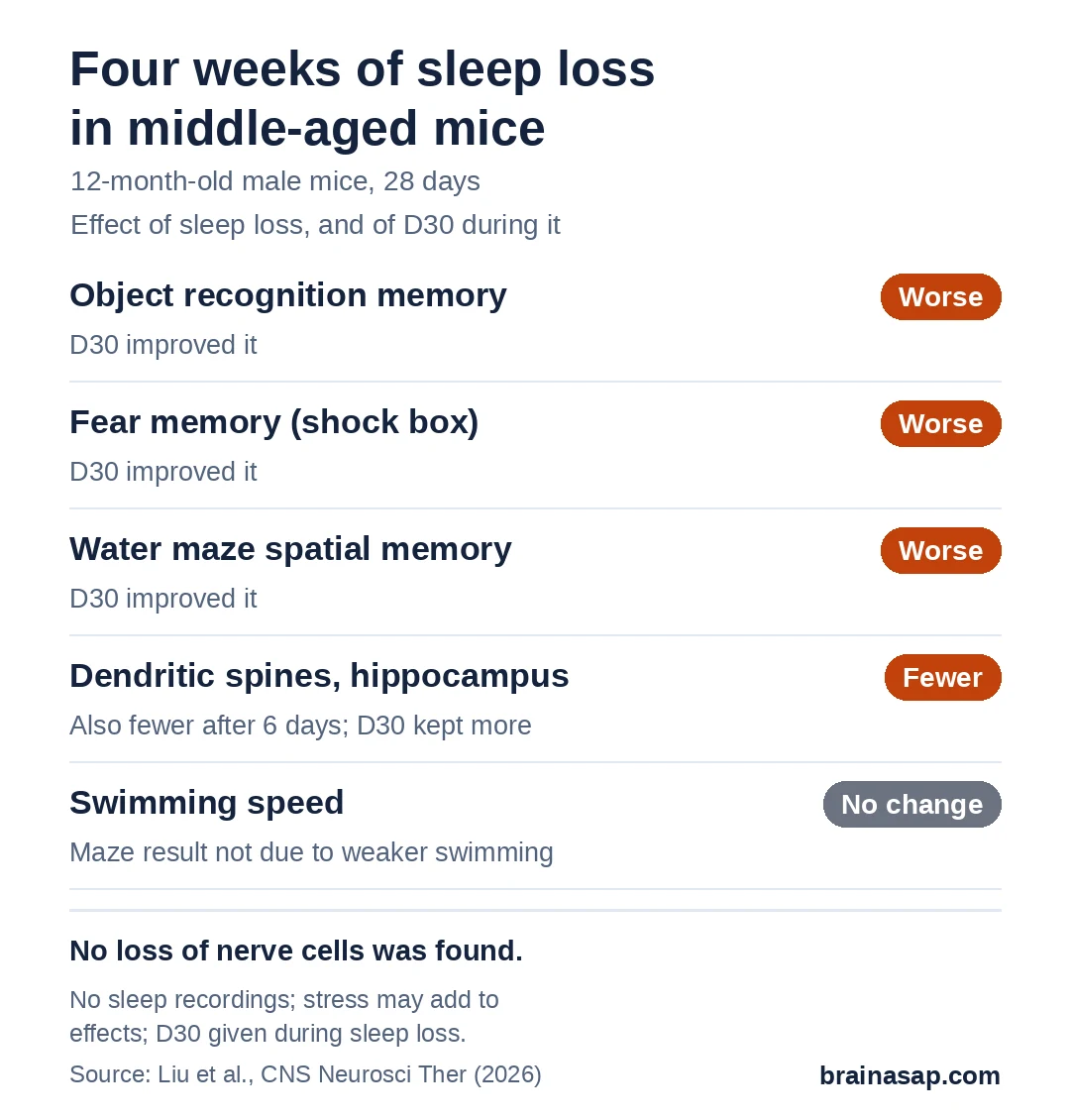
After four weeks, sleep-deprived mice did worse at:
- Spotting a new object: Less interest in a new toy versus a familiar one.
- Remembering a scary place: Less freezing in a box where they had received a mild shock.
- Finding a hidden platform: Fewer crossings over its old spot in a water maze.
Swimming speed and distance did not change, so the maze result was not just tired legs. The mice also built poorer nests and showed more depression-like and anxiety-like behavior.
Fewer Connections and Quieter Support Cells
In the hippocampus, a memory hub, nerve cells lost dendritic spines, the tiny bumps where they receive signals. Both 6 and 28 days cut spine numbers, with a bigger drop after 28. Proteins that hold connections together also fell. The researchers did not find nerve cells dying.
The brain's support cells changed too. Microglia, the immune cells, and astrocytes became less branched, which suggests they were doing less of their usual housekeeping. In these middle-aged mice, sleep loss seemed to suppress microglia rather than inflame them, unlike some studies in young mice.
In the blood, long-term sleep loss shifted chemicals linked to energy production and fat handling.
What the D30 Compound Did
D30 is an experimental small molecule that can reach the brain. Mice given D30 throughout the four weeks of sleep loss:
- Scored better on all three memory tests than untreated sleep-deprived mice
- Kept more dendritic spines and connection proteins
- Had more normal-looking support cells and blood chemistry
The protection was partial, and D30 was given during the sleep loss, so it is unknown whether it can repair damage after the fact.
Limits of a Mouse Sleep Study
- Sleep not measured: No brain recordings confirmed how much sleep the mice lost.
- Stress mixed in: A rotating pole and night light are stressful on their own, and stress hormones weren't measured.
- Male mice only.
- Small groups: 5 to 10 mice per test.
- D30 is not a medicine: No human studies are mentioned.
The study adds animal evidence that weeks of broken sleep can weaken the brain's memory wiring in midlife, through changes in support cells and metabolism. The obvious takeaway for people is protecting sleep itself; whether a drug like D30 could ever help is a much longer question.
Citation: DOI: 10.1002/cns.71134. Liu X, Lin H, Zhong J, et al. Sleep deprivation induces glial dysfunction, synaptic loss, metabolic imbalance, and cognitive impairment in 12-month-old mice: protective effects of D30. CNS Neurosci Ther. 2026.
Study Design: Randomized experiments in 12-month-old male mice; 6-day and 28-day sleep deprivation with or without D30.
Sample Size: 10 mice per group for behavior; 5 to 6 per group for tissue measures.
Key Statistic: Water maze platform crossings: sleep-loss by D30 interaction F(1,36) = 10.41, p = 0.0027.
Caveat: No EEG confirmation of sleep loss; possible stress confound; male mice only; D30 given preventively.