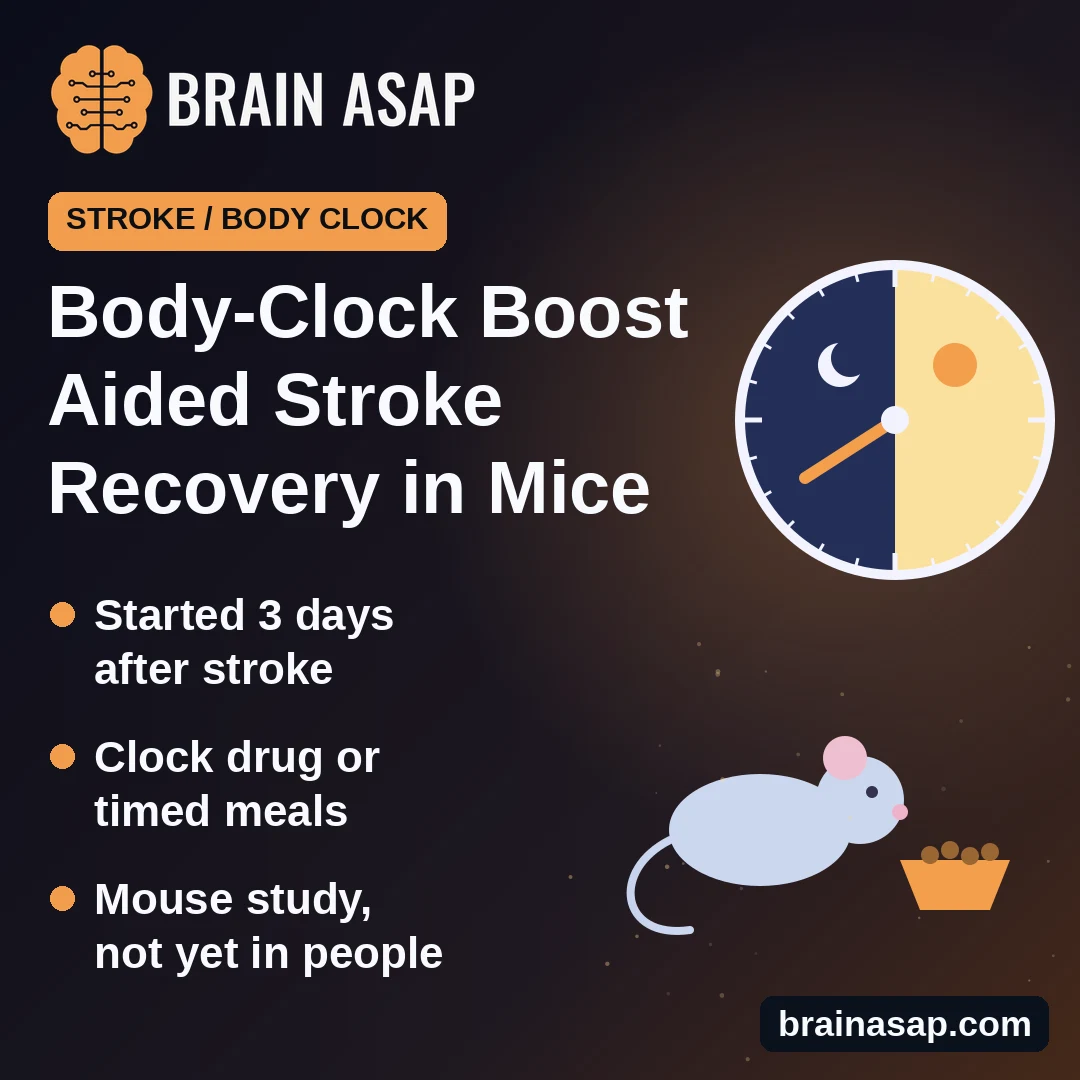
TL;DR: In mice, strengthening the body's daily clock starting three days after a stroke, with an experimental clock drug or by limiting meals to the animals' active hours, led to smaller brain injuries and better walking. This is early animal research, not a treatment for people.
Key Findings
- Stroke scrambled daily rhythms in mice and slowed the brain's fluid-clearing system.
- Clock drug KL001: Smaller lesions in two stroke models; better walking was shown in the photothrombotic model.
- Meals timed to active hours: Smaller lesions and better walking too.
- Meals at the wrong time: No benefit.
- Started 3 days late: Benefits appeared even with delayed treatment.
- Melatonin and light boosted fluid flow in healthy mice but were not tested after stroke.
Source: Journal of Clinical Investigation (2026) | Waight et al.
Today's best stroke treatments, clot-busting drugs and clot removal, only work within hours. After that limited window, recovery relies mainly on rehab.
This mouse study from the University of Rochester asked whether something could still help days later: strengthening the body's 24-hour clock.
Why the Body Clock Matters for the Injured Brain
The brain has a waste-clearing system, called the glymphatic system, that flushes fluid through channels around blood vessels. It works on a daily rhythm, running hardest during sleep. After a stroke, both daily rhythms and this fluid flow are disrupted.
The researchers first confirmed this in mice. Strokes made their day-night activity patterns weaker and cut fluid flow in the brain. Then they tested ways to strengthen the clock:
- KL001: An experimental drug that stabilizes a core clock protein.
- High-dose melatonin at a set time.
- A short light pulse at the start of the active period.
- Time-restricted feeding: Food available only at certain hours.
In healthy mice, all four could boost fluid flow, but only when given at the right time of day.
A Clock Drug Helped Even Days After Stroke
Mice are active at night. Starting three days after a stroke, the researchers gave KL001 four hours into the mice's active night for eight days.
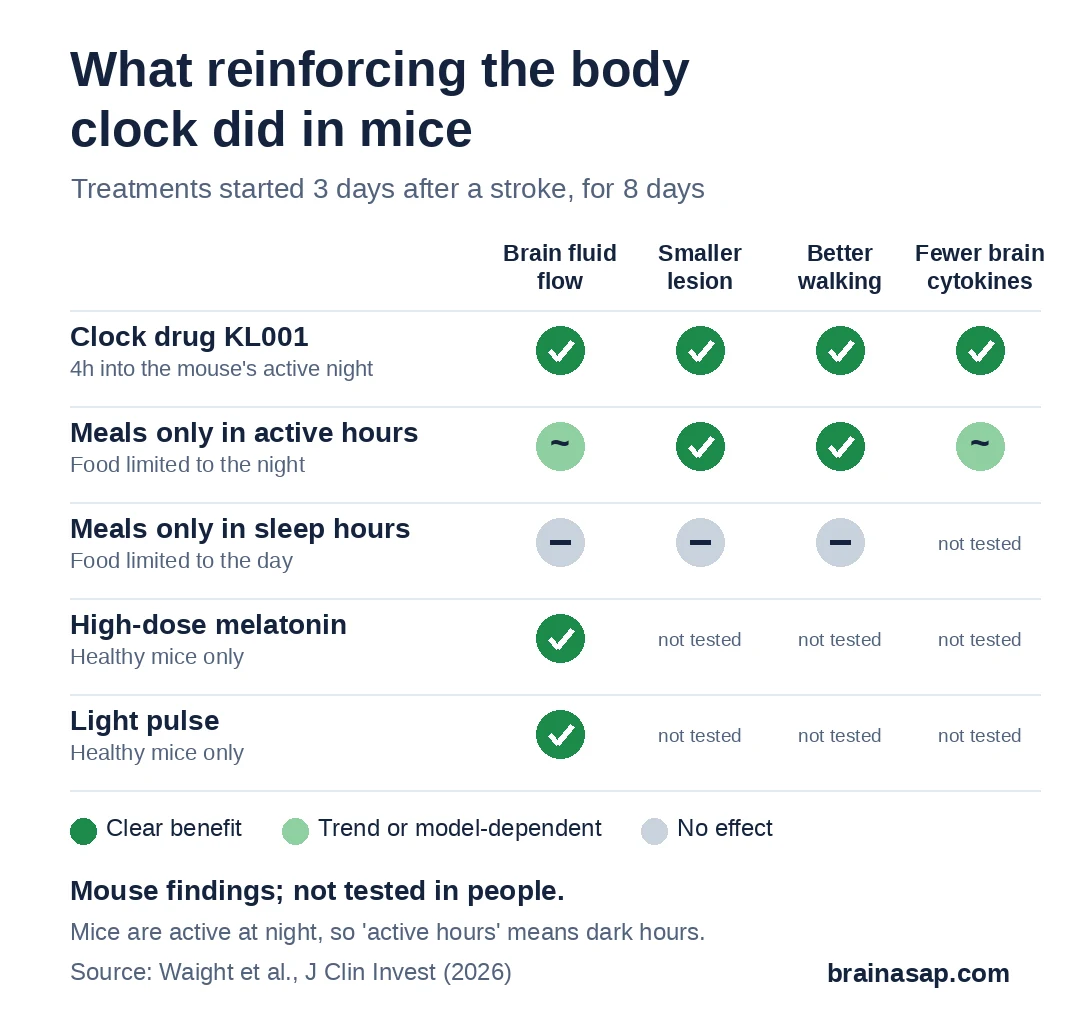
- Smaller lesions in two different stroke models.
- Better walking: Faster on a narrow wire-walking test.
- More brain fluid flow and steadier daily activity.
- Lower inflammation signals (cytokines) in the brain, though not in the blood.
MRI scans of the same mice before and after treatment backed up the smaller lesions, with no difference in total brain size.
Mealtimes Worked Too, but Only the Right Ones
Limiting food to the mice's active hours for eight days, starting three days after stroke, also shrank lesions and improved walking. Its effect on fluid flow and brain inflammation was weaker and not consistently significant.
Limiting food to the sleep hours did nothing. The timing, not just fasting, seemed to be what mattered.
Big Gaps Before This Reaches People
- Mice, not people: Mice are active at night and recover differently.
- Short follow-up: 11 days after stroke.
- Lesion size can shrink as swelling fades, so part of the change may reflect fluid, not saved tissue.
- KL001 is experimental and not available for patients.
- Melatonin and light were not tested after stroke; a lower, human-like melatonin dose did not work.
Timing Could Become Part of Stroke Recovery
This does not mean stroke survivors should start fasting or take melatonin; neither was shown to help people here. But it points to a cheap, testable idea: that reinforcing daily rhythms in the days after a stroke might aid recovery.
The key question is whether timed meals, light or rhythm-focused hospital routines improve recovery in human stroke trials.
Citation: DOI: 10.1172/JCI201800. Waight E, Zhu Y, Caudell A, et al. Chronotherapy to reinforce circadian rhythms improves poststroke outcomes and glymphatic function in mice. J Clin Invest. 2026;136(12):e201800.
Study Design: Preclinical mouse experiments (photothrombotic and transient MCA occlusion stroke models; male and female C57BL/6 mice).
Sample Size: Group sizes vary by experiment; see paper and supplement.
Key Statistic: KL001 and active-phase feeding started 3 days post-stroke reduced lesion volume and improved wire-walk velocity vs controls.
Caveat: Animal study; short follow-up; lesion changes may partly reflect edema resolution; KL001 not clinically available.