TL;DR: Female rats that learned to stop fearing a sound during their active hours (night, for rats) held on to that lesson better than rats trained during their resting hours. A brain pathway that calms fear was more active, and had more nerve-cell contact points, at that time of day.
Key Findings
- Better recall at night: Rats trained and tested in their active phase froze less on the final test.
- Busier fear-calming pathway: 13.5% vs 8.8% of prefrontal-to-amygdala neurons switched on.
- More contact points: More dendritic spines in that pathway during the active phase.
- Small rat study: 6 rats per group in the fear experiment.
Source: Brain Structure and Function (2026) | Andrys et al.
Exposure therapy for anxiety and PTSD works by teaching the brain that a feared cue is now safe. Earlier studies in rodents and people suggest that this "extinction" learning sticks better when it happens during the body's active part of the day.
Why would the clock matter? A team at the Universities of Iowa and Colorado looked inside the rat brain for an answer.
Teaching Rats a Sound Was Safe
The researchers used 24 female rats. Rats are active at night, so the two timing groups were:
- Active-phase rats: Trained and tested 4 hours into their dark (active) period.
- Resting-phase rats: Trained and tested 4 hours into their light (resting) period.
On day 1, fear-trained rats heard a tone paired with a mild foot shock. On day 2, in a new cage, they heard the tone many times with no shock, learning it was now safe. On day 3, the researchers played the tone again to see how well that safety lesson held. Control rats went through the same steps without shocks.
The Safety Lesson Stuck Better During Active Hours
Both groups showed similar fear of the tone at the start of day 2, and both calmed down at a similar pace during extinction training. The difference came on day 3: the active-phase rats froze less when they heard the tone, showing better recall of the safety lesson.
Control rats showed no time-of-day difference in activity, so the result was not simply rats being livelier at night.
A Fear-Calming Pathway Was More Active
The team tagged neurons in the ventromedial prefrontal cortex that send signals to the amygdala, a pathway known to help quiet fear. After the day-3 test, the researchers measured how many of these neurons had recently fired.
In fear-trained rats, 13.5% of these pathway neurons were active in the active-phase group, versus 8.8% in the resting-phase group. Control rats showed no difference.
More Nerve-Cell Contact Points at Night
In a second experiment with 16 untrained rats (8 female, 8 male), the researchers counted dendritic spines, the tiny knobs where neurons receive signals, on the same pathway.
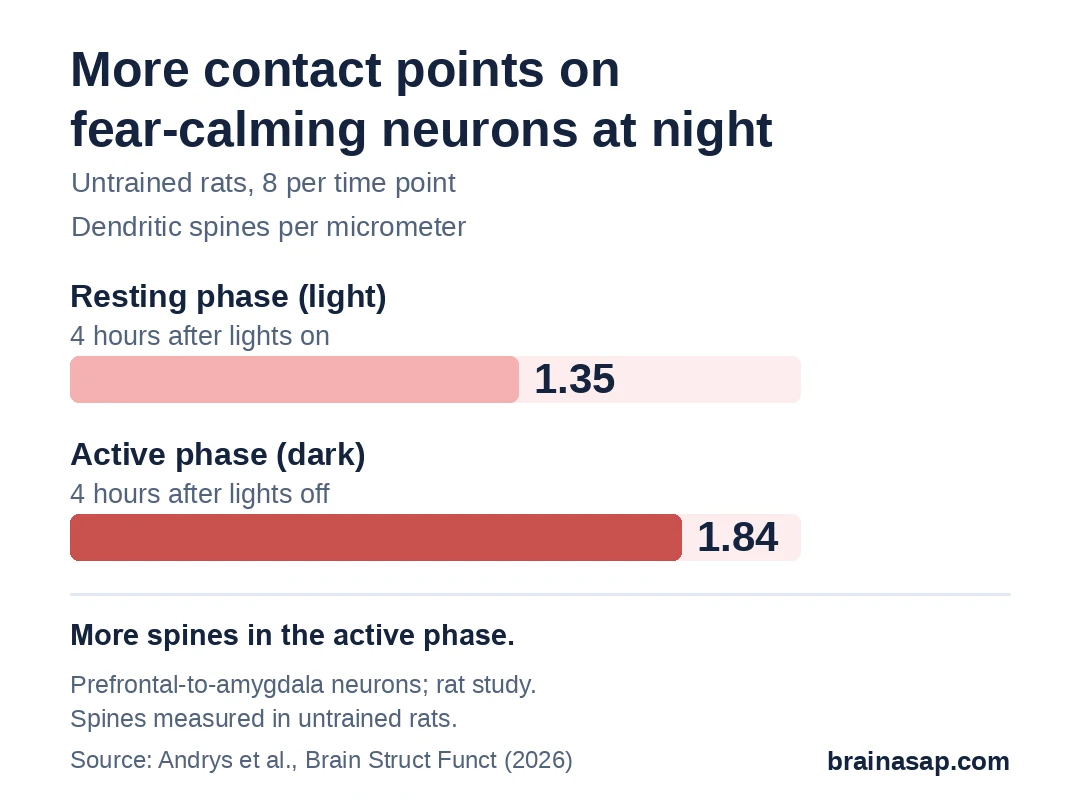
Spine density was higher in the active phase (1.84 vs 1.35 spines per micrometer). The gain came from thin and stubby spines, the more changeable types, while larger "mushroom" spines did not differ.
What a Rat Study Can and Can't Show
- Rats, not people: This is not a test of when to schedule therapy.
- Links, not proof: More activity and spines went along with better recall, but the study did not show they cause it.
- Different rats for each part: Spines were measured in untrained rats, not the ones tested for fear.
- Small groups: 6 rats per group for behavior; too few males and females to compare sexes properly.
- Females only in the fear test.
Does Timing Matter for Exposure Therapy?
The study points to a possible mechanism for why the time of day could shape how well fear-unlearning sticks. The open question is whether scheduling exposure therapy during a person's most alert hours makes its gains last longer, which only human trials can answer.
Citation: DOI: 10.1007/s00429-026-03176-8. Andrys NRR, Johnson EA, Rowe EB, Millisor LA, McDole BK, Baratta MV, Radley JJ, Spencer RL. Daily rhythms in fear extinction memory reflect structural and functional changes in a prefrontal-amygdala circuit. Brain Struct Funct. 2026;231:136.
Study Design: Rat experiments with viral circuit labeling, FOS activity mapping and dendritic spine reconstruction.
Sample Size: Experiment 1: 24 female rats (6 per group); Experiment 2: 16 untrained rats (8 female, 8 male).
Key Statistic: Day-3 extinction recall ZT effect F(1,10) = 6.29, p = .031; spine density 1.84 vs 1.35 spines/µm (higher in the active phase, p = .011).
Caveat: Animal study; associations between circuit changes and behavior are not causal tests.