TL;DR: A household survey published in 2026 in a rural area of Jharkhand, India, gave 310 young people aged 10 to 19 a standard 21-question screening questionnaire for depression, anxiety and stress symptoms over the past week.
Most screened positive for at least mild symptoms. Teens from tribal communities screened positive for depression more often than other teens in the same villages (72% vs 57%), but the questionnaire flags symptoms rather than diagnosing illness.
Key Findings
- High symptom rates: 64% screened positive for at least mild depression symptoms, 79% for anxiety and 64% for stress.
- Depression gap: 72% of tribal teens vs 57% of nontribal teens screened positive for depression symptoms, a statistically clear difference.
- More serious symptoms: 59% of tribal teens vs 40% of nontribal teens scored in the moderate or worse depression range.
- No clear gap for anxiety or stress: Both were common in both groups.
- Fewer advantages: Tribal teens' parents had less schooling, which the survey did not adjust for.
Source: Cureus (2026) | Mazumdar et al.
In rural India, a teenager struggling with low mood may live hours from the nearest mental health service. In the area of this study, local clinics and health centers offered no mental health services at all.
A 2026 study in Cureus, by Rajdeep Mazumdar and colleagues at the Rajendra Institute of Medical Sciences in Ranchi, measured how common these symptoms were among young people in one rural block of Jharkhand, and whether teens from Scheduled Tribe communities, mostly Oraon and Munda, fared differently from their neighbors.
How Was the Survey Done?
From December 2024 to June 2025, interviewers visited homes registered with the institute's rural health center in Ormanjhi Block, near Ranchi. About 36% of the block's population belongs to Scheduled Tribes.
- Interviewed: 340 young people aged 10 to 19; 310 gave complete answers
- Tribal teens: 137, identified by self-report and checked against the state's official list
- Nontribal teens: 173 from the same villages
- Girls: 60%
Each teen answered a Hindi version of the DASS-21, a widely used screening questionnaire with 7 questions each on depression, anxiety and stress over the past week, in private with an interviewer.
How Many Screened Positive?
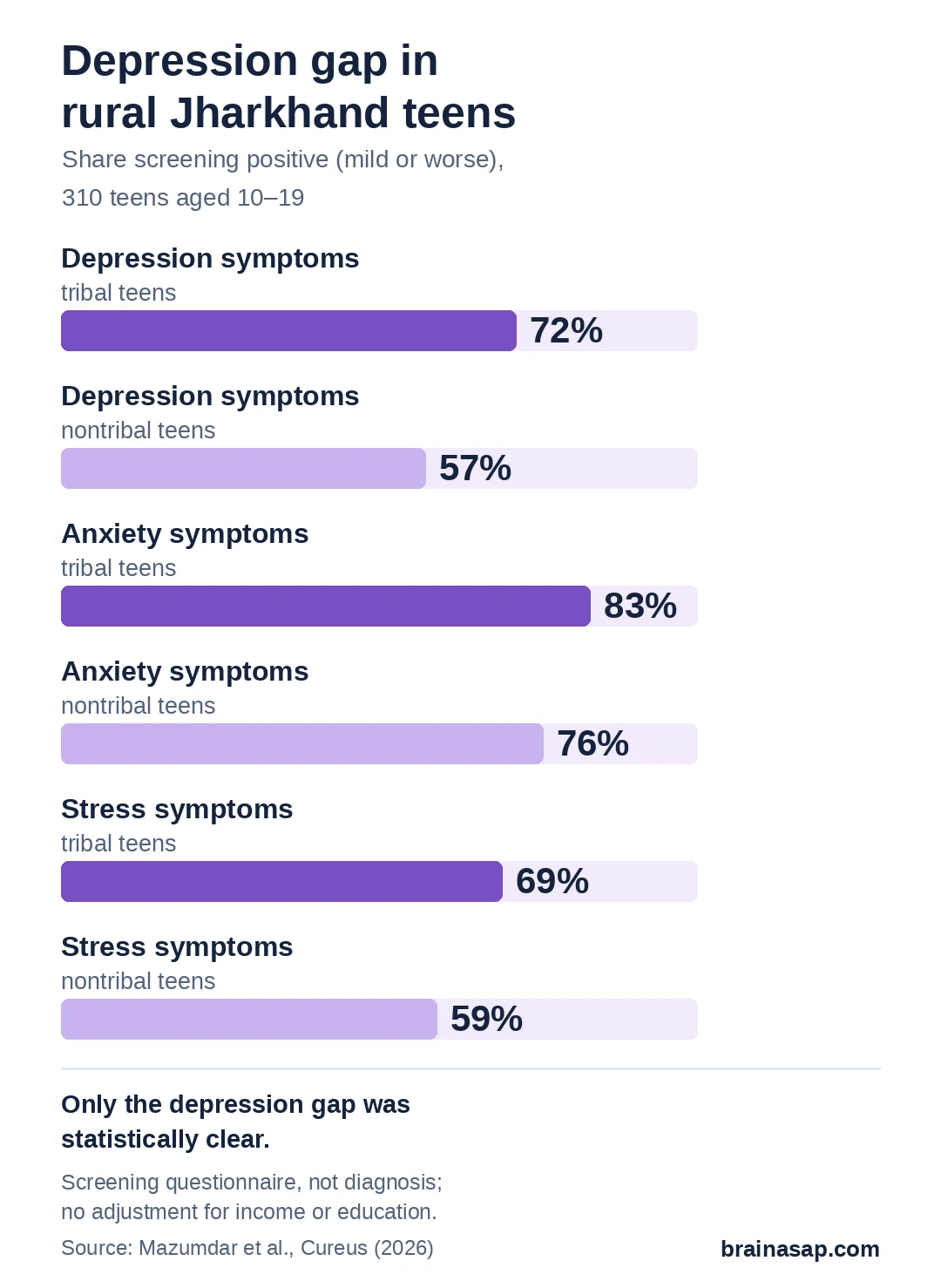
Symptoms were common in both groups. Anxiety was the most widespread: more than a third of all teens scored in the "extremely severe" range for anxiety symptoms.
For depression, the gap between groups was clear. Tribal teens had about 1.9 times the odds of screening positive, and their average depression score was higher (15.5 vs 12.8), a small-to-medium difference.
Why Might Tribal Teens Have Fared Worse?
Tribal families in the survey had fewer advantages on paper:
- Fathers with middle school education or less: 65% of tribal teens vs 33% of nontribal teens
- Mothers with middle school education or less: 63% vs 43%
- Higher-income households: 34% vs 46% (not statistically clear)
Mazumdar and colleagues pointed to poverty, lower parental education and limited health care as likely reasons. Because the analysis did not adjust for these factors, it cannot say whether tribal identity itself, or the hardships that often go with it, explains the gap.
What Limits These Findings?
- Screening, not diagnosis: "Mild or worse" on the DASS-21 counts many teens whose symptoms might not meet criteria for a disorder.
- No adjustment: Group comparisons were simple, with no control for income, parental education or age.
- One block: Results may not apply to other parts of Jharkhand or India.
- Who was missed: Teens at boarding schools, working away from home during the day or who had migrated were likely underrepresented.
- One moment in time: The survey cannot show what caused symptoms.
A Case for Local, Culturally Fitting Mental Health Support
Even with these limits, the numbers point to a large unmet need in a place with no local mental health services. Mazumdar's team called for school-based screening and community counseling that fits local cultures.
A useful next step would be a study that follows up teens who screen positive with full clinical assessments, and accounts for family income and education, to show how many need care and what drives the depression gap.
Citation: DOI: 10.7759/cureus.114694 Mazumdar R, Sagar V, Kujur A, Sunderam S. Prevalence and Severity of Depression, Anxiety, and Stress Among Tribal and Nontribal Adolescents in a Rural Block of Jharkhand: A Cross-Sectional Study. Cureus. 2026;18(8):e114694.
Study Design: Community-based cross-sectional household survey (December 2024–June 2025), consecutive sampling of RHTC-registered households; interviewer-administered Hindi DASS-21; chi-square, Mann–Whitney U and crude odds ratios.
Sample Size: 310 adolescents aged 10–19 (137 tribal, 173 nontribal) in Ormanjhi Block, Ranchi, Jharkhand; 340 interviewed.
Key Statistic: Mild-or-worse depression 71.5% vs 57.2% (χ² = 6.76, p = 0.009; crude OR 1.88, 95% CI 1.16–3.03); moderate-to-extremely severe 59.1% vs 39.8%. Anxiety 83.2% vs 75.7% (p = 0.108); stress 69.3% vs 59.0% (p = 0.059). Mean depression 15.5 vs 12.8 (Mann–Whitney p = 0.006; d = 0.28).
Caveat: Screening tool with low (mild) threshold; unadjusted bivariate comparisons; single rural block; possible exclusion of boarding-school, working and migrant teens; cross-sectional.