TL;DR: In female mice, both too little and too much estrogen led to depression-like and anxious behavior, and both lowered one estrogen receptor in a mood-related brain area. Boosting that receptor eased the effects of stress.
Key Findings
- U-shaped pattern in men: In 6,481 US men, both low and high blood estrogen were linked to higher odds of depression.
- Stress lowered estrogen in female mice only: Male mice became depressed-acting but kept normal estrogen.
- Too low or too high, same result: Both led to depression-like behavior in female mice.
- One receptor dropped in both cases: Estrogen receptor alpha fell in the lower hippocampus.
- Adding receptor back helped: Stressed female mice acted less depressed and showed less brain inflammation.
Source: International Journal of Biological Sciences (2026) | Wang et al.
Women are diagnosed with depression about twice as often as men, and mood problems often cluster around times of big hormone change. Yet hormone therapy has given mixed results for mood: some studies find it helps, others find it can make things worse.
A team at Chongqing Medical University in China proposed a simple idea that could explain both: maybe estrogen needs to stay in a healthy middle range, and trouble starts when it swings too low or too high.
Low and High Estrogen Both Linked to Depression in Men
The researchers first looked at 6,481 men in a large US health survey (NHANES), using blood estradiol (the main form of estrogen) and a depression questionnaire. They chose men on purpose, because menstrual cycles and menopause make estrogen in women much harder to pin down in a single blood test.
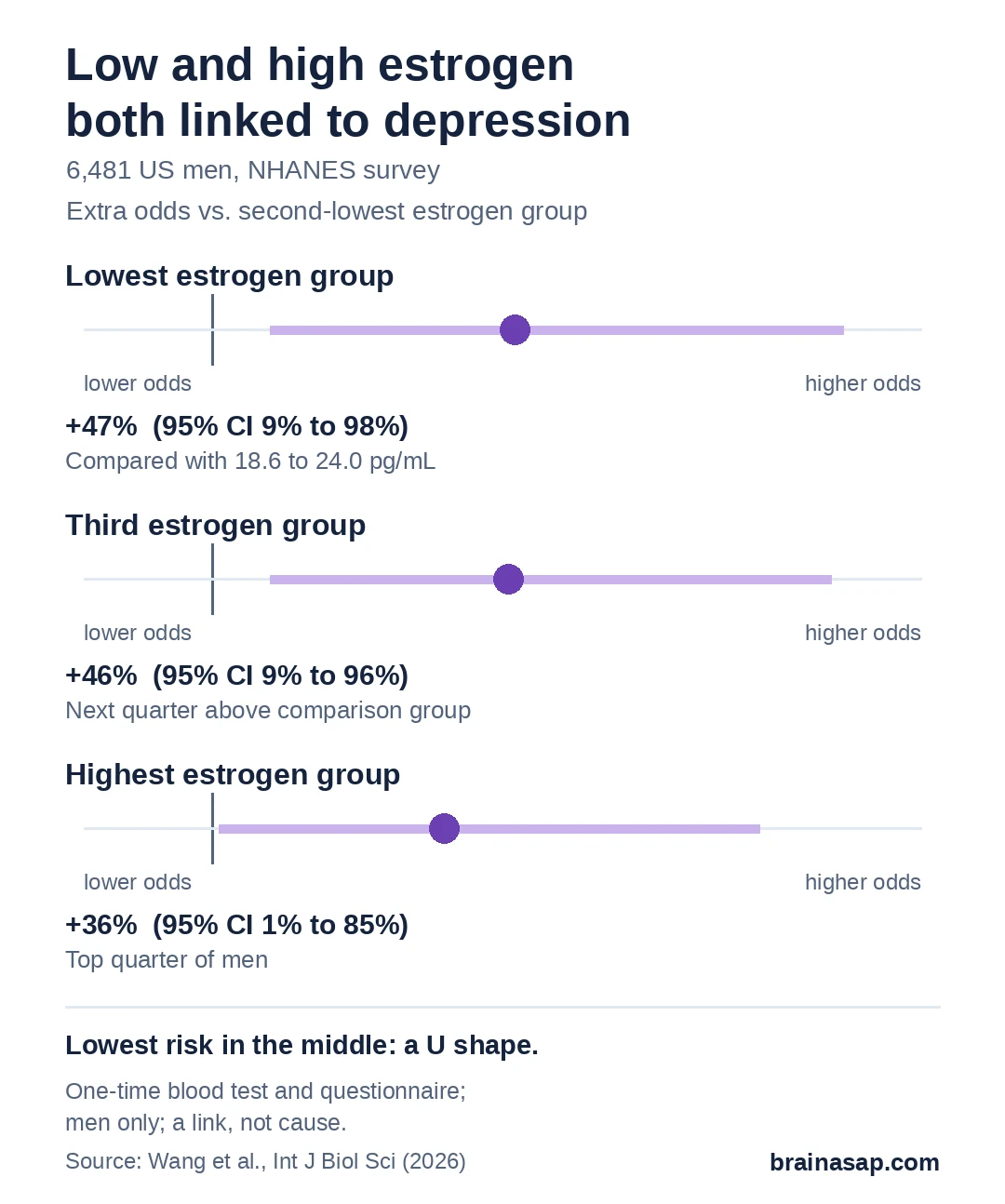
Compared with men in the second-lowest estrogen group, those in the lowest group had 47% higher odds of depression, and those in the two highest groups had 36% to 46% higher odds. That makes a U shape, with the lowest risk in the middle.
Stress Lowered Estrogen in Female Mice Only
Next, the team moved to mice with normal, intact hormones. Mice were held in tubes for 6 hours a day for 21 days, a standard way to cause chronic stress.
Both male and female mice showed depression-like signs: less interest in sugar water (a mouse sign of lost pleasure) and giving up sooner when hung by the tail. But only females:
- Lost estrogen: Blood estradiol fell.
- Acted more anxious: Spent less time in the open center of a test arena.
- Lost a receptor: Estrogen receptor alpha dropped in the lower (ventral) hippocampus, a region involved in mood and stress. A second receptor, beta, did not change.
Too Much Estrogen Did the Same Thing
The researchers then gave unstressed female mice daily estradiol injections, enough to roughly double normal levels, similar to the high levels during fertility treatment.
These mice developed the same depression-like and anxious behavior as the stressed mice. And again, estrogen receptor alpha dropped in the ventral hippocampus. Below normal estrogen, the receptor rose and fell with estrogen; above normal, more estrogen meant less receptor.
Gene activity in the brains of both groups of mice also lined up with patterns seen in postmortem brain tissue from women with major depression, pointing to inflammation, fat handling and weaker nerve connections.
Blocking or Boosting the Receptor Changed Behavior
To test whether the receptor matters, the team tried it both ways in female mice:
- Blocking it: A drug that blocks receptor alpha made a short, mild stress (7 days) enough to cause depression-like behavior.
- Boosting it: A virus that made extra receptor alpha in the ventral hippocampus protected mice from 21 days of stress. They kept their taste for sugar water, struggled longer and explored more, and their brains showed less inflammation.
From Mice and Men to Women Is Still a Long Step
- Human data are men only: The U-shaped link has not been shown in women here.
- Snapshot data: One blood test and one questionnaire can't show which came first.
- Extreme mouse models: Daily restraint and high-dose injections are harsher than everyday hormone changes.
- Small lab groups: 3 to 20 mice per test, depending on the experiment.
- No treatment tested in people.
The open question is whether women whose estrogen swings far from their usual range, such as during perimenopause or fertility treatment, show the same receptor drop and mood risk, and whether keeping estrogen in balance, rather than simply adding more, protects mood.
Citation: DOI: 10.7150/ijbs.137575. Wang Z, Ren Y, Cheng F, et al. Disrupted estrogen homeostasis drives female-specific depressive-like and anxiety-like behaviors via convergent ERα downregulation in the ventral hippocampus. Int J Biol Sci. 2026;22(14):8074-8089.
Study Design: Cross-sectional analysis of NHANES men plus mouse experiments (chronic restraint stress, high-dose estradiol, receptor blocking and overexpression) with gene and protein profiling.
Sample Size: 6,481 men; mouse groups of 3 to 20 depending on the test.
Key Statistic: Depression odds vs. second estradiol quartile: Q1 OR 1.47 (1.09–1.98), Q3 1.46 (1.09–1.96), Q4 1.36 (1.01–1.85).
Caveat: Human data are cross-sectional and male-only; behavioral findings are from mouse models.