TL;DR: In a small American trial, adults with anxiety and depression either floated in a dark, quiet tank of warm salt water or rested in a reclining chair for 6 sessions.
Floaters were much more likely to say they felt boundless, felt like they had no body and felt their heartbeat and breathing more strongly. Mood and anxiety improved in all groups, with no clear difference detected between floating and the chair.
Key Findings
- A boundless feeling: People who floated rated a sense of oneness and blurred edges between self and surroundings much higher than people who rested in the chair.
- Highest ratings with flexible sessions: This group had the highest average boundlessness ratings, but its difference from fixed float sessions was not statistically clear.
- More body awareness: Floaters felt their heartbeat and breathing far more strongly than chair users, by about 23 to 29 points on a 0-to-100 scale.
- Mood gains were similar: Depression, anxiety and mood improved in all groups, with no clear difference between floating and the chair.
- Some overlap with psychedelics: Floaters' ratings overlapped with some published ketamine and psilocybin ratings for boundless feelings. This was an indirect comparison with separate healthy volunteers, not proof of equivalent experiences or treatment benefits.
Source: Neuroscience of Consciousness (2026) | Tobel, Cone, Choquette et al.
Imagine lying in water so salty you float without effort, at skin temperature, in total darkness and silence. Most of what your senses normally report simply drops away.
A 2026 study in Neuroscience of Consciousness, by researchers at the Laureate Institute for Brain Research in Tulsa, Oklahoma and the Institute for Advanced Consciousness Studies in Santa Monica, California, asked what that experience feels like for people with anxiety and depression.
They gave the state a name: aquahenosis, or "oneness with water."
Floating vs Resting in a Chair
This was a new look at data from an earlier randomized feasibility trial. Of 75 adults assigned to a group, 57 finished all 6 sessions. Nearly all had major depression, and most also had an anxiety disorder.
Each person was randomly assigned to 1 of 3 groups:
- Set float schedule (19 people): six 1-hour floats over 6 weeks in a lightproof, soundproof room, in a shallow pool of Epsom salt water
- Flexible float schedule (21 people): the same pool, but people chose when to float over 12 weeks and could stay up to 2 hours
- Recliner chair (17 people): six weekly 1-hour sessions in a zero-gravity reclining chair in a dim, quieter room, fully clothed
After the last session, everyone rated their experience on a long questionnaire about altered states, the same one often used in psychedelic research. After sessions, they also rated how strongly they had felt their heartbeat and breathing.
What Did Floating Feel Like?
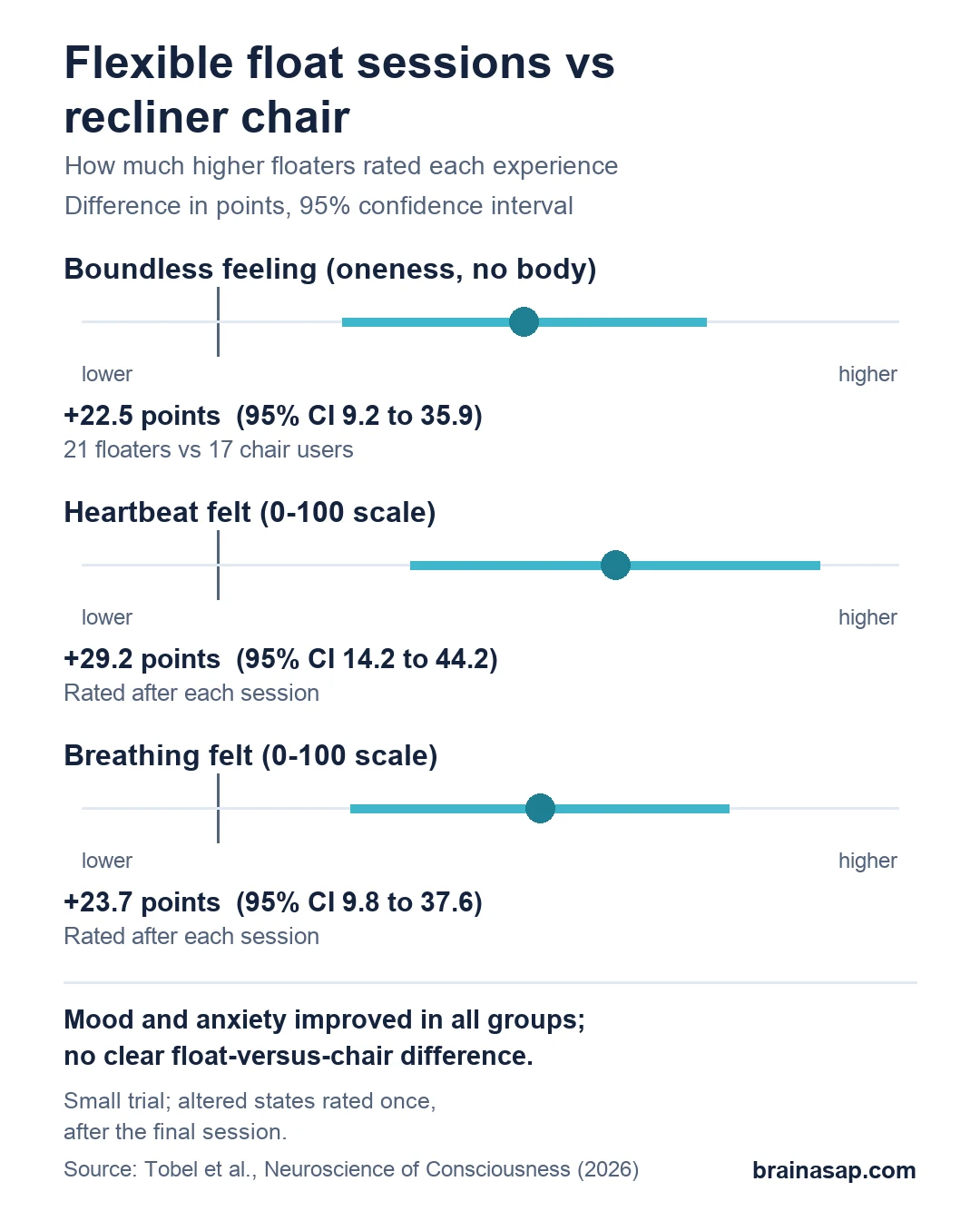
Floaters rated the "boundless" part of the questionnaire much higher than chair users. That part covers feelings of oneness, bliss and the edges of the self dissolving.
- Flexible float vs chair: about 22.5 points higher
- Set float schedule vs chair: about 12.7 points higher
Within that, the biggest gap was in feeling disembodied, with items like "I felt as if I no longer had a body." Floaters also scored higher on feeling united with their surroundings and on spiritual experience.
Body signals stood out too. Both float groups rated how strongly they felt their heartbeat about 29 points higher, and their breathing about 23 points higher, than chair users on a 0-to-100 scale.
Did Floating Help Mood More Than the Chair?
Not clearly. Depression, anxiety and mood ratings improved from start to finish in all 3 groups, including the chair group, and the groups did not clearly differ.
A statistical model did find a pattern. Floating went with feeling more boundless, and people who felt more boundless showed bigger gains in good mood and bigger drops in depression scores. That is a statistical link, not proof that the boundless feeling caused the improvement.
How Close Is This to a Psychedelic Trip?
Tobel and colleagues compared floaters' ratings with published average ratings from healthy volunteers given ketamine or psilocybin, the active ingredient in "magic mushrooms."
Floating looked similar to ketamine and to low doses of psilocybin on the boundless, disembodied and blissful feelings. It did not produce the visual effects, such as patterns and imagery, that mark those drugs.
Limits to Keep in Mind
- Small groups: Only 17 to 21 people per group finished.
- Rated once, at the end: The altered-state questionnaire came after the last session, so it can't show how feelings changed from session to session.
- Different conditions: The chair room was not as dark or quiet, people stayed clothed, and the flexible group floated longer, so several things differed at once.
- Loose drug comparison: Psychedelic ratings came from other studies of healthy volunteers, compared mostly by eye.
- Secondary analysis: These questions were not the trial's main aim.
A Drug-Free Way to Study Altered States
Tobel and colleagues also suggested that floating could be a way to study, or even prepare people for, self-dissolving experiences without drugs. Whether that boundless feeling actually helps anxiety or depression is still unknown, since mood improved about as much with a recliner chair.
Citation: DOI: 10.1093/nc/niag044 Tobel T, Cone A, Choquette E, Garland M, Johnson MA, Mink K, Lynch C, Frohlich J, Feinstein JS, Reggente N, Khalsa S. Aquahenosis: a non-pharmacological altered state of consciousness induced by floatation-REST in individuals with anxiety and depression. Neuroscience of Consciousness. 2026;2026(1):niag044.
Study Design: Secondary analysis of a randomized controlled feasibility trial (NCT03899090): Pool-REST prescribed, Pool-REST preferred and Chair-REST; 5D-ASC/11-ASC after the 6th session, MAIA-S and interoceptive intensity ratings; Welch ANOVAs with FDR correction; exploratory mediation.
Sample Size: 75 randomized adults with anxiety and depression at LIBR, Tulsa; 57 completed all 6 sessions (Chair 17, Pool-REST 19, Pool-REST Preferred 21).
Key Statistic: Oceanic Boundlessness: F(2, 35.3) = 9.57, pFDR = 0.002; Preferred vs Chair +22.53 (95% CI 9.18–35.88); Pool-REST vs Chair +12.74 (2.73–22.76). Heartbeat intensity Preferred vs Chair +29.20 (14.17–44.22); breath intensity +23.67 (9.76–37.59). Clinical outcomes improved in all groups (P < .001) without significant between-group differences. OB mediated positive affect (ab = 2.633, 95% CI 1.020–4.719) and MADRS (ab = −3.415, 95% CI −6.527 to −1.235).
Caveat: Small feasibility sample; altered states rated once after the final session; chair condition differed in light, sound, clothing and temperature; psychedelic comparisons from other studies of healthy volunteers; exploratory mediation.