TL;DR: In an 8-week trial of about 500 adults with mild or moderate depression in Germany and Poland, people taking a daily lavender oil capsule improved somewhat more than people taking a dummy capsule.
A 2026 follow-up look at that trial's symptom ratings found the extra improvement was clearest for sadness, tiredness and trouble concentrating, and smallest for sleep. Silexan's maker paid for that research.
Key Findings
- Better than a dummy pill overall: On a 60-point depression scale, scores fell about 12 points with lavender capsules vs 10 points with dummy capsules.
- Sertraline comparator: Scores fell about 13 points with sertraline, a common prescription antidepressant tested in the same trial.
- Biggest edge on core symptoms: Compared with the dummy capsule, lavender did best on tiredness, sadness and concentration, each by a fraction of a point on a 6-point rating.
- Little difference for sleep: Sleep improved about as much with the dummy capsule.
Source: International Journal of Neuropsychopharmacology (2026) | Möller et al.
Lavender has a calming reputation, and in parts of Europe a standardized lavender oil capsule called silexan is already approved for anxiety. Could it help with depression, too?
An earlier trial suggested it might. A 2026 study in the International Journal of Neuropsychopharmacology, by Hans-Jürgen Möller, Siegfried Kasper and colleagues, went back to that trial's data to see which depression symptoms changed most.
Lavender, Sertraline or a Dummy Capsule
The original trial, called LEAD, ran at 53 clinics in Germany and Poland. It included 498 adults, about 2 in 3 of them women, with mild or moderate depression and no thoughts of suicide. Each took 1 of 3 daily treatments for 8 weeks:
- Lavender: 80 mg of silexan, a lavender oil made from Lavandula angustifolia flowers (170 people)
- Sertraline: 50 mg, a widely used prescription antidepressant (171 people)
- Dummy capsule: a look-alike with no active ingredient (157 people)
Neither patients nor doctors knew who got what. Psychiatrists or family doctors rated depression on a standard 60-point scale made of 10 symptom questions, each scored 0 to 6.
Did Lavender Help Overall?
After 8 weeks, average depression scores fell by:
- Lavender: 12.1 points
- Sertraline: 12.6 points
- Dummy capsule: 10.0 points
Both active treatments beat the dummy capsule. About half the people on lavender or sertraline had their score cut at least in half (54% on each), compared with 42% on the dummy capsule.
The authors cite a 2-point benchmark for a clinically important difference in total score. Lavender's average 2-point edge was around that benchmark; this does not guarantee a noticeable benefit for each patient.
Which Symptoms Changed Most?
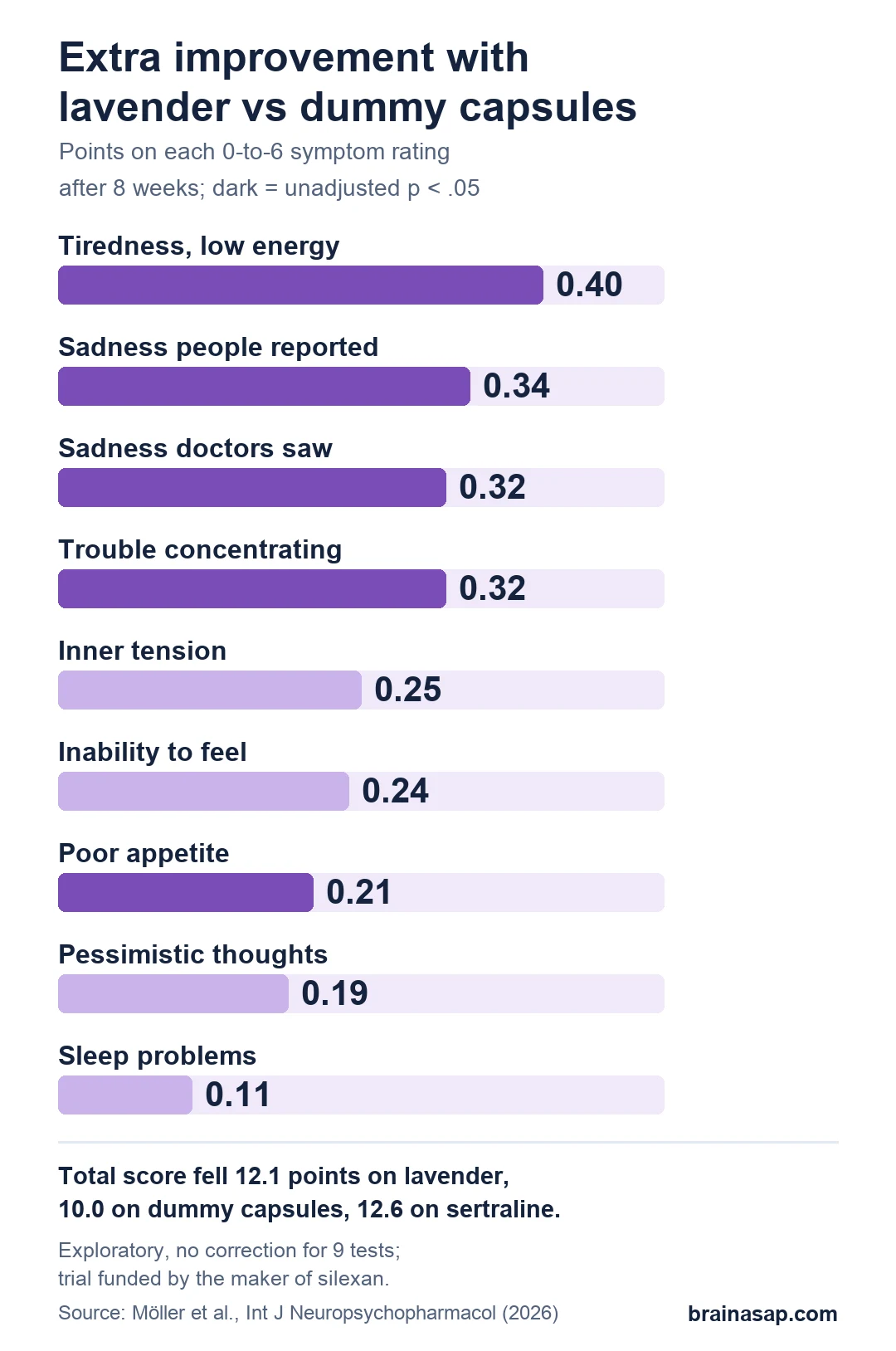
Researchers compared 9 of the 10 symptom ratings. (The tenth, suicidal thoughts, was left out because anyone scoring above 0 on it had to leave the trial.)
The result? Five of the 9 symptom comparisons favored lavender at the study's unadjusted statistical threshold, with the largest advantages for tiredness and sadness. The tests were exploratory and were not corrected for multiple comparisons.
- Favored lavender before multiple-testing correction: tiredness, how sad people said they felt, how sad they looked, trouble concentrating, poor appetite
- Close but not clear: inner tension, inability to feel
- No clear difference: sleep, pessimistic thoughts
Sertraline's pattern was much the same. Möller, Kasper and colleagues argued that lavender's benefit wasn't just its known calming effect, because anxiety-related symptoms didn't improve more than others.
Reasons for Caution
- Exploratory reanalysis: The symptom-by-symptom tests were planned ahead but not corrected for running 9 comparisons, so some differences could be chance.
- Small differences: Gaps were 0.1 to 0.4 points on a 0-to-6 rating; there's no agreed cutoff for what matters to patients on a single symptom.
- Industry funding: Dr. Willmar Schwabe, the company that makes silexan, funded the trial, and one author works there.
- Not like store-bought oil: Silexan is a specific pharmaceutical-grade preparation; lavender oil from a shop or a diffuser wasn't tested.
- Limited group: Only mild or moderate depression, no suicidal thoughts, 8 weeks, and almost all white participants.
- Not a head-to-head test: Lavender and sertraline looked similar, but the trial wasn't designed to show they work equally well.
Is Lavender an Option for Mild Depression?
This analysis suggests the lavender capsule eased several core symptoms of depression, not just anxiety, in one well-run but company-funded trial.
Independent trials, longer follow-up and more varied patients would show whether that holds. Anyone considering it should talk with a doctor, especially before combining it with other medications.
Citation: DOI: 10.1093/ijnp/pyag041 | Möller HJ, Anghelescu IG, Volz HP, Seifritz E, Schläfke S, Kasper S. Effects of lavender oil preparation silexan on different symptoms of major depression – results from a randomized, controlled trial. International Journal of Neuropsychopharmacology. 2026;29(9):pyag041.
Study Design: Pre-planned exploratory item-level analysis of the MADRS from the LEAD randomized, double-blind, double-dummy trial (EudraCT 2020-000688-22): silexan 80 mg/d vs sertraline 50 mg/d vs placebo for 8 weeks; ANCOVA, treatment-policy estimand, no multiplicity adjustment.
Sample Size: 498 treated outpatients with mild or moderate MDD at 53 sites in Germany and Poland (silexan 170, sertraline 171, placebo 157).
Key Statistic: MADRS total change −12.1 silexan, −12.6 sertraline, −10.0 placebo (silexan vs placebo P = .008). Silexan superior to placebo (P < .05) on apparent sadness, reported sadness, reduced appetite, concentration difficulties and lassitude (largest: −1.46 vs −1.06, P = .003).
Caveat: Exploratory item tests without multiplicity control; no validated item-level clinical threshold; sponsor-funded with sponsor-employed author; excluded suicidality and severe depression.