TL;DR: A 2026 study found that a gene called MAFF was more active in brain tissue from people who had Parkinson’s disease than from people who didn’t. A genetic analysis linked naturally higher MAFF to a slightly lower risk of Parkinson’s, but that result was borderline, and the lab checks used only a handful of samples.
Key Findings
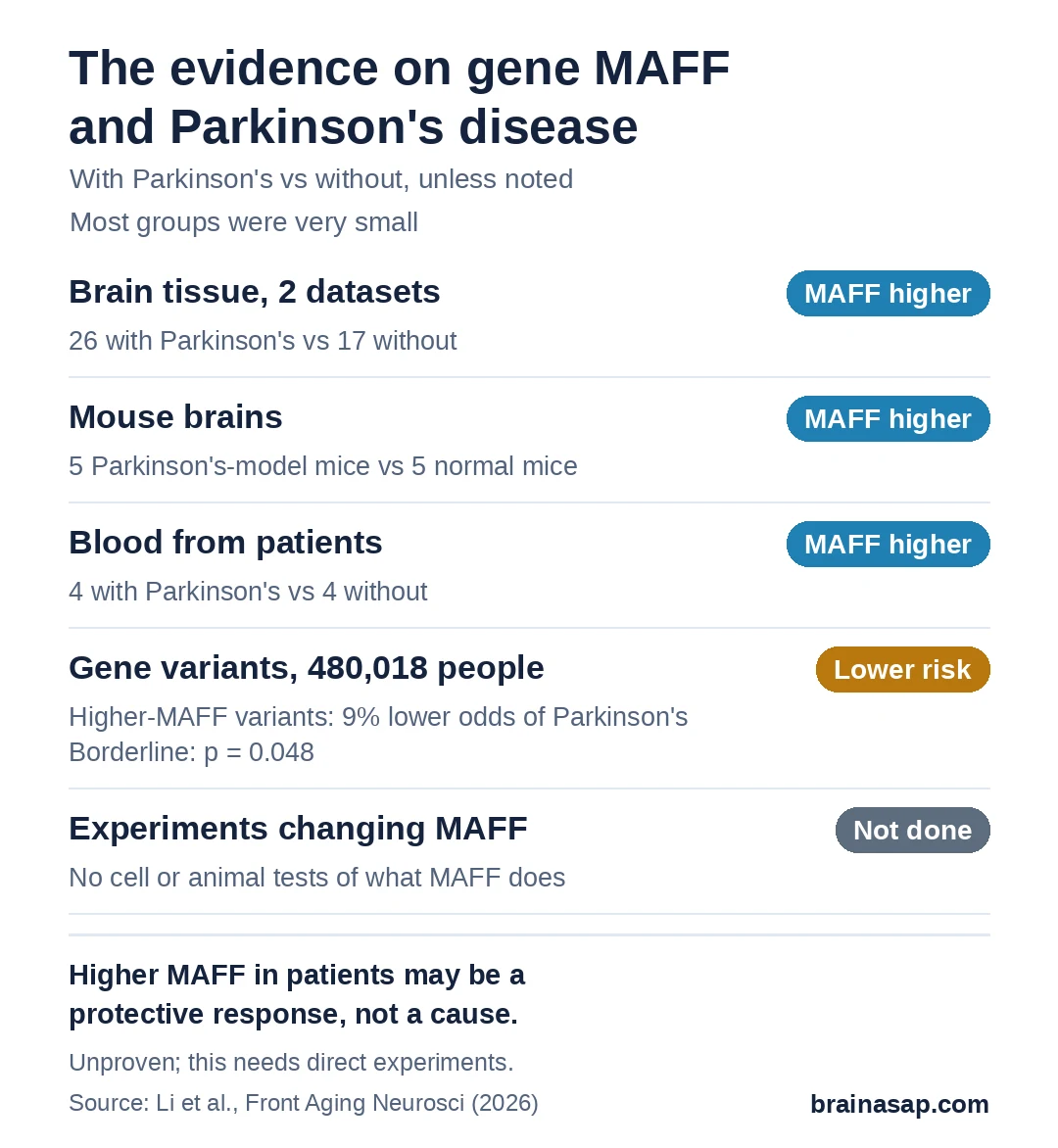
- More active in Parkinson’s brain tissue: MAFF activity was higher in brain samples from 26 people who had Parkinson’s than from 17 people without it, in 2 public datasets.
- Same pattern in tiny lab checks: MAFF was also higher in 5 Parkinson’s-model mice vs 5 normal mice, and in blood from 4 patients vs 4 people without Parkinson’s.
- Genetic link to lower risk: among about 480,000 people of European ancestry, gene variants that raise MAFF activity were linked to about 9% lower odds of Parkinson’s.
- That link was borderline: its p-value was 0.048, just under the usual 0.05 threshold for statistical significance.
- Not tested directly: no experiment raised or lowered MAFF to see what it does in cells or animals.
Source: Frontiers in Aging Neuroscience (2026) | Li et al.
When a gene is more active in people with a disease, it’s tempting to think the gene is part of the problem. But it might be the body’s attempt to fight back.
A 2026 study in Frontiers in Aging Neuroscience, by neurologists at the First Hospital of Shanxi Medical University in China, ran into exactly that puzzle with a gene called MAFF and Parkinson’s disease.
What Is MAFF?
MAFF makes a protein that helps switch other genes on or off. It does this by pairing with partner proteins, including one called Nrf2 that turns on the cell’s defenses against oxidative stress, a kind of chemical wear and tear that damages cells.
Oxidative stress is thought to help kill the dopamine-making nerve cells that die in Parkinson’s. That made MAFF a reasonable gene to look at.
MAFF Was More Active in Parkinson’s Brain Tissue
Li and colleagues first reused 2 public datasets of brain tissue from the substantia nigra, the area where Parkinson’s kills dopamine cells. All samples came from donors after death:
- Dataset 1: 16 people who had Parkinson’s, 9 who didn’t
- Dataset 2: 10 people who had Parkinson’s, 8 who didn’t
In both, MAFF was more active in tissue from people who had Parkinson’s.
Researchers also checked how well MAFF levels alone sorted samples into Parkinson’s and non-Parkinson’s groups. On a scale where 0.5 is a coin flip and 1.0 is perfect sorting, MAFF scored 0.74 in the first dataset and 0.84 in the second. That’s fair to good, but in very small groups.
Small Lab Checks Pointed the Same Way
The team then measured MAFF in new samples:
- Mice: MAFF activity was higher in the brains of 5 mice bred to carry a human Parkinson’s gene change than in 5 normal mice.
- People: MAFF protein was higher in blood from 4 patients with Parkinson’s than from 4 people without it, all from the same hospital.
A separate gene-activity check in whole blood also found higher MAFF in 10 patients vs 10 controls. With 4 or 5 per group in the mouse and protein checks, a single unusual sample could swing the result, so these checks support the pattern without confirming it.
Why a Genetic Link to Lower Risk Matters
Higher MAFF in patients can’t tell us whether MAFF helps or harms, because Parkinson’s itself, or its medicines, might raise it.
To get around that, the team used a method called Mendelian randomization. It uses gene variants people are born with as a natural experiment: if variants that raise MAFF activity also change Parkinson’s risk, MAFF may be on the causal path.
Data came from a large genetic database of 480,018 people of European ancestry, including 2,638 with Parkinson’s. People whose variants pushed MAFF activity up had about 9% lower odds of Parkinson’s.
That points the opposite way from “MAFF causes harm.” Li and colleagues suggested that higher MAFF in patients may be a protective response, not a cause.
But the genetic result was borderline. Its p-value was 0.048, just under the 0.05 cutoff, and the range of likely effects stretched from about 18% lower odds to almost no difference.
Other Findings Came From Computer Analyses
- Blood vessel cells: in a dataset of single brain cells from 6 people with Parkinson’s and 10 without, MAFF was most active in 2 kinds of cells that line and wrap blood vessels.
- Inflammation pathway: genes that rise and fall with MAFF included a signaling pathway involved in inflammation.
- A possible drug match: in a computer model, a chemical called diphenylcyclopropenone fit onto the MAFF protein. It was not tested in cells, animals or people.
Where the Evidence Falls Short
- Tiny groups: 26 vs 17 brain samples, 5 vs 5 mice and 4 vs 4 blood samples.
- Borderline genetic result: p = 0.048 in one database of European ancestry, with no repeat in a second group.
- No direct test: the team did not raise or lower MAFF in cells or animals, which they named as a limitation.
- Possible data label error: one Methods sentence names a lung cancer dataset for the immune-cell analysis, which may be a typo.
Is MAFF Protecting Brain Cells or Just Along for the Ride?
What’s needed next is the experiment this study didn’t do: raise or lower MAFF in nerve cells or Parkinson’s-model mice and see whether dopamine cells survive better or worse.
Until then, MAFF is a lead worth checking, not a proven protector or a blood test for Parkinson’s.
Citation: DOI: 10.3389/fnagi.2026.1759121. Li X, Wang Q, Min G, Yuan X, Tian Y. MAFF as a potential novel protective factor against Parkinson’s disease: evidence from Mendelian randomization and single-cell RNA sequencing. Front Aging Neurosci. 2026;18:1759121.
Study Design: Bioinformatic analysis of public brain transcriptome and single-cell datasets, two-sample Mendelian randomization, plus RT-qPCR in mice and human whole blood, and serum ELISA in patients.
Sample Size: 26 Parkinson’s vs 17 control brain samples; 6 vs 10 single-cell samples; GWAS of 480,018 (2,638 cases); 5 vs 5 mice; 10 vs 10 whole-blood samples for gene activity; 4 vs 4 serum samples for protein.
Key Statistic: Genetically higher MAFF expression and Parkinson’s: OR 0.91 (95% CI 0.82–1.00), p = 0.048.
Caveat: Very small validation samples; borderline MR result; no functional experiments.