TL;DR: Mice kept under long-term stress began showing anxious and depression-like behavior on lab tests, a common animal model of depression. Mangiferin, a natural compound found in mango plants, reduced those behaviors and protected brain connections in a memory-and-mood region.
That benefit depended on star-shaped support cells called astrocytes: reducing a protective protein called Nrf2 in those cells removed the antidepressant-like effect reported in the mouse tests.
Key Findings
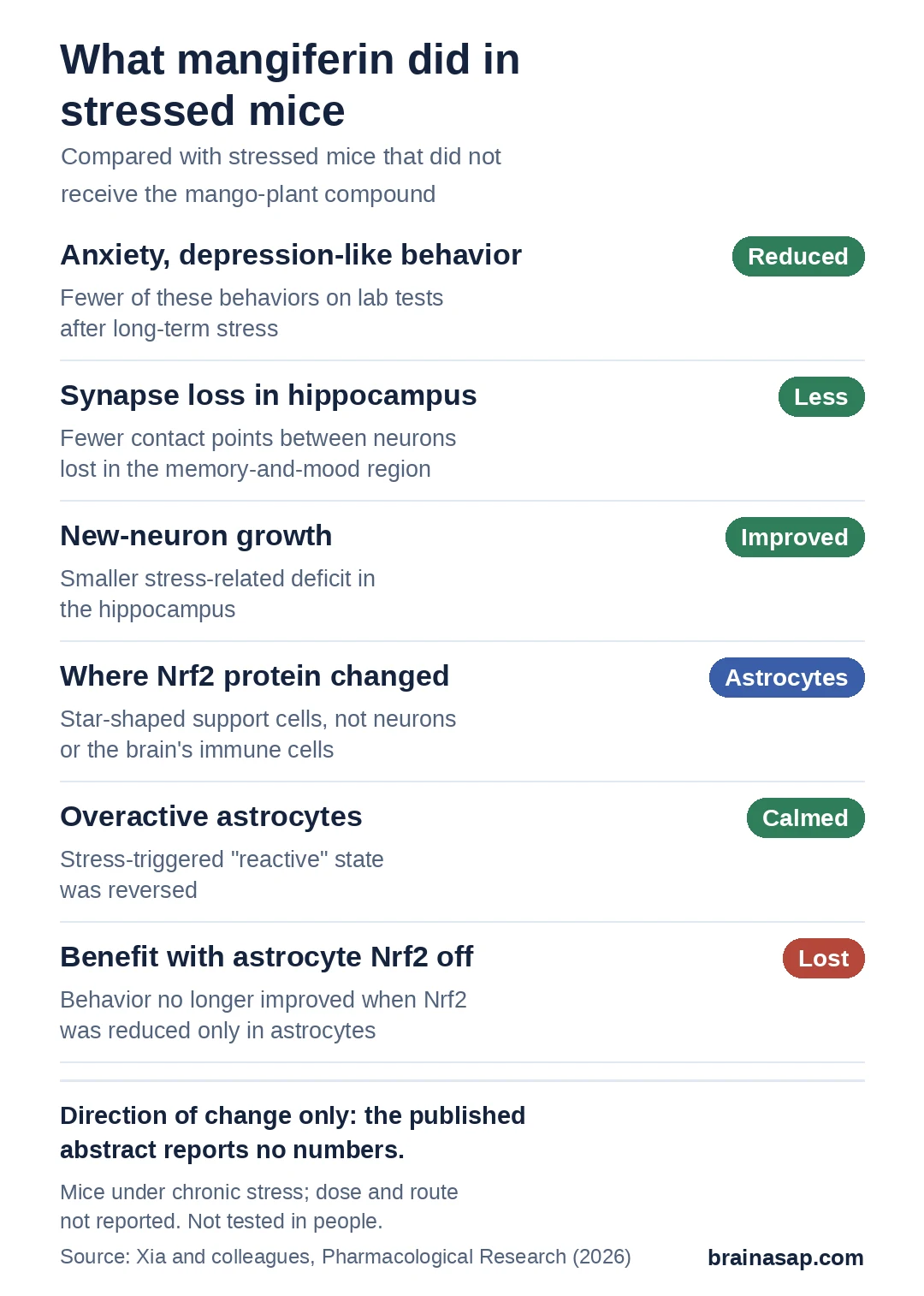
- Less anxiety- and depression-like behavior: stressed mice given mangiferin showed fewer of these behaviors than stressed mice without it.
- Brain connections and new neurons protected: in the hippocampus, mangiferin-treated mice lost fewer synapses, the contact points between neurons, and kept more of their usual new-neuron growth.
- Astrocytes, not neurons, showed the change: a protective protein called Nrf2 shifted mainly in astrocytes, not in neurons or the brain's immune cells.
- Reducing Nrf2 changed the result: when Nrf2 was reduced in astrocytes, the antidepressant-like effect was lost.
- Size of effects unknown: the published summary gives no group sizes, doses or numbers.
Source: Pharmacological Research (2026) | Zhi-Xuan Xia, Zu-Cheng Shen and colleagues
Most antidepressants are designed around neurons and the chemical messengers they pass, such as serotonin.
A 2026 study in Pharmacological Research points somewhere else: at astrocytes, the star-shaped cells that support neurons, and at a plant compound that seemed to work through them in stressed mice.
What Is Mangiferin?
Mangiferin is a natural compound found in the leaves, bark and fruit peel of the mango tree, as well as in some other medicinal plants. It has been studied mostly for its antioxidant effects.
Earlier research had suggested that it eases anxiety- and depression-like behavior after chronic stress. How it might do that was unclear, which is the question Xia, Shen and colleagues set out to answer.
How Do You Study Depression in Mice?
Mice cannot report their mood. Studies like this look at behavior in laboratory tests under chronic stress. The results are described as anxiety- or depression-like behavior.
In this study, stressed mice given mangiferin showed fewer of those behaviors than stressed mice that did not get it. This study's published summary does not name the specific tests, the dose or how long treatment lasted.
Protecting the Brain's Memory-and-Mood Hub
Inside the brain, the team looked at the hippocampus, a region involved in memory and mood.
Chronic stress cost the mice synapses, the contact points where neurons pass signals, and slowed the hippocampus's ongoing production of new neurons. Mice given mangiferin lost fewer synapses and had smaller deficits in new-neuron growth.
Why Astrocytes Took Center Stage
Nrf2 is a protein that acts as a master switch for a cell's defenses against chemical damage. After stress and mangiferin treatment, Nrf2 levels shifted mainly in hippocampal astrocytes, not in neurons or in microglia, the brain's resident immune cells.
To test whether that mattered, the researchers reduced Nrf2 only in astrocytes. The antidepressant-like effect reported in the mouse tests disappeared. This finding supports a role for Nrf2 in astrocytes.
Astrocytes can change their activity in response to stress. The abstract reports that mangiferin reduced the signs of this reactive state.
A Fatty Tag That Keeps a Protein Alive
Digging further, the team found that mangiferin acted through DHHC2, an enzyme that attaches a small fatty-acid tag to other proteins.
When Nrf2 carried that tag, it moved more readily into the cell's nucleus, where it switches on protective genes. Tagging also shielded Nrf2 from Keap1, a partner protein that normally marks Nrf2 for destruction. With Nrf2 lasting longer, reactive astrocytes kept their defenses switched on.
What This Does Not Show
- Mice, not people: behavior tests in stressed mice capture parts of depression, not the human illness, and nothing here was tested in patients
- Not about eating mangoes: the summary does not give the dose or how it was given, and a purified compound in mice says nothing about mango fruit or supplements
- No numbers available: only the published abstract was reviewed, so how large any difference was, and how many mice were tested, cannot be judged
- One pathway among possibly many: showing that blocking astrocyte Nrf2 removes the benefit does not rule out other effects of mangiferin
The Question for the Next Study
The more lasting idea here may be the target rather than the compound. If the support cells around neurons can be pushed back to a healthier state, that opens a different route for depression treatment than the neuron-focused drugs in use today.
Whether mangiferin, or any drug acting on astrocyte Nrf2, can do that safely in people at a realistic dose is the question this study leaves open.
Citation: DOI: 10.1016/j.phrs.2026.109734. Xia ZX, Zhao YL, Tian D, Zhang XT, Wang SY, Cao HY, Ding QQ, Zheng L, Zheng HP, Du GK, Zhang Y, Cao T, Tao WC, Chen Z, Luo YX, Shen ZC. Mangiferin Buffers Depressive-Like Behaviors by Modulating Astrocytic DHHC2 in the Hippocampus. Pharmacological Research 2026;109734. Published online November 7, 2026.
Study Design: Preclinical laboratory study in mice exposed to chronic stress. Behavioral testing for anxiety- and depressive-like behavior; hippocampal synapse and neurogenesis measures; cell-type-specific Nrf2 expression in astrocytes, neurons and microglia; astrocyte-specific Nrf2 knockdown; mechanistic study of DHHC2-mediated Nrf2 palmitoylation, nuclear translocation and Keap1-mediated ubiquitination and proteasomal degradation.
Sample Size: Not reported in the available abstract.
Key Statistic: None published in the abstract. Reported directions: mangiferin alleviated anxiety- and depressive-like behaviors in chronically stressed mice, reduced synaptic loss, ameliorated hippocampal neurogenesis deficits and reversed reactive astrogliosis; astrocytic Nrf2 knockdown abrogated its antidepressant-like effect.
Caveat: Only the published abstract of this peer-reviewed article was available for this write-up, so no group sizes, doses, routes, behavioral tests or effect sizes could be checked and the size of every difference is unknown. All findings come from mice under chronic stress; none test mangiferin, mango products or supplements in people, and nothing here supports using mangiferin to treat depression or anxiety.