TL;DR: A 2026 study in the Barcelona area asked 165 teens aged 12 to 16 how often their mother and father talked things through with them, how often they struggled with everyday thinking skills such as switching between tasks, and about their anxiety and depression symptoms.
Teens who felt their parents, especially their fathers, communicated more reported fewer anxiety and depression symptoms. Much of that link went along with fewer self-reported thinking struggles, but a one-time survey cannot show cause.
Key Findings
- More parent talk, fewer symptoms: After accounting for age, sex and school, teens who reported more communication with their father or mother had fewer anxiety and depression symptoms.
- Fathers stood out: Father communication and father neglect each had a clear link with symptoms; for mothers, only communication did, and only just.
- Thinking struggles in between: Teens' reports of trouble shifting between tasks or thoughts (correlation of 0.58 with symptoms) accounted for much of the parent link.
- School setting: Teens at schools serving poorer, more vulnerable neighborhoods had somewhat more symptoms and reported less parent communication.
- About 1 in 5 of the 163 teens with valid symptom T-scores scored in the elevated range.
Source: Depression and Anxiety (2026) | Carballo-Márquez et al.
Parents often wonder whether their everyday conversations with a teenager make any difference. A small Spanish study suggests they may, and points to a possible route: teens' everyday thinking skills.
This research, published in 2026 in Depression and Anxiety by Anna Carballo-Márquez, Bruno Porras-Garcia and colleagues at the International University of Catalonia, looked at how parenting style, thinking skills and mood fit together in early adolescence.
Who Took Part?
Between 2024 and 2026, researchers visited 5 secondary schools in the Barcelona metropolitan area. Of 285 students approached, 165 took part, with parent consent.
- Age: 12 to 16, average about 13
- Boys and girls: roughly half each
- Lower-vulnerability schools: 119 teens at schools with stable, mostly well-resourced families
- Higher-vulnerability schools: 46 teens at schools serving many low-income, unemployed or newly arrived immigrant families
What Did Teens Report?
Each teen filled in 3 paper questionnaires during a school visit:
- Parenting style: how often each parent talked and listened (communication), was harsh or rejecting (hostility), or showed little interest (neglect)
- Everyday thinking skills: how often they had trouble controlling impulses, keeping information in mind, or shifting flexibly between tasks or ideas
- Anxiety and depression: a 47-item questionnaire covering worry, fears, panic, obsessive thoughts and low mood
How Did Parenting and Thinking Skills Line Up With Symptoms?
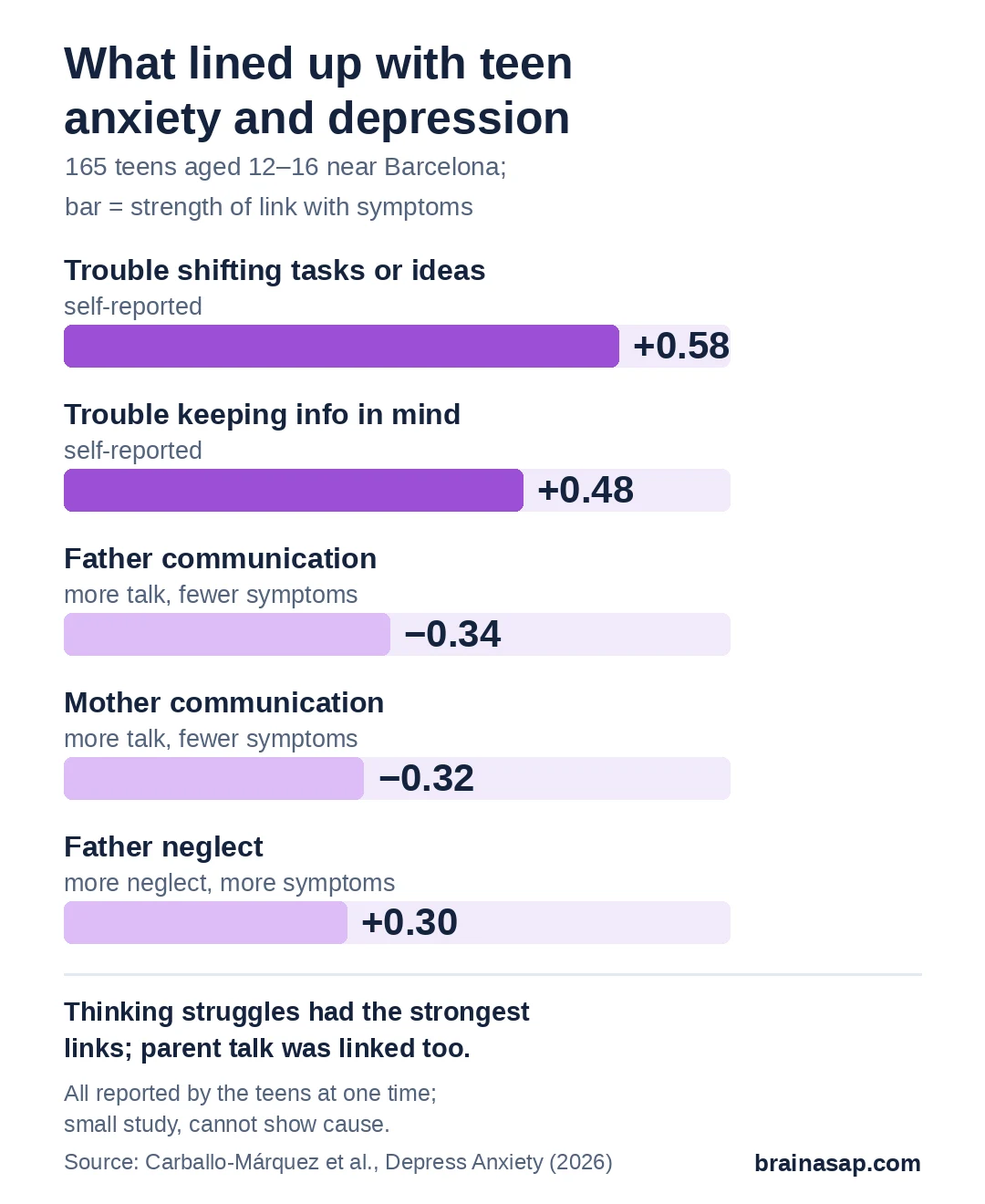
Self-reported thinking struggles had the strongest links with symptoms, especially trouble shifting between tasks or ideas.
In models that accounted for age, sex and type of school:
- Father communication: more talk, fewer symptoms (clear link)
- Father neglect: more neglect, more symptoms (clear link)
- Mother communication: more talk, fewer symptoms (just reached significance)
- Hostility from either parent: no independent link
Next, the team checked whether thinking struggles sat between parenting and symptoms. For all 3 parenting links above, the direct link faded once thinking struggles were added. Trouble with flexible thinking carried the clearest share each time.
Did the School Setting Matter?
Teens at higher-vulnerability schools scored higher for anxiety and depression symptoms (average 57 vs 53, on a scale where 50 is typical for their age and 65 or more is elevated). They also reported less communication with both parents.
Their self-reported thinking struggles, though, were about the same as at other schools.
What Limits These Findings?
- Small and local: 165 teens from 5 schools near Barcelona, with only 46 in higher-vulnerability schools.
- One moment in time: Anxious or low teens may see their parents and their own thinking more negatively, rather than the other way round.
- All from teens: Parenting, thinking skills and symptoms all came from the same teen's answers, which can inflate links; thinking skills were not measured with tests.
- Shaky neglect measure: The neglect questions were not very consistent with each other, so neglect results need extra caution.
- Exploratory: No sample size was planned for these analyses, and family income was not recorded.
Could Thinking-Skills Training Help Teens Under Strain?
Carballo-Márquez and colleagues suggested that schools, especially in vulnerable areas, could train teens' thinking skills as a way to protect mental health. Their wider project is testing a virtual-reality training program.
Whether that training, or more talk at home, actually lowers anxiety and depression symptoms is the question those follow-up results will need to answer.
Citation: DOI: 10.1155/da/1162692 Carballo-Márquez A, Garcia-Casanovas A, Porras-Garcia B, Ampatzoglou A, Fernández-Capo M, Rojas-Rincón J, Gámiz-Sanfeliu M, Fernández-Cardellach C, Garolera M. Mediational Role of Executive Functions on Parental Style and Anxiety and Depression Symptoms in Adolescents From Different Vulnerability Environments: A Cross-Sectional Study. Depression and Anxiety. 2026;2026:1162692.
Study Design: Cross-sectional baseline analysis of the E-Emotio project; CRPBI-A parenting styles, BRIEF-2 self-report (inhibition, working memory, flexibility), RCADS total internalizing T-score; hierarchical regression and PROCESS Model 4 parallel mediation adjusted for age, sex and school vulnerability.
Sample Size: 165 adolescents aged 12–16 from 5 schools in the Barcelona metropolitan area (119 low-, 46 high-vulnerability).
Key Statistic: Adjusted β: paternal communication −0.27 (p = 0.001); paternal neglect 0.28 (p = 0.009); maternal communication −0.16 (p = 0.047). Spearman r with RCADS: flexibility 0.583, working memory 0.482, paternal communication −0.342, maternal communication −0.315. RCADS T 57.4 vs 53.3 (p = 0.034); 19.6% T ≥ 65.
Caveat: Small exploratory sample; cross-sectional; single-informant self-report; low reliability of neglect scale; clustering within 5 schools; no SES detail.