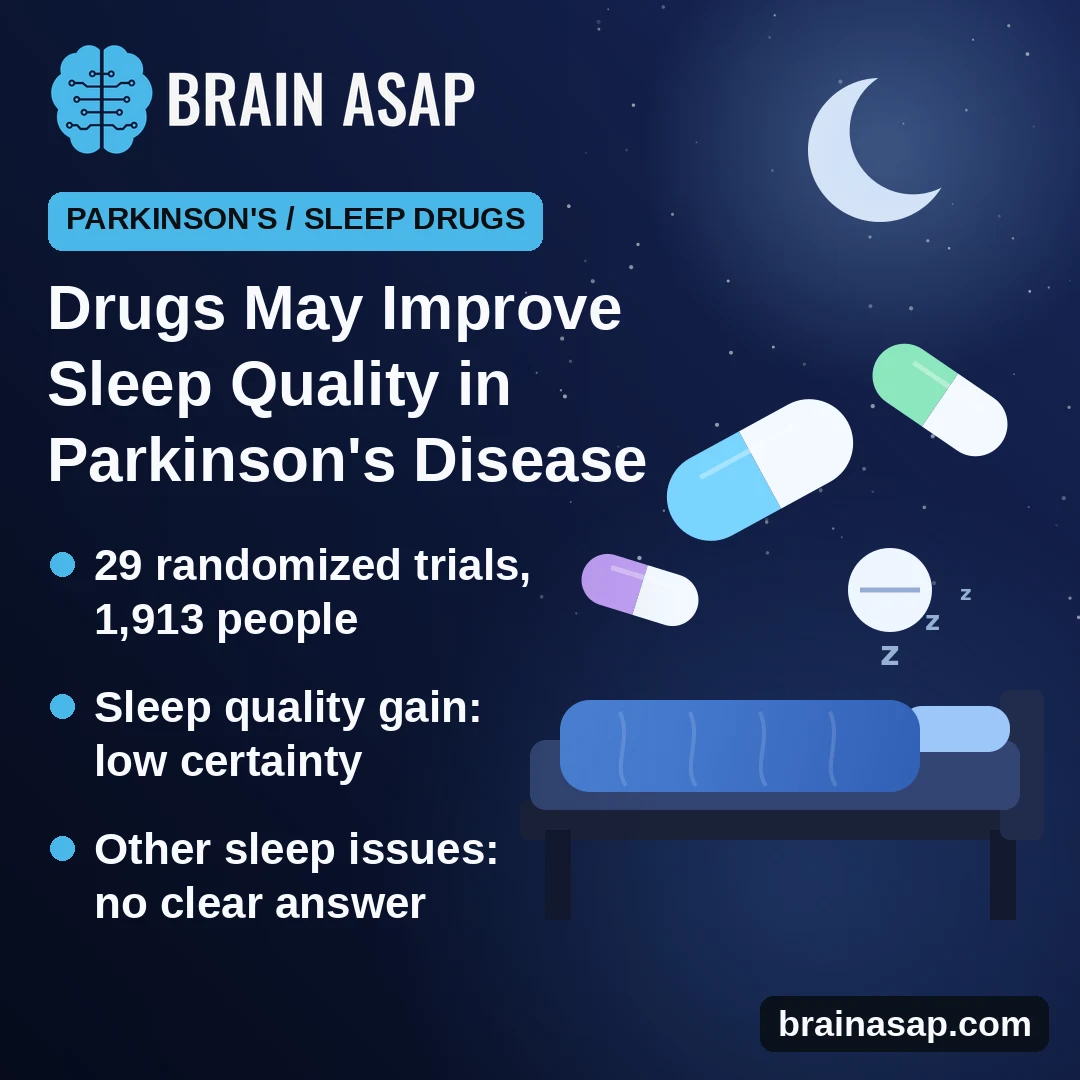
TL;DR: Pooling 29 trials of 1,913 people with Parkinson’s disease, the researchers found sleep drugs improved overall sleep quality by 2.66 points on a questionnaire compared with placebo. The evidence was low certainty, and other sleep problems showed unclear results.
Key Findings
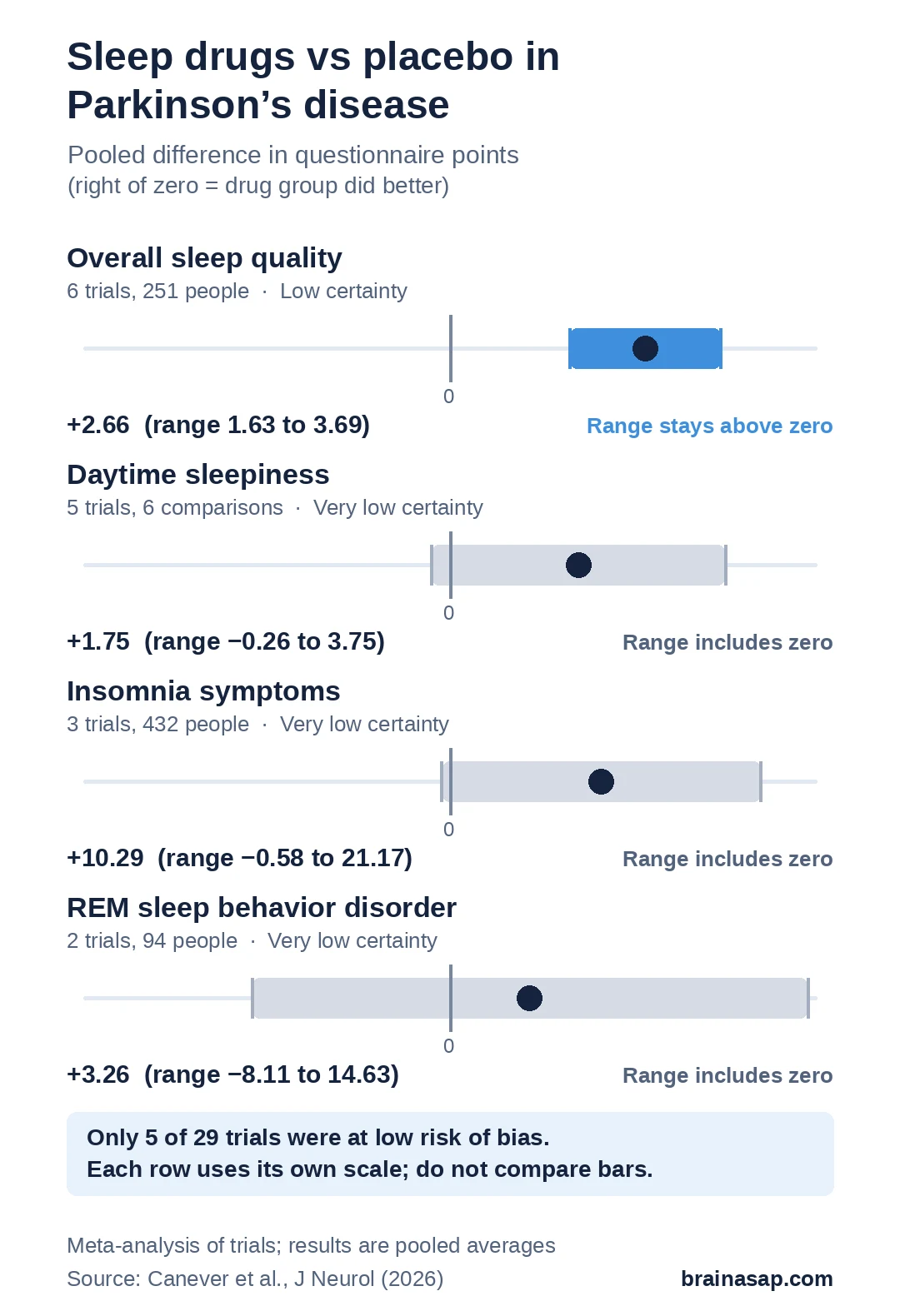
- Sleep quality better (low certainty): Across 6 trials (251 people), drug groups scored 2.66 points better than placebo groups on the Pittsburgh Sleep Quality Index (95% CI 1.63 to 3.69). All 6 trials pointed the same way.
- Daytime sleepiness unclear: Pooled result leaned toward benefit (1.75 points) but could not rule out no effect (95% CI −0.26 to 3.75).
- Insomnia and REM sleep behavior disorder not reliably pooled: Trials disagreed too much; authors call results exploratory only.
- Weak evidence: Certainty low for sleep quality, very low for the other three; only 5 of 29 trials had low risk of bias.
- No surprise safety signals, with limits: Trials lasted 2 to 24 weeks; side effect reporting too uneven to pool.
Source: Journal of Neurology (2026) | Canever et al.
Which drugs help people with Parkinson’s sleep better? After pooling 29 trials, one answer holds up, if only loosely: overall sleep quality scored 2.66 points better on a drug than on placebo. For daytime sleepiness, insomnia, and acting out dreams, the trials could not give a clear answer.
Ask people with Parkinson’s what else besides tremor and stiffness makes life hard, and sleep comes up again and again. Some can’t sleep, some can’t stay awake by day, and some act out vivid dreams at night. Doctors have many drugs to try, from melatonin to wake-promoting medicines, but it has been hard to say what actually works.
What the Review Pooled
A team from the Federal University of Santa Catarina in Brazil searched six research databases for randomized controlled trials of any drug used to treat sleep problems in adults with Parkinson’s. The researchers found 29 trials published between 2002 and 2025, with 1,913 participants in total. Treatment lasted from 2 to 24 weeks.
The trials covered a wide mix of medicines: melatonin, wake-promoting drugs such as modafinil, dopamine-type drugs such as rotigotine and ropinirole, and several single-trial drugs including cannabidiol and clonazepam. Ten trials focused on daytime sleepiness, seven on REM sleep behavior disorder, two on insomnia, and ten on overall sleep quality.
Where trials used the same questionnaire, the team pooled them into one average. This is a meta-analysis, and here it compares people who took a drug (the “drug group”) with people who took a placebo (the “placebo group”). The reported number is a difference in questionnaire points, arranged so a positive number always means better.
Sleep Quality: 2.66 Points Better, All 6 Trials Agreed
Six trials measured sleep quality with the Pittsburgh Sleep Quality Index (PSQI), a questionnaire where a lower score means better sleep. They tested melatonin (4 trials), modafinil (1), and a rotigotine skin patch (1).
Together, the drug groups came out 2.66 points better than the placebo groups (95% CI 1.63 to 3.69). Every one of the six trials leaned the same way, with individual results from 1.40 to 4.29 points. Dropping any single trial left the answer intact, with the range staying between 2.20 and 3.11.
Within that, melatonin looked consistent: the four melatonin trials together gave a 2.20-point gain. The biggest single-trial gain, 4.29 points, came from the rotigotine patch. The authors warn that rotigotine is mainly a movement drug, so part of that gain may come from easier nights (less stiffness, easier turning over in bed) rather than a direct sleep effect.
Sleepiness, Insomnia, and Dream-Acting Results Were Unclear
Daytime Sleepiness
Five trials (six comparisons) measured sleepiness with the Epworth Sleepiness Scale, where a lower score is better. They tested modafinil, methylphenidate, melatonin, and piribedil. The pooled gain was 1.75 points, but the range (−0.26 to 3.75) included zero, so this can’t be called a real effect.
Most of the disagreement came from one small crossover trial from 2002, in which each person tried both drug and placebo in turn. It was the only comparison that favored placebo (by 2.59 points), and the authors suspect leftover drug effect carried into the second period. Take that one trial out and the pooled gain becomes a statistically significant 2.51 points. That is why the authors treat the whole result as fragile.
Two single-trial results (piribedil, a dopamine-type drug, and melatonin) did show gains of 1.70 and 1.50 points. With one trial each, they are leads, not proof. Trials longer than 4 weeks also looked better than shorter ones, but that rests on very few trials and the authors say it should not guide treatment.
Insomnia and REM Sleep Behavior Disorder
REM sleep behavior disorder (RBD) is a condition where people physically act out dreams because the usual muscle paralysis of REM sleep fails.
For insomnia symptoms, three trials each tested a different drug and their results varied hugely (gains of 9.90, 19.53, and 1.50 points on the Parkinson’s Disease Sleep Scale). The pooled gain of 10.29 points (95% CI −0.58 to 21.17) included zero, and it became statistically significant only when one particular trial was removed.
For RBD, two trials (zonisamide and safinamide) went in opposite directions: zonisamide was linked to a statistically significant worsening, safinamide to a large improvement. Averaging them (3.26 points, 95% CI −8.11 to 14.63) says almost nothing. The RBD analysis also relied on a general Parkinson’s sleep scale rather than an RBD-specific one, and neither trial used the standard diagnostic criteria for RBD.
Side Effects Could Not Be Pooled
The team did not pool side effects because trials counted them so differently. Melatonin trials reported side effects in anywhere from 0% to 88.6% of participants. The highest rates in single trials were for dopamine-type drugs: 74.3% for prolonged-release ropinirole and 62.9% for rotigotine. Quitting because of side effects was generally uncommon, with cannabidiol highest at 15.0%. The authors found no unexpected safety problem, but they say this reassurance does not extend to long-term use.
Limits of the Evidence
- Weak trials: Only 5 of 29 (17.2%) had low risk of bias; 18 had some concerns and 6 high risk. Randomization details and missing data were the most common problems.
- Mixed bag: Pooled numbers blend different drugs, doses, disease stages, and questionnaires. Even the sleep-quality result is only low certainty.
- Small numbers: Most results rest on 2 to 6 trials; a few single trials drive several subgroup findings.
- Short follow-up: Trials ran 2 to 24 weeks; long-term benefit and safety unknown.
- Points are not nights of sleep: A 2.66-point gain is described as close to a meaningful difference in similar groups, but does not say how much better any one person will sleep.
- Analysis choices: Authors used their own software and estimated some missing values; they say they checked other assumptions, but the paper does not show those results. Publication bias could not be formally tested.
Better Trials of Sleep Drugs in Parkinson’s Disease Are Needed
This is not a recommendation for any one drug, and it should not push anyone to start a sleep medicine on their own. Parkinson’s treatment is individual, and several of these drugs, especially the dopamine-type ones, come with real side effects.
What the review does show is where the evidence is thin. There is a modest but consistent sign, on low-certainty evidence, that drug treatment (melatonin in particular) may improve overall sleep quality. For daytime sleepiness, insomnia, and RBD, doctors are still working without solid answers from trials. The authors call for trials that target one specific sleep problem, use the same measures, and report side effects the same way.
Citation: DOI: 10.1007/s00415-026-14158-5. Canever JB, Cechinel da Silva L, Apio FS, Cimarosti HI. Pharmacological treatment of sleep disorder phenotypes in Parkinson’s disease: a systematic review and meta-analysis of randomised controlled trials. Journal of Neurology. 2026;273:618.
Study Design: Systematic review and meta-analysis of randomized controlled trials (six databases; protocol registered in PROSPERO CRD420261412614); random-effects pooling; Cochrane RoB 2 risk-of-bias ratings; GRADE certainty ratings.
Sample Size: 29 randomized trials, 1,913 participants with Parkinson’s disease (2002 to 2025).
Key Statistic: Overall sleep quality (PSQI, 6 trials, 251 participants): mean difference 2.66 points in favor of drug treatment (95% CI 1.63 to 3.69; I² = 71%; low certainty).
Caveat: Only 17.2% of trials were at low risk of bias; pooled results for daytime sleepiness, insomnia symptoms, and REM sleep behavior disorder were non-significant with very high heterogeneity (I² 91% to 99%) and rated very low certainty; different drugs and scales were combined; safety data were not pooled; trials lasted 2 to 24 weeks.