TL;DR: In a 2026 online survey of 242 people from aging-service organizations across 42 states in the United States, nearly all said they would consider offering a depression program for older adults run by trained non-specialists. Most said they would need money, dedicated staff and training to make it happen.
Key Findings
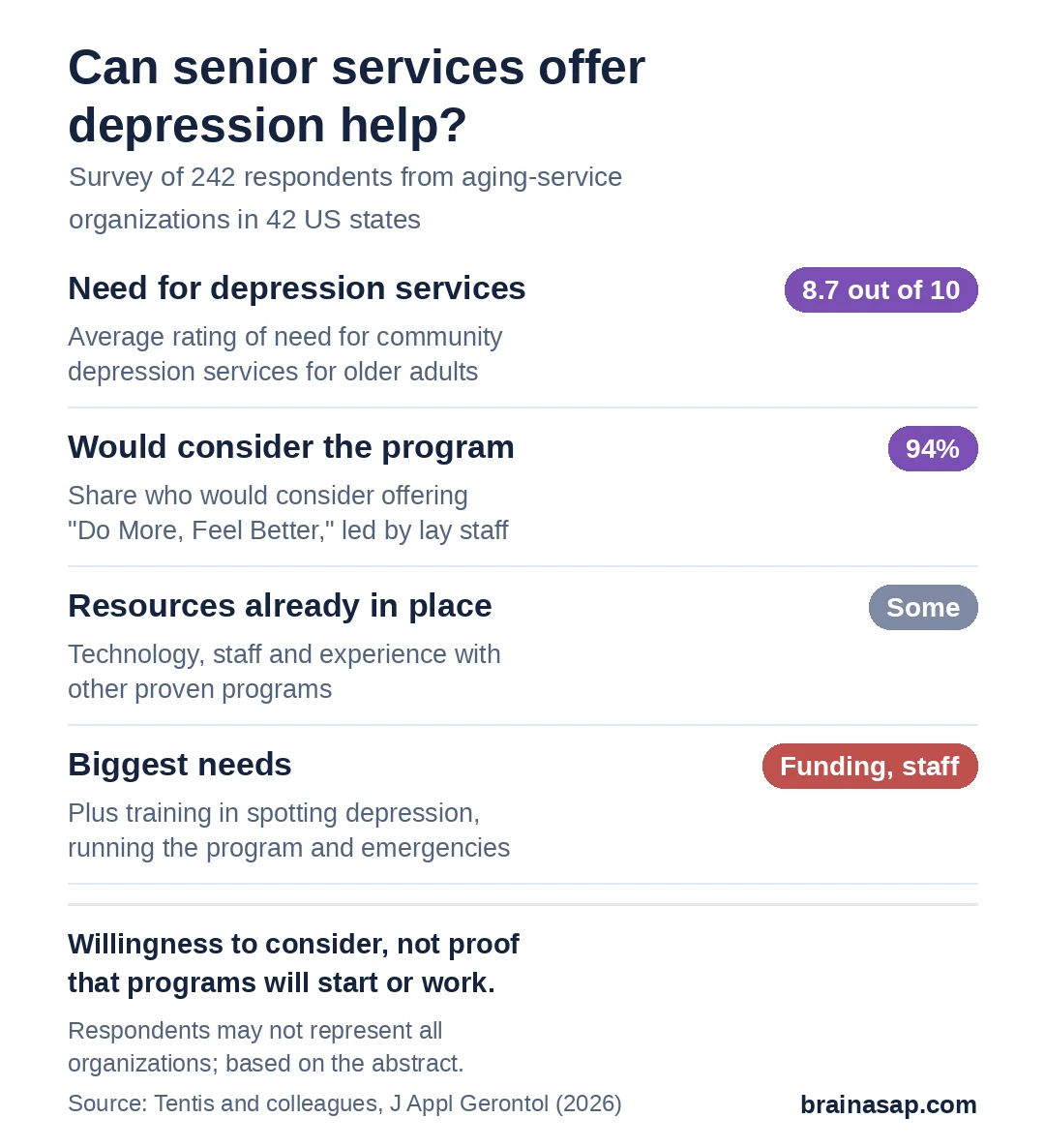
- Strong sense of need: Respondents rated the need for community depression services for older adults at 8.7 out of 10 on average.
- Broad interest: 94% said their organization would consider offering the program, called "Do More, Feel Better."
- Some groundwork in place: Most already had some useful resources, such as technology, staff and experience running other proven programs.
- Biggest gaps: Funding, dedicated staff, and training in spotting depression, running the program and handling emergencies.
Source: Journal of Applied Gerontology (2026) | Tentis, Gum and colleagues
Could the community organizations that already serve older adults help more people get support for depression? A national survey asked what it would take to offer a specific program.
Asking Aging-Service Organizations Across the US
A 2026 study in the Journal of Applied Gerontology, led by Sierra Tentis and Amber Gum of the University of South Florida with colleagues at the University of Washington and Weill Cornell, surveyed people at community organizations that serve older adults.
At the center of the survey was a depression program called "Do More, Feel Better." It is designed to be led by trained lay staff, meaning people without professional mental health credentials, rather than therapists.
An online survey, sent by email, asked organizations about:
- How much their communities need depression services
- Whether they would consider offering the program
- What resources they already have
- What resources they would still need
In all, 242 people from organizations in 42 states responded.
Nearly All Would Consider the Program
Respondents saw a clear gap. On a 10-point scale, they rated the need for community-based depression services at 8.7 on average.
Interest was just as high: 94% said they would consider offering "Do More, Feel Better."
Funding, Staff and Training Top the Wish List
Most respondents said their organization already had some building blocks, such as:
- Technology
- Staff
- Experience running other evidence-based programs
Still, most said they lacked key pieces specific to this program. Their most critical needs were:
- Funding
- Dedicated personnel whose job includes the program
- Training in recognizing depression, delivering the program and handling emergencies, such as a client in crisis
Interest Isn't the Same as Action
- Considering isn't doing: saying they would consider the program doesn't mean organizations will run it
- Self-selected responses: organizations interested in mental health may have been more likely to answer, so the results may not represent all aging services
- Opinions, not outcomes: the survey did not test whether the program helps older adults' depression
- Abstract only: this article is based on the published abstract, which does not give a response rate or a breakdown by type of organization
Turning Interest Into Programs
Respondents were open to considering the program and said they would need funding, staff and training to offer it.
A next question is whether providing those resources leads organizations to actually launch the program, and whether older adults who take part feel better as a result.
Citation: DOI: 10.1177/07334648261506403. Tentis S, Griffith Fillipo IR, Raue PJ, Sirey JA, Steinman L, Wang M, Gum A. Aging Service Organizational Capacity to Deliver Evidence-Based Depression Programs: A National Survey. Journal of Applied Gerontology. Published online November 7, 2026. PMID: 42995728.
Study Design: National online survey distributed by email to aging service organizations.
Sample Size: 242 respondents across 42 US states.
Key Statistic: Perceived need for community-based depression services 8.7/10; 94% would consider implementing "Do More, Feel Better."
Caveat: Willingness to consider is not implementation or evidence of program effectiveness; respondents may not represent all aging-service organizations. This article relies on the PubMed abstract only.