TL;DR: In an online survey of 258 adults with Tourette syndrome, people who recalled worse tics as children also tended to recall worse tics as adults, and so did those with obsessive-compulsive disorder. About 6 in 10 said a major life event was happening when their adult tics were at their worst.
Key Findings
- Childhood and adult tics were linked: Adults who recalled more severe and disruptive tics in childhood also reported more severe and disruptive tics at their adult worst.
- OCD: Having obsessive-compulsive disorder (OCD) was linked to worse adult tics.
- Life events: 153 of 258 (59%) reported a significant life event when their adult tics peaked; negative and neutral events were linked to worse tics, positive events were not.
Source: Frontiers in Psychiatry (2026) | Kaylor et al.
When a child is diagnosed with Tourette syndrome, one of the first questions families ask is: will the tics last into adulthood?
Many children see their tics fade in their teens, but some don't. Very little research has looked at what goes along with tics that stay severe in adults.
Adults Looked Back on Their Worst Tics
A 2026 study in Frontiers in Psychiatry, from a team at Massachusetts General Hospital led by A. Kaylor, surveyed 258 adults with Tourette syndrome. Tourette syndrome is a condition that starts in childhood and causes tics: sudden, repeated movements or sounds that are hard to hold back.
The study invited people who had participated in earlier Tourette genetics research. The online questionnaire asked about current tics and two recalled periods:
- Their worst-ever period in childhood
- Their worst-ever period in adulthood
For each, they rated how severe the tics were and how much the tics got in the way of daily life. They also answered questions about OCD and ADHD symptoms, medications and major life events.
Which Factors Went With Worse Adult Tics?
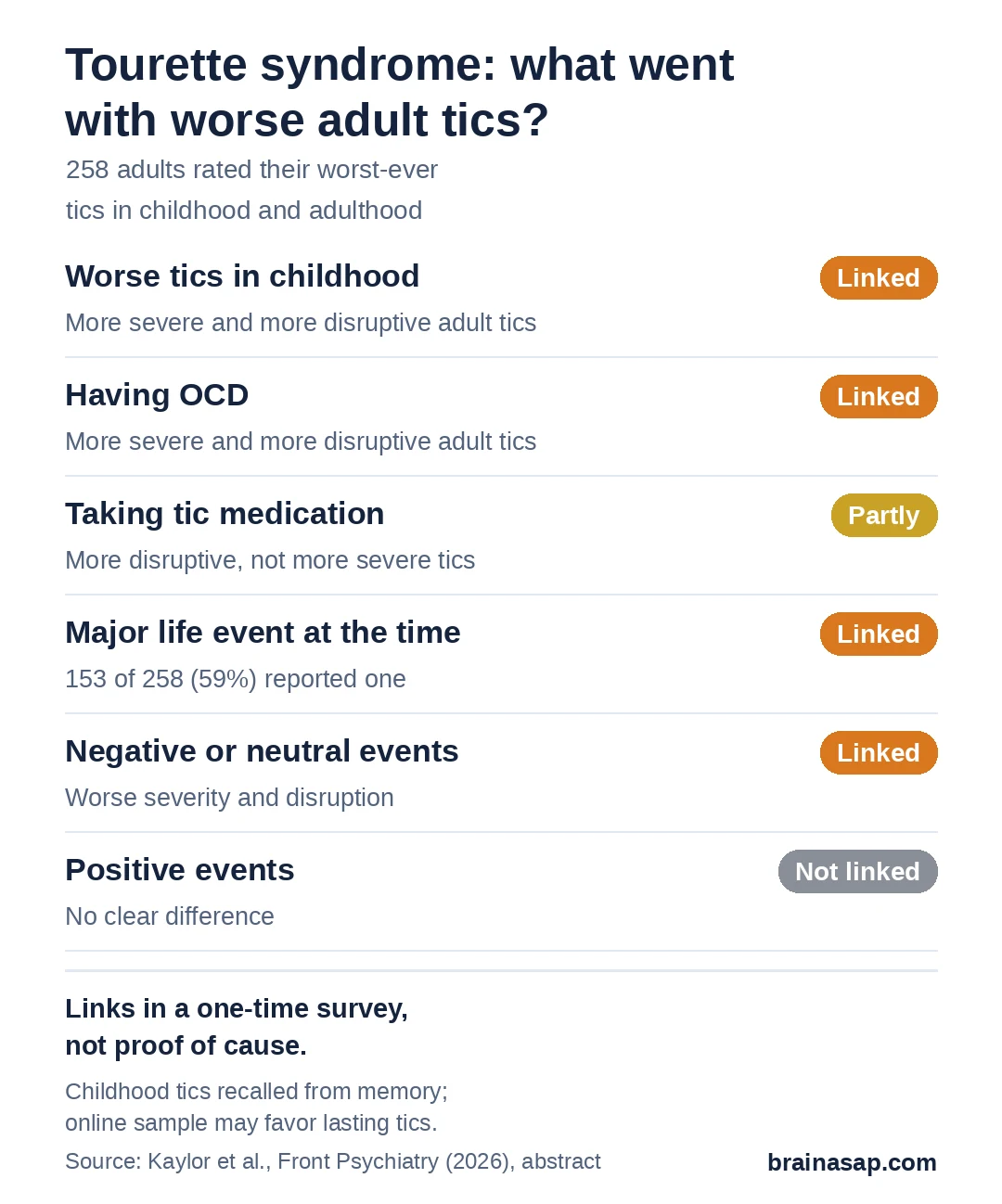
- Worse childhood tics: linked to both more severe and more disruptive adult tics
- OCD: linked to more severe adult tics. The link with disruption was weaker after accounting for other factors
- Tic medication: linked to more disruptive adult tics, but not more severe ones
One possible explanation is that people whose tics disrupt daily life are more likely to take medication. The study did not test whether medication changed their tics.
Did Life Events Play a Part?
Kaylor's team also asked whether something big was going on in participants' lives when their adult tics were at their worst. 153 of 258 (59%) said yes.
Compared with people who reported no major event at that time:
- Events the researchers coded as negative: linked to more severe and disruptive tics
- Events the researchers coded as neutral: also linked to more severe and disruptive tics
- Positive events: not clearly linked
Work, school, and romantic relationships were the most common topics in the reports. The study cannot tell whether a life event triggered the tics or how participants themselves would have classified the event.
Why Memories Can Mislead
- Looking back: Adults rated their childhood tics from memory, sometimes decades later
- Single snapshot: A one-time survey cannot show that childhood tics or OCD caused adult tics
- Selection: Adults with continuing symptoms may have been more likely to respond
- Who responded: The survey went to 758 adults from earlier genetics studies. About 44% responded before eligibility exclusions
Following Children Forward Is the Next Step
The survey identifies patterns worth following in future studies. It does not establish a prognosis for a child with Tourette syndrome.
Studies that follow children with Tourette syndrome into adulthood, rating their tics as they go, would show whether these early signs truly predict who keeps their tics.
Citation: DOI: 10.3389/fpsyt.2026.1948693 · Kaylor A, Senior JA, Realbuto E, LaRochelle J, Yu D, Noriega-Makarskyy DT, Essa A, Mathews CA, Scharf JM. Clinical factors predicting tic persistence into adulthood. Frontiers in Psychiatry. 2026. · Original journal article
Study Design: Cross-sectional online questionnaire with retrospective ratings of worst-ever childhood and adulthood tic severity and impairment.
Sample Size: 258 adults with Tourette syndrome.
Key Statistic: 153 of 258 (59.3%) reported a significant life event at the time of worst-ever adult tics; worse childhood tics and co-occurring OCD were associated with worse adult tic severity and impairment.
Caveat: Retrospective self-report and possible selection toward persistent tics. The published abstract and journal methods and results were checked.