TL;DR: In people with two copies of the APOE4 gene and mild memory problems, the experimental Alzheimer's pill valiltramiprosate lowered a blood tau marker by 36%, while it rose 17% on placebo. But the main trial missed its primary goal, and this company-run analysis is not proof the drug works.
Key Findings
- Main trial missed: No significant benefit on the primary thinking test in the full group of 325.
- Blood tau fell: p-tau217 was lower on the drug at 6, 12 and 18 months.
- Mild memory problems subgroup: 36% drop on the drug vs 17% rise on placebo.
- Nerve-damage marker: Lower on the drug at 18 months in that subgroup.
- Funded and written largely by the drug's maker.
Source: Drugs (2026) | Hey et al.
People with two copies of the APOE4 gene have the highest genetic risk of Alzheimer's, and they face the most brain-swelling side effects from today's antibody drugs. So a pill that avoids those side effects has drawn attention.
Valiltramiprosate (ALZ-801) is designed to stop amyloid proteins from clumping into toxic small clusters. Its phase 3 trial, APOLLOE4, missed its main goal. This new report looks at what happened to blood markers of Alzheimer's during that trial and an earlier one.
The Trial That Missed Its Main Goal
APOLLOE4 randomly assigned 325 people with early Alzheimer's and two APOE4 copies to:
- Drug group: Valiltramiprosate 265 mg twice a day (163 people).
- Placebo group: Matching dummy pills (162 people).
After 78 weeks (about 18 months), the drug did not significantly beat placebo on the main thinking test across everyone. In a pre-planned subgroup with mild cognitive impairment (MCI, memory problems without dementia), earlier reports found small, borderline benefits on thinking and daily function and less shrinkage of the hippocampus.
A Blood Tau Marker Moved the Right Way
The team measured p-tau217, a blood marker that tracks Alzheimer's brain changes, every six months using an FDA-cleared test. In the full phase 3 group, p-tau217 was significantly lower on the drug than on placebo at weeks 26, 52 and 78.
The change was clearest in the MCI subgroup:
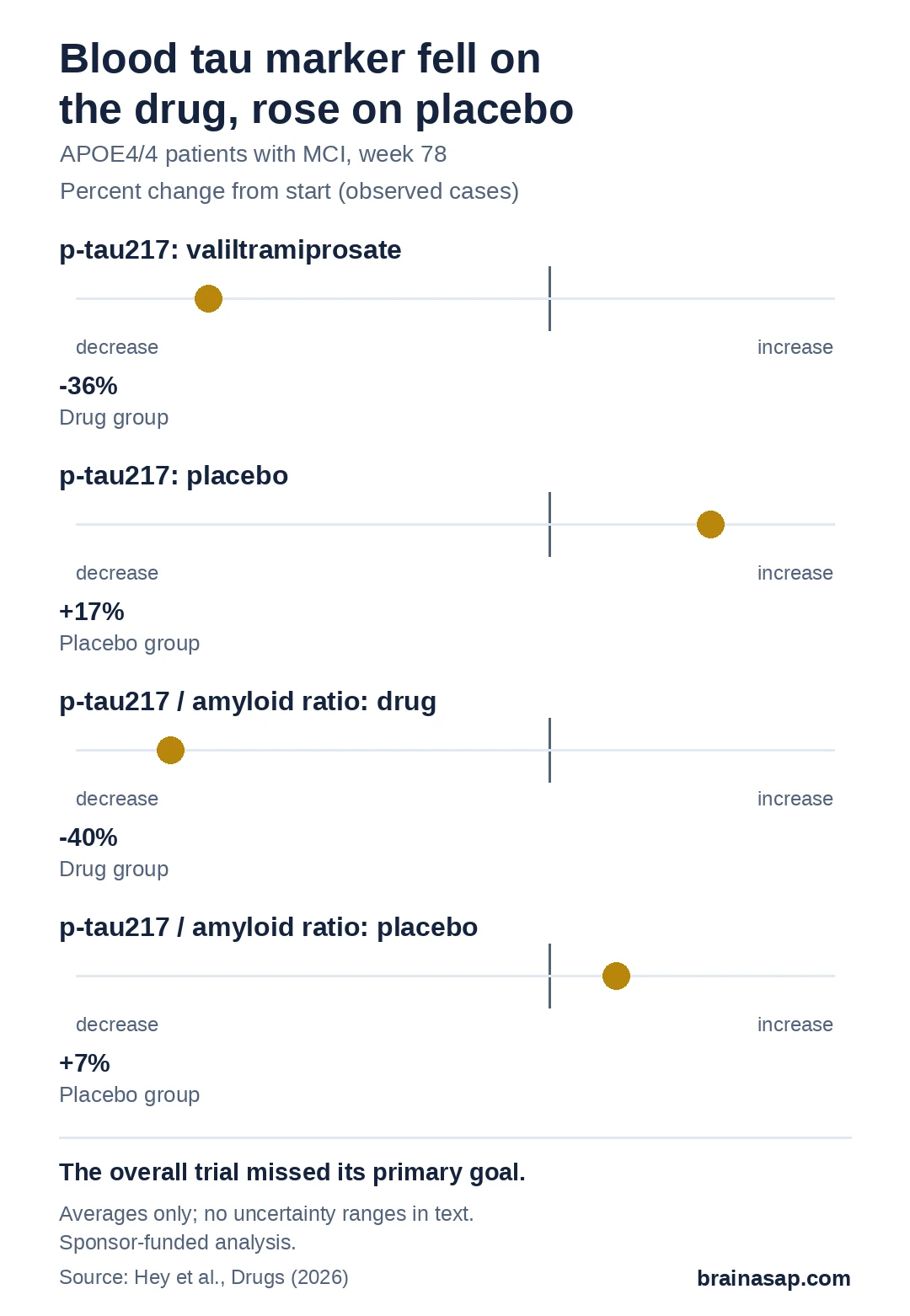
In people with mild Alzheimer's dementia, the drop was only a numerical trend. A nerve-damage marker, neurofilament light, was also lower on the drug at week 78 in the MCI group.
Marker Changes Tracked Brain and Thinking Changes
Within the MCI group, people whose p-tau217 fell more tended to do better on thinking and daily-function scores and to lose less hippocampus and brain volume. These correlations were modest (r about 0.28 to 0.38).
In the earlier open-label phase 2 study of 84 APOE4 carriers, p-tau217 stayed lower over four years on the drug.
Reasons for Caution
- Primary goal missed: The positive findings come from a subgroup and from biomarkers.
- Observed cases only: People who dropped out are not counted, and results were not corrected for testing many outcomes.
- No placebo in phase 2: The four-year data were compared with the phase 3 placebo group.
- Company involvement: Funded by Alzheon (with NIH support for phase 3); many authors are Alzheon employees.
- A marker is not a memory: Lower blood tau does not by itself show patients are better.
What Would Settle It
The biomarker pattern fits the drug doing something in the brain, especially at the MCI stage. What it cannot do is replace a trial where the drug clearly beats placebo on thinking and daily life. A new trial focused on APOE4 carriers with MCI would be the real test.
Citation: DOI: 10.1007/s40265-026-02381-3. Hey JA, Abushakra S, Power A, et al. Plasma biomarker effects of oral valiltramiprosate/ALZ-801 in early Alzheimer's disease from phase 3 and phase 2 trials. Drugs. 2026;86:1705-1721.
Study Design: Biomarker analyses of a randomized, placebo-controlled phase 3 trial (APOLLOE4, NCT04770220) and an open-label phase 2 study (NCT04693520).
Sample Size: Phase 3: 325 randomized APOE4/4 homozygotes; phase 2: 84 treated APOE4 carriers.
Key Statistic: MCI subgroup p-tau217 change: -36% on drug vs +17% on placebo (observed cases).
Caveat: Phase 3 missed its primary endpoint; subgroup and observed-case analyses; sponsor-funded with sponsor authors.