TL;DR: In brain scans of 146 older adults, people with Alzheimer's dementia had weaker white matter wiring across 268 brain connections compared with healthy peers, but people with milder memory loss showed no clear difference. Wiring strength didn't line up with scores on hand movement tests like grip and finger tapping.
Key Findings
- 146 adults aged 65+: 68 healthy, 44 with mild memory loss, 34 with Alzheimer's dementia.
- 268 weaker connections in Alzheimer's vs healthy peers, many around memory areas.
- Only 3 weaker connections in Alzheimer's vs mild memory loss.
- No clear difference between mild memory loss and healthy peers.
- No link to hand skills: Grip, tapping, spiral tracing and sequence learning didn't track wiring.
Source: Neuroimage: Reports (2026) | Cote et al.
Alzheimer's is known as a memory disease, but it often affects movement too. More than 30% of people with memory-type mild cognitive impairment have walking problems, and small slowdowns in finger tapping and grip strength show up early.
Researchers at the University of Utah wondered if the brain's long-distance wiring could explain those motor changes. They also asked when in the disease that wiring starts to weaken.
Three Groups of Older Adults in the Scanner
Everyone was 65 or older, with an average age of about 74. The groups were:
- Healthy peers (68): No thinking problems.
- Mild memory loss (44): Amnestic mild cognitive impairment, meaning memory slips beyond normal aging but daily life mostly intact.
- Alzheimer's dementia (34): Mild-stage, memory-led dementia diagnosed by clinical tests.
Each person had a diffusion MRI scan, which tracks how water moves along nerve fibers. From that, the team estimated how strongly hundreds of brain regions are wired to one another. A subset of 103 people also did hand tests: finger tapping, grip strength, tracing a spiral, and learning a button-pressing sequence on a game controller.
Wiring Was Weaker Mainly at the Dementia Stage
Compared with healthy peers, people with Alzheimer's dementia had weaker wiring in a network of 268 connections spanning 144 brain regions. The hardest-hit links involved the temporal lobe, especially the parahippocampal gyrus, plus the thalamus and hippocampus. These are areas known to be affected early in Alzheimer's.
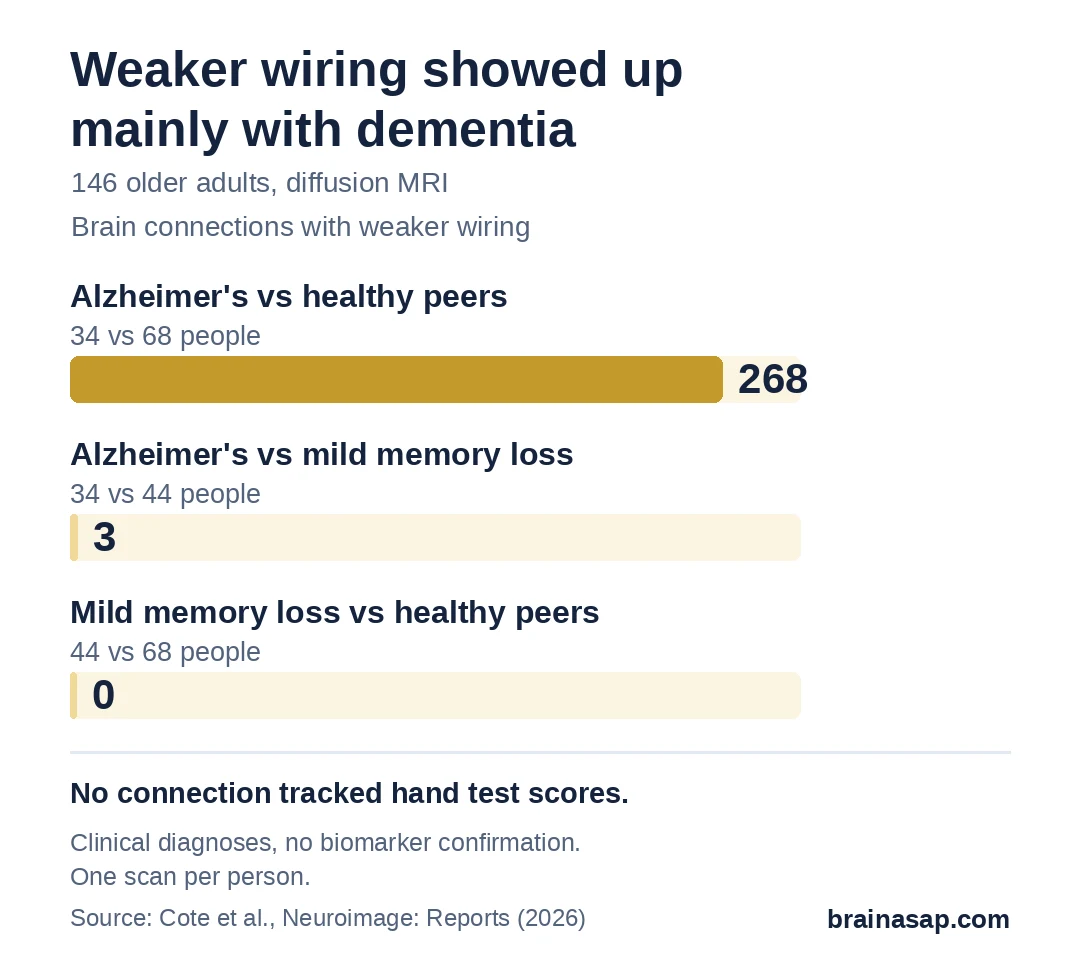
Between Alzheimer's and mild memory loss, only 3 connections differed, all on the right side of the brain. People with mild memory loss didn't differ clearly from healthy peers at all.
The authors read this as a sign that these wiring changes show up later in the disease, after memory has already slipped.
Hand Skills and Wiring Didn't Line Up
The team expected stronger wiring between sensory and movement areas to go with better hand performance. That's not what the researchers found. None of the hand tests was linked to wiring strength anywhere in the brain.
The authors offer a few reasons:
- Small spread: Earlier work in this group found only small motor differences between groups, leaving little variation to detect.
- Motion adjustment: People with dementia moved more in the scanner and also did worse on hand tests, so correcting for head motion may have hidden a real link.
- Wrong measure: Connection-by-connection wiring may miss diffuse damage that other MRI measures can pick up.
Diagnoses Weren't Confirmed With Biomarkers
- Clinical labels only: No amyloid or tau tests, so some "Alzheimer's" cases may have other causes, and some healthy peers may have early disease.
- Snapshot: One scan per person, so it can't show wiring changing over time.
- Noisy scans: One strong diffusion setting and no distortion correction.
- Hands only: Walking and balance weren't tested.
- Smaller motor subset: Just 20 people with Alzheimer's did the hand tests.
Walking and Balance Are the Next Place to Look
For now, this study suggests brain wiring loss in Alzheimer's is clearest once dementia has set in, and it doesn't explain the small hand-skill changes seen in this group. Whether wiring tracks walking and balance problems, and whether it changes in the same people over years, needs longer studies with biomarker-confirmed diagnoses.
Citation: DOI: 10.1016/j.ynirp.2026.100405. Cote S, Ruitenberg MFL, van der Geest JN, Frost NA, King JB, Duff K, Koppelmans V. White matter microstructure and motor function in amnestic mild cognitive impairment and Alzheimer's dementia. Neuroimage: Reports. 2026;6:100405.
Study Design: Cross-sectional diffusion MRI study with probabilistic tractography and threshold-free network-based statistics.
Sample Size: 146 scans (68 cognitively unimpaired, 44 amnestic MCI, 34 mild AD); 103 with motor tests.
Key Statistic: 268 connections with lower structural connectivity in AD vs controls; 3 in AD vs aMCI; none in aMCI vs controls; no connectivity-motor associations.
Caveat: Clinical diagnoses without biomarker confirmation; cross-sectional; streamline counts are estimates.