How Cocaine Rewires the Brain’s Reward Circuit
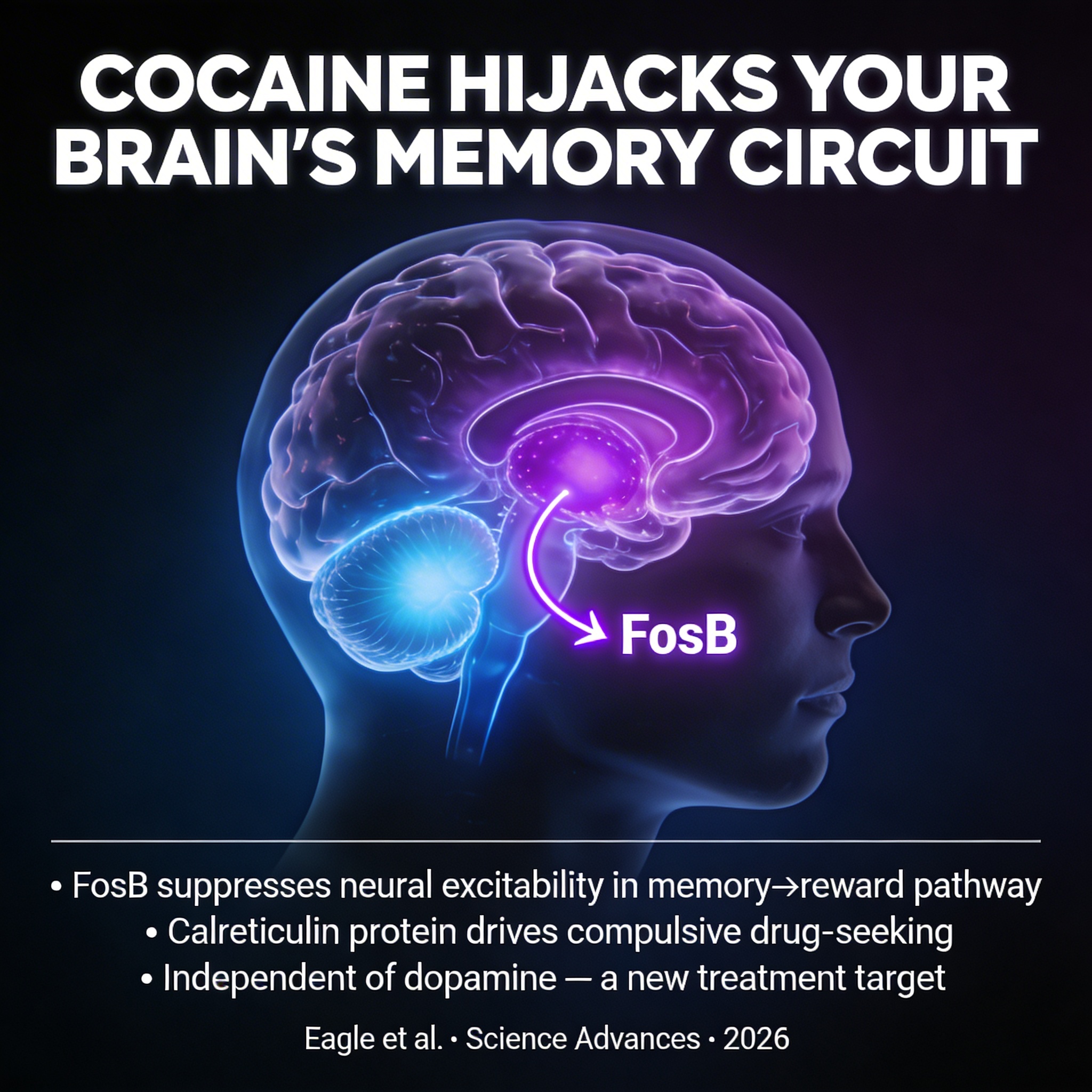
TL;DR: Cocaine hijacks a transcription factor called FosB in a brain circuit connecting the hippocampus to the nucleus accumbens, suppressing neural excitability and driving compulsive drug-seeking behavior—a mechanism that could reshape addiction treatment.
The brain has two competing drives during addiction: the conscious desire to quit and the limbic system’s relentless pull toward the drug. Researchers have long understood that cocaine changes dopamine and plasticity in reward regions, yet they’ve missed a critical piece: how the brain’s electrical properties themselves shift to amplify craving. A new study reveals that cocaine doesn’t just alter motivation—it rewires the neuronal excitability of circuits that connect memory to reward.
Key Findings
- FosB/ΔFosB drives excitability suppression: Chronic cocaine exposure increases FosB expression in ventral hippocampus (vHPC) neurons projecting to nucleus accumbens (NAc), and this transcription factor directly mediates decreased neuronal excitability.
- Calreticulin is the molecular brake: Cocaine induces FosB-dependent upregulation of calreticulin, an ER-resident calcium-buffering protein; overexpressing calreticulin alone reduces vHPC excitability by approximately 25% in whole-cell recordings.
- Knockdown of FosB blocks cocaine’s effect: Selective deletion of FosB in vHPC-NAc neurons prevented cocaine-induced decreases in neuronal excitability and abolished both forced abstinence-induced seeking and continued cocaine-paired chamber preference (time spent approximately 200–400 s in control vs. crKO mice).
- Circuit-specific knockdown abolishes cocaine reward: CRISPR-mediated FosB knockout in vHPC-NAc neurons (but not other vHPC populations) eliminated the motivation to work for cocaine under progressive ratio schedules while leaving baseline motivation intact.
- Calreticulin knockdown reverses behavioral effects: Viral knockdown of calreticulin in NAc-projecting vHPC neurons increased vCA1 excitability and attenuated both the preference for cocaine-paired chambers and active nosepoke responses during self-administration.
- No effect on dopamine or acute reward: The FosB/ΔFosB-mediated changes in excitability were independent of dopamine signaling or acute reward—instead, they specifically drove the consolidation and maintenance of cocaine-seeking memory.
Source: Science Advances (2026) | Eagle et al.
The Missing Link in Addiction Neuroscience
For decades, addiction research has focused on dopamine—the neurotransmitter that encodes reward and drives reinforcement learning. But dopamine alone cannot explain why addicts crave cocaine long after withdrawal ends, or why environmental cues trigger relapse with crushing force.
FosB is a transcription factor that acts as a molecular record-keeper of chronic drug use. When cocaine floods the brain, FosB gradually accumulates and shifts to a longer-lasting variant called ΔFosB. This change persists even when the drug is gone, making it a potential driver of addiction’s long-term grip. Yet its exact role in the circuits that link memory, emotion, and reward remained murky.
Mapping the Cocaine Circuit
The researchers focused on a specific pathway: neurons in the ventral hippocampus that project to the nucleus accumbens. The hippocampus is the brain’s memory center. The nucleus accumbens is the reward center.
This vHPC-to-NAc circuit is critical. It encodes contextual memories of reward—the setting, the ritual, the anticipation. Cocaine exposure had been shown to increase FosB in these neurons, but nobody had tested whether FosB actually caused the behavioral addiction or was simply a bystander.
The team trained male mice to self-administer cocaine intravenously for 14 days. Robust increased FosB/ΔFosB expression appeared in vHPC neurons, with a three-fold increase in protein levels. Crucially, when they measured the electrical properties of these neurons using whole-cell patch-clamp electrophysiology—the gold standard for measuring neuronal excitability—they found something striking: neurons from cocaine-exposed mice fired fewer spikes at equivalent current inputs.
Calreticulin: The Molecular Valve
To trace the mechanism, the researchers used RNA-sequencing to identify which genes were regulated by FosB in vHPC-NAc neurons following cocaine exposure. Among 270 upregulated genes and 390 downregulated genes, one stood out: calreticulin, an endoplasmic reticulum calcium-binding protein.
Calcium dynamics are fundamental to neuronal firing. When calcium accumulates inside a cell, it suppresses excitability—essentially muting the neuron. Calreticulin buffers intracellular calcium, preventing it from spiking too high.
Cocaine increased calreticulin expression in vHPC neurons within one day, and the effect persisted through 14 days. When researchers overexpressed calreticulin in vHPC-NAc neurons without cocaine exposure, neuronal excitability dropped by approximately 25%. This single protein accounted for much of cocaine’s suppressive effect.
The Behavioral Consequences
But does suppressing excitability actually drive drug-seeking? The team ran the critical test: they used CRISPR to selectively knock out FosB in vHPC neurons that project to the NAc. The knockout mice showed no cocaine-induced decrease in neuronal excitability—the electrical suppression vanished.
Behaviorally, the difference was dramatic. Control mice spent more time in a chamber paired with cocaine than a chamber paired with saline. FosB knockout mice showed no preference for the cocaine-paired chamber. They also failed to escalate self-administration during a forced abstinence period—a hallmark of addiction severity.
Most tellingly: under a progressive ratio schedule (where mice had to work harder for each cocaine infusion to measure motivation), FosB knockout mice stopped responding. They did not develop the compulsive, escalating drive that characterizes addiction.
Proving Calreticulin Is Essential
To close the loop, the researchers knocked down calreticulin specifically in the NAc-projecting vHPC neurons of normal cocaine-exposed mice. Knockdown of calreticulin reversed the behavioral effects: mice spent more time in the cocaine-paired chamber and pressed the lever more often.
This elegant result proves that calreticulin-mediated suppression of excitability is necessary for cocaine to drive seeking behavior. Suppress excitability, and the brain encodes a more powerful cocaine memory. Restore excitability, and that memory weakens.
Why Excitability Matters for Addiction
The conventional view holds that cocaine increases motivation through dopamine and synaptic plasticity. This study suggests a parallel mechanism: cocaine decreases the electrical responsiveness of memory-to-reward circuits, making them more sensitive to cues and less able to override the seeking impulse.
Think of it this way. A less excitable neuron is harder to fire, but once it does fire, the signal propagates with greater weight in the circuit. Cocaine essentially attunes the vHPC-NAc pathway to cocaine-related memories while dampening other inputs—a kind of neural gain control that narrows the brain’s attention to the drug.
FosB and calreticulin accomplish this without any change in dopamine release or baseline reward. Instead, they reprogram how memories are consolidated and retrieved. This explains why environmental triggers can pull an addict back toward the drug, even in the absence of acute dopamine signaling.
Implications for Treatment
If FosB/ΔFosB-mediated suppression of vHPC-NAc excitability is a key driver of cocaine-seeking, then targeting this pathway could offer a new therapeutic angle. Current medications for cocaine addiction are lacking. But the specificity of this mechanism—it depends on a particular transcription factor in a particular circuit—suggests that interventions could be designed to disrupt FosB function or calreticulin expression without broad side effects.
The study also hints at why extinction-based therapies (like cue exposure) might struggle in addiction: they’re trying to build new memories and override old ones in a circuit that cocaine has already engineered to resist change. A drug that restores normal excitability to vHPC-NAc neurons could make the brain more plastic and responsive to behavioral interventions.
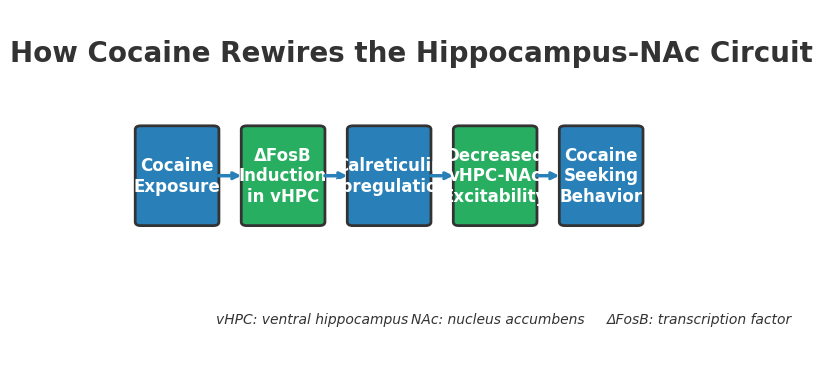
Image file: cocaine-fosb-calreticulin-circuit.png — Diagram showing how cocaine drives FosB expression in vHPC neurons projecting to NAc, leading to calreticulin-mediated calcium buffering and suppressed excitability. This reduced excitability enhances memory consolidation of cocaine-paired contexts, driving compulsive seeking behavior.
Limitations and Open Questions
The study was conducted in male mice, and sex differences in cocaine addiction are well documented. Female mice show greater escalation of intake and higher relapse rates—findings that may or may not be driven by FosB/calreticulin signaling. Future work should test whether this mechanism scales to females.
Additionally, the work focuses on one brain circuit. Cocaine affects the entire reward system, prefrontal cortex, amygdala, and dorsal striatum—circuits not examined here. Whether FosB/ΔFosB operates similarly in these regions remains unknown.
Finally, the study uses acute cocaine self-administration over 14 days. Extended cocaine exposure over weeks or months might recruit additional mechanisms beyond FosB/calreticulin-mediated excitability suppression.
Citation: Eagle AL, Sugimoto C, Doyle MA, Anderson D, Mousavi SL, Dykstra M, Kuhn HM, Murray BR, Bastle RM, Simmons S, He J, Maze I, Mazei-Robison MS, Robison AJ. Transcriptional regulation of ventral hippocampus-nucleus accumbens circuit excitability drives cocaine seeking. Science Advances. 2026;12(10):eadv1236. DOI: 10.1126/sciadv.adv1236
Authors’ affiliations: Department of Physiology, Michigan State University (Eagle, Sugimoto, Doyle, Anderson, Mousavi, Dykstra, Kuhn, Murray, Maze, Mazei-Robison); Department of Neuroscience, University of Texas at Dallas (Mousavi, Bastle, Simmons, He, Robison); Friedman Brain Institute, Icahn School of Medicine at Mount Sinai (Kuhn); Department of Biochemistry, Michigan State University (Maze).