TL;DR: A meta-analysis pooling 63 studies and 265,079 people found that cannabis users had about twice the odds of committing violence as non-users (2.05 times in the general population, 2.49 times among psychiatric patients). The gap shrank to 1.17 times in studies that followed people over time. The design shows an association, not that cannabis caused the violence.
Key Findings
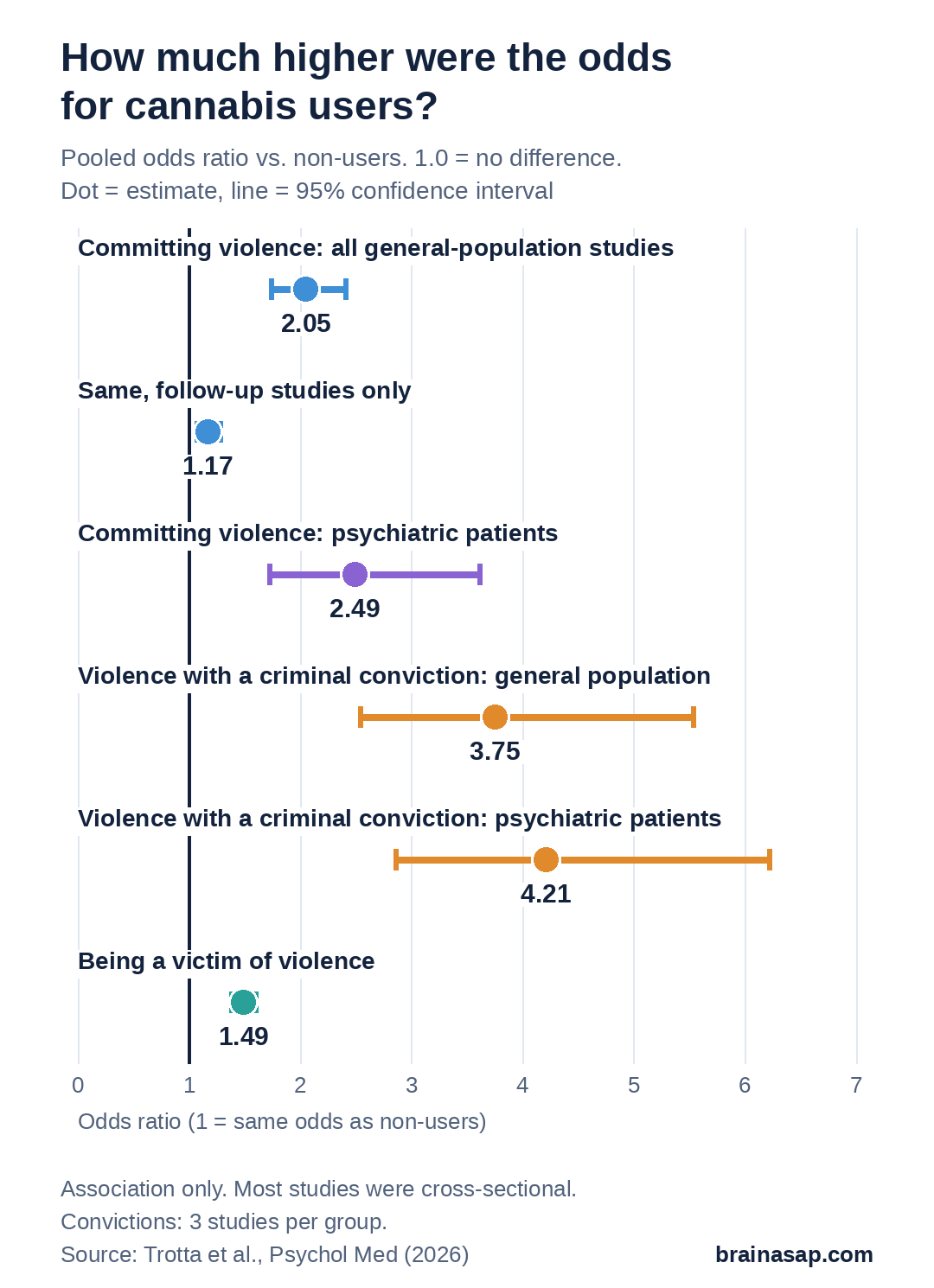
- About double the odds: Cannabis users had 2.05 times the odds of committing violence in general-population studies and 2.49 times in psychiatric-patient studies, compared with non-users.
- Follow-up studies showed less: When studies tracked people forward in time, the general-population figure fell to 1.17 times, versus 2.37 times in one-time snapshot surveys.
- Convictions stood out: In 3 studies per group that used criminal convictions as the outcome, the odds were 3.75 times higher (general population) and 4.21 times higher (psychiatric patients).
- Victims too, but weakly: Cannabis users also had 1.49 times the odds of being a victim of violence, and only 1.05 times in follow-up studies.
- Results varied a lot: The studies disagreed widely with one another, so the pooled numbers are averages across very different settings.
Source: Psychological Medicine (2026) | Trotta et al.
Cannabis is legal for adults in a growing number of places, and its potency has climbed. Most of the safety conversation has focused on the user: memory, driving, psychosis. A less-studied question is whether cannabis use goes along with harm to other people. This review, from a team at King’s College London, set out to pool what the research says.
It is worth stating up front what this kind of study can and cannot say. It compares groups. It does not say that most cannabis users are violent, and it does not show that cannabis makes a person violent. The question is only whether violence was more common in one group than the other.
What the Researchers Did
The team searched three major databases for studies published through November 2024. They looked for studies that compared cannabis users with non-users from the same population and measured violence, either as the person who committed it or the person who experienced it. Violence could be physical, sexual, or psychological, as each study defined it. Studies where cannabis was lumped in with other drugs were left out.
Of 7,539 records found, 63 studies (265,079 people) had data that could be pooled. Most were snapshot (cross-sectional) surveys: 46 were cross-sectional and 17 followed people forward in time. Fifty studied the general population and 13 studied psychiatric patient groups, several of them people with schizophrenia-spectrum or other psychotic disorders. By the authors’ quality ratings, 13 studies were good, 45 fair and 5 poor.
Reading an Odds Ratio
The results are given as odds ratios. An odds ratio of 1 means the same odds in both groups. An odds ratio of 2 means the odds were about double in cannabis users compared with non-users. It is not quite the same as “twice as likely,” and it says nothing about how many people in either group were violent. Each estimate also comes with a 95% confidence interval, the range of values the data reasonably support.
What They Found
Committing violence
Across general-population studies, cannabis users had 2.05 times the odds of committing violence (95% CI 1.74–2.41). Among psychiatric patients the figure was 2.49 times (95% CI 1.72–3.61). Leaving out the five poor-quality studies barely changed the picture.
The size of the gap depended on the kind of violence and how it was measured:
- Violence with a criminal conviction: 3.75 times (general population) and 4.21 times (psychiatric patients). Only 3 studies fed each figure, but they agreed closely with one another.
- Self-reported violence: 2.02 times (general population) and 2.18 times (psychiatric patients).
- Intimate-partner or dating violence: 1.22 times, much lower than the 2.79 times for other kinds of violence.
- By sex: 1.51 times in male-only studies and 1.98 times in female-only studies.
Snapshot studies versus follow-up studies
This is the most important pattern for interpreting the rest. In snapshot studies, which ask about cannabis and violence at about the same time, the general-population odds were 2.37 times higher. In follow-up studies, which measure cannabis first and violence afterward, the figure dropped to 1.17 times (95% CI 1.07–1.28). It was still above 1, but far smaller.
Among psychiatric patients the follow-up studies went the other way: 3.71 times in 4 follow-up studies, versus 2.08 times in 10 snapshot studies. That is a small number of studies, so it is a hint rather than a conclusion.
Being a victim of violence
Cannabis users also had higher odds of being on the receiving end: 1.49 times (95% CI 1.38–1.60), somewhat higher in women (1.60) than in men (1.30). As with perpetration, the follow-up studies showed much less (1.05 times, versus 2.20 times in snapshot studies). The authors suggest this may reflect greater exposure to risky situations or social circles rather than a direct effect.
Why the Numbers Can’t Prove Cannabis Causes Violence
- Most studies were snapshots: They cannot show which came first. The smaller follow-up figure suggests part of the larger gap may reflect other things.
- Other factors travel with cannabis use: The authors point to impulsivity, antisocial traits, difficult social circumstances and exposure to violent environments, which can raise both cannabis use and violence risk. Most studies did not fully account for use of alcohol or other drugs.
- The studies disagreed widely: Statistical heterogeneity was very high for most comparisons (for example, 98.6% for the main general-population estimate), so a single pooled number hides a lot of variation.
- Possible publication bias: The authors’ statistical tests suggested small studies tended to show larger effects. A correction method lowered some figures (for example, psychiatric-patient studies from 2.49 to 1.85, and criminal-record studies from 3.75 to 3.51) but the results stayed above 1.
- Cannabis use was measured loosely: Studies rarely recorded how often, how much, or how strong the cannabis was, and most predate today’s high-potency products. The review could not say whether heavier use goes with higher odds.
- Some eligible studies were left out: Many could not be pooled because their data were incomplete, and only English-language studies were included.
Why It Matters
The clearest takeaway is that violence belongs on the list of things researchers should track when they study cannabis harms, alongside psychosis and driving. The stronger link in psychiatric patients also supports the authors’ call for clinicians to routinely ask about cannabis use, since it may be one modifiable factor in a person’s overall risk.
What the review does not show is that cannabis is the reason behind any given act of violence, or that stopping cannabis would reduce violence. The authors say as much: they call for long-running studies with detailed records of how much cannabis people use, and for trials testing whether cutting back changes violence.
Citation: DOI: 10.1017/S0033291726105856. Trotta G, Rodriguez V, Marino P, Gurmesa M, Spinazzola E, Li Z, Alameda L, Di Forti M, Murray R, Vassos E. Cannabis use is associated with increased risk of violence: A systematic review and meta-analysis. Psychological Medicine. 2026;56:e296.
Study Design: Systematic review and random-effects meta-analysis (PRISMA; PROSPERO CRD42021240658) of MEDLINE, EMBASE and PsycINFO through November 2024; quality rated with the Newcastle–Ottawa Scale.
Sample Size: 63 studies (N = 265,079); 46 cross-sectional and 17 prospective; 50 general-population and 13 psychiatric samples.
Key Statistic: Perpetration odds ratio 2.05 (95% CI 1.74–2.41) in the general population and 2.49 (1.72–3.61) in psychiatric patients; 1.17 (1.07–1.28) in general-population follow-up studies; victimization 1.49 (1.38–1.60).
Caveat: Mostly cross-sectional data, very high heterogeneity, evidence of publication bias, limited control for other substance use and no measure of dose or potency; an association, not proof of cause.