TL;DR: Among 450 older stroke survivors in a Chinese hospital who lived with ongoing pain, thinking abilities fell into three patterns, and about 1 in 10 had broad thinking problems. Men and people with depression were more often in the weaker groups, but this one-time snapshot cannot show what causes what.
Key Findings
- 450 patients aged 60+: All had pain lasting at least 3 months after a stroke.
- Below-normal average: 20 of 30 on a common thinking screen (26+ is normal).
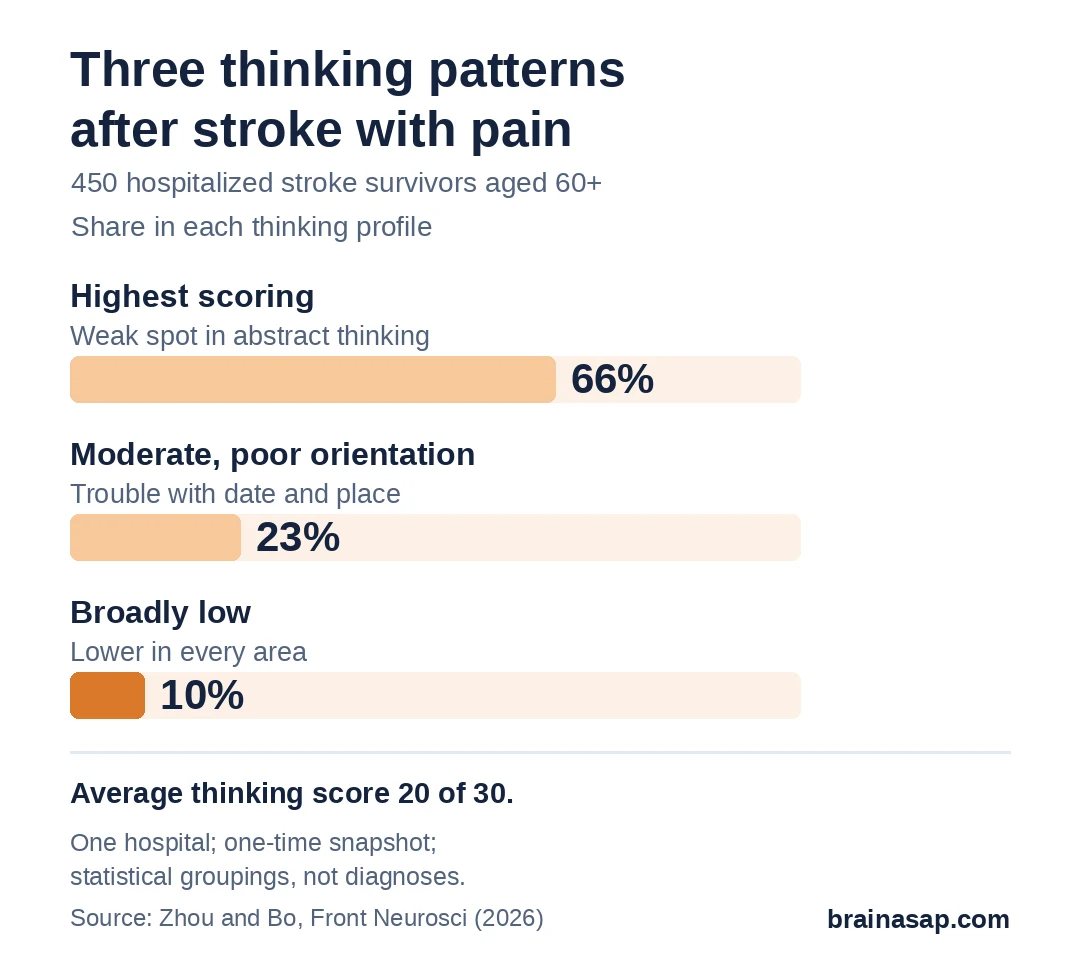
- Three patterns: 66% highest scoring, 23% moderate with poor orientation, 10% broadly low.
- Men more affected: Roughly 2 to 4 times the odds of the weaker patterns.
- No depression, lower odds of the weaker patterns.
Source: Frontiers in Neuroscience (2026) | Zhou and Bo
More than half of stroke survivors develop long-lasting pain, from aching shoulders to burning nerve pain. Chronic pain also tends to travel with memory and thinking problems. In older stroke survivors, those two burdens can pile up.
Neurologists at Nanjing First Hospital in China looked at whether such patients share one thinking profile or several distinct ones.
450 Older Stroke Survivors With Ongoing Pain
Between August 2025 and January 2026, the team interviewed 450 hospitalized patients aged 60 or older whose pain began after their stroke and lasted at least 3 months. Each completed the Montreal Cognitive Assessment (MoCA), a 30-point thinking screen, plus questionnaires on anxiety, depression, pain catastrophizing and social activities.
The average MoCA score was 20, well below the usual normal cutoff of 26.
Three Thinking Patterns Emerged
A statistical method that groups people by similar test patterns sorted patients into three profiles:
- Highest scoring: Highest scores overall, with a relative weak spot in abstract thinking (66%).
- Moderate, poor orientation: Middling scores and trouble knowing the date or place (23%).
- Broadly low: Lower scores across all areas (10%).
Who Landed in the Weaker Groups
- Sex: Men had about 4 times the odds of the moderate pattern and 2 times the odds of the broadly low pattern, compared with women.
- Depression: People without depression had about 60% to 67% lower odds of the weaker patterns.
- Pain type: The broadly low pattern was most common with complex regional pain syndrome (18%) and shoulder pain (12%), and less common with central post-stroke nerve pain (5%) or headache (3%).
- Anxiety: Links were inconsistent across anxiety levels.
Why These Patterns Are Only a Starting Point
- One-time snapshot: Pain, mood and thinking were measured together, so no direction can be inferred.
- One hospital, convenience sample: Hospitalized patients may differ from those at home.
- Missing factors: Medications, nutrition and physical activity were not measured.
- Profiles are statistical: A four-group model fit the data slightly better; the authors chose three for clarity.
Screening Thinking in Stroke Survivors With Pain Makes Sense
The practical point is that older stroke survivors living with pain often have below-normal thinking scores, and depression is part of the picture. Checking memory and mood alongside pain seems sensible. Whether treating depression or pain can slow cognitive decline needs studies that follow patients over time.
Citation: DOI: 10.3389/fnins.2026.1940893. Zhou J, Bo L. Latent profile classification of cognitive function and its influencing factors in elderly patients with chronic pain after stroke. Front Neurosci. 2026;20:1940893.
Study Design: Single-center cross-sectional study with latent profile analysis and multinomial logistic regression.
Sample Size: 450 hospitalized patients aged 60+ (499 questionnaires distributed).
Key Statistic: Mean MoCA 20.09 ± 5.14; profiles 66.4% / 23.3% / 10.2%; male OR 4.006 (moderate) and 2.127 (low) vs reference profile.
Caveat: Cross-sectional convenience sample; profiles are data-driven, not validated subtypes.