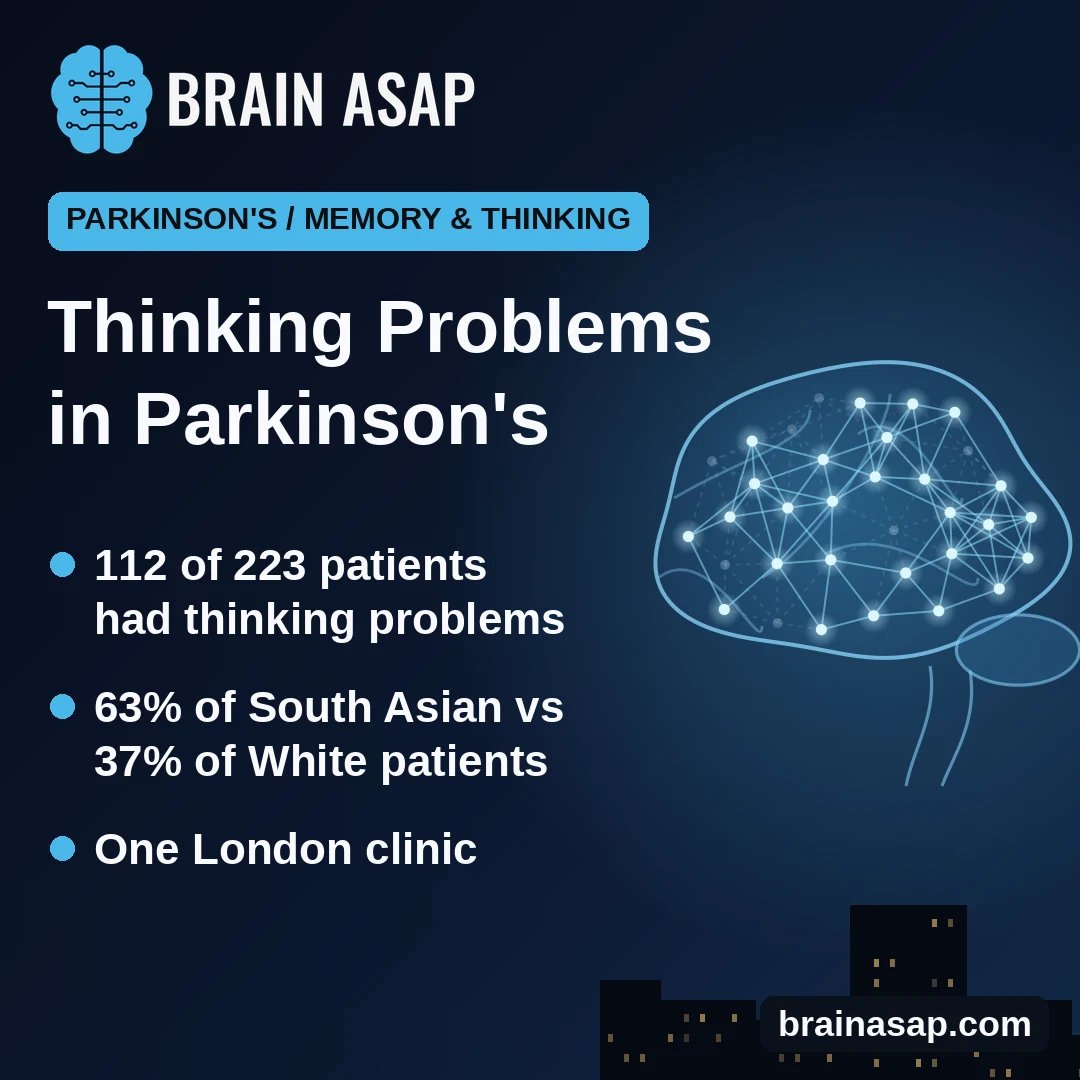
TL;DR: At a busy, ethnically diverse Parkinson's clinic in East London, about half of 223 patients had thinking problems — either mild cognitive impairment or dementia — when a team of specialists reviewed each case. Thinking problems were more common in South Asian patients than in White patients, and they went along with smoking history, more severe movement symptoms, and more daytime sleepiness. The study shows links, not causes.
Key Findings
- About half had thinking problems: 112 of 223 patients — 62 with dementia and 50 with mild cognitive impairment — a median of 4 years after their Parkinson's diagnosis.
- More common in South Asian patients: 54 of 86 South Asian patients (63%) had thinking problems, compared with 36 of 98 White patients (37%).
- The gap held after adjustment: Accounting for age, gender, education, years with Parkinson's, and depression scores, South Asian patients had about 3.6 times the odds of thinking problems.
- Smoking stood out among vascular factors: Having ever smoked came with about 3.6 times the odds; high blood pressure and type 2 diabetes did not show independent links.
- Movement and sleepiness scores tracked it too: Each extra point on the movement-severity exam came with about 7% higher odds, and each extra point on a daytime sleepiness scale with about 8% higher odds.
Source: medRxiv preprint (2026) | Zirra et al.
Parkinson's disease is best known for tremor, stiffness, and slowness. But for many people and their families, the change they fear most is in thinking: memory lapses, trouble planning, losing track of a conversation. Those changes can range from mild to severe enough to be dementia.
How common are they? Estimates vary a lot, and most come from studies of mostly White, better-off patients, often diagnosed with short pen-and-paper screening tests. Those tests are quick and useful, but scores can be pulled down by language, culture, and years of schooling rather than by the disease itself.
A team at Queen Mary University of London and the Royal London Hospital set out to get a more careful answer in a place where those problems matter most: a Parkinson's clinic serving one of the most diverse parts of the UK.
Who Was Studied
Between July 2022 and July 2025, the researchers recruited patients one after another from the movement disorders clinic at the Royal London Hospital, a specialist referral center. To avoid leaving out people who find research hard to reach, they offered home visits, worked with bilingual researchers, used translated questionnaires where possible, and allowed a family member to consent for someone who could no longer do so.
After removing people who turned out to have a different condition or who withdrew, 223 patients with Parkinson's were included:
- 98 White patients (44%)
- 86 South Asian patients (39%)
- 39 from other backgrounds (17%), including Black African, Black Caribbean, Middle Eastern, other Asian, and mixed ethnicity
Ethnicity was self-reported. The typical patient was 70 years old and had been diagnosed about 4 years earlier. Many lived in poorer areas: in both comparison groups, the typical patient's neighborhood ranked in the third-most-deprived tenth of England.
How Thinking Was Judged
Everyone had two visits. The first covered movement and other Parkinson's symptoms plus a short thinking test, the Montreal Cognitive Assessment. The second added a structured interview that rates how much memory and thinking affect daily life.
Patients whose results looked abnormal on either test — 150 in all — were then discussed at a case meeting of movement disorder neurologists, a cognitive neurologist, a specialist nurse, and the researchers who had met them. The team weighed each person's first language, education, age, other illnesses, medicines, mood scores, doctors' letters, and brain scans when available, then settled on a single label.
Two plain names for the groups the study compared:
- Thinking problems means either mild cognitive impairment or dementia.
- Normal thinking means neither.
The difference between the two kinds of thinking problems is about daily life. Mild cognitive impairment is a real decline in one or more thinking skills that does not seriously get in the way of everyday activities. Dementia is a decline in more than one area that does.
Half the Clinic Had Thinking Problems
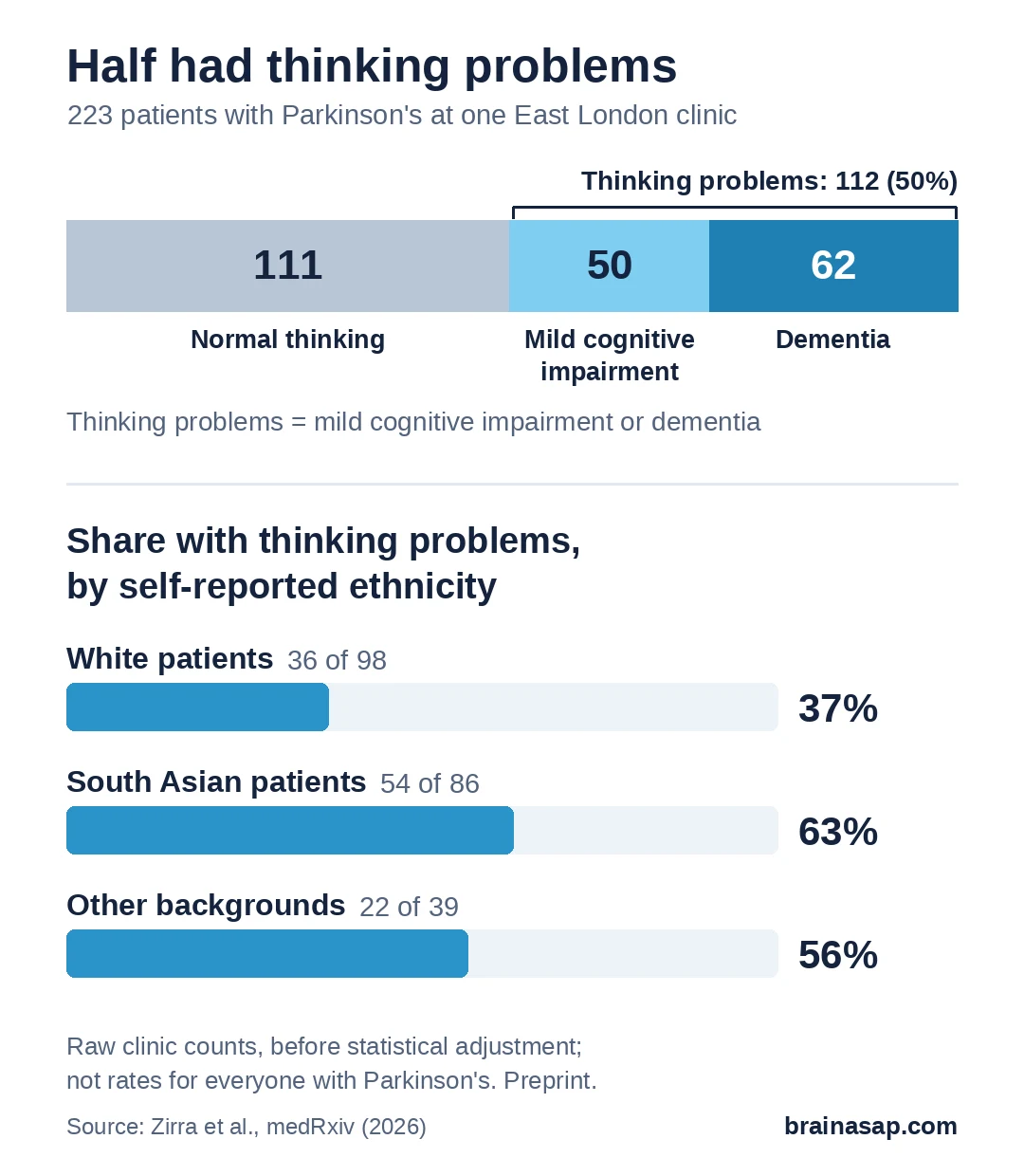
Of the 223 patients, 112 (50%) had thinking problems: 62 with dementia (28%) and 50 with mild cognitive impairment (22%). The other 111 had normal thinking.
People with thinking problems were older (median 74 versus 66), had fewer years of schooling (median 10 versus 13), and had higher depression scores. None of that is surprising; older age, less education, and depression have been linked to thinking problems in Parkinson's before.
The authors note that the overall share is similar to what UK community studies have found at around this point in the illness. They had expected it might be higher, given that a specialist clinic tends to see more complex cases.
A Gap Between South Asian and White Patients
Thinking problems were more common among South Asian patients: 54 of 86 (63%), compared with 36 of 98 White patients (37%). Among patients from other backgrounds, 22 of 39 had thinking problems.
South Asian patients in this clinic were, on average, different in other ways too, so the researchers used statistical models to account for age, gender, years of education, years with Parkinson's, and depression scores.
After those adjustments, South Asian patients had about 3.6 times the odds of thinking problems compared with other patients in the study. Adding blood pressure, diabetes, cholesterol, smoking, movement severity, sleepiness, or neighborhood deprivation to the model, one at a time, didn't make the gap go away.
That is a finding about who was affected in this clinic, not an explanation of why. The authors say so directly: the differences "may reflect a complex interplay of cultural, socioeconomic, and educational factors rather than ethnicity alone." They raise several possibilities:
- Testing bias. An earlier analysis of the same project, using the short screening test alone, put thinking problems at 73% in South Asian patients, 75% in Black patients, and 45% in White patients. The specialist review found lower rates in both groups (63% and 37%), which the authors take as a sign that it corrected some of the cultural bias in pen-and-paper tests — though perhaps not all of it.
- Money and circumstances. When the researchers looked at dementia on its own, the South Asian link weakened and was no longer statistically clear once neighborhood deprivation was taken into account. That points toward social and economic factors, not biology.
- Biology. Heart and blood-vessel risk factors and a gene variant tied to dementia risk (APOE) could play a part. The authors call the gene idea speculative, and the gap held after accounting for the vascular factors they measured.
So the useful takeaway isn't that South Asian heritage harms the brain. It's that this group, in this clinic, carried a heavier load of thinking problems, and that careful, culturally aware assessment matters for getting the numbers right.
Smoking, Movement, and Sleepiness
The team also looked at health factors that are sometimes changeable. Results are given as odds ratios, which compare the odds of having thinking problems. An odds ratio of 1 means no difference; 2 means about double the odds.
Smoking. About 36% of patients with thinking problems had ever smoked, compared with 23% of those with normal thinking. After adjustment, ever-smokers had about 3.6 times the odds of thinking problems.
That stands out because smoking has long been linked to a lower chance of developing Parkinson's in the first place. High cholesterol showed a weaker link (about double the odds, only just statistically significant); high blood pressure and type 2 diabetes showed none after adjustment.
Movement severity. Doctors score Parkinson's movement symptoms on a standard exam where higher numbers mean more severe stiffness, slowness, and tremor. Each additional point came with about 7% higher odds of thinking problems. That sounds small, but the scale is wide: the typical patient with thinking problems scored 47, versus 23 for those with normal thinking. By the model's arithmetic, 10 extra points works out to roughly double the odds.
Daytime sleepiness. On a 24-point questionnaire about dozing off during everyday activities, each additional point came with about 8% higher odds. Typical scores were 8.5 among those with thinking problems and 6 among those with normal thinking.
For dementia alone, a weaker sense of smell also stood out. Signs of acting out dreams during sleep, a symptom often linked to thinking decline in Parkinson's, did not show a clear link here, possibly because it was measured by questionnaire rather than a sleep study.
None of these results show that smoking, movement problems, or sleepiness cause thinking decline. Everything was measured at the same point in time, so the arrows could run either way: thinking problems might, for example, contribute to daytime sleepiness.
What This Study Can't Tell Us
- One clinic. All patients came from a single specialist hospital in London. The results may not match rural areas, other countries, or people with Parkinson's who never see a specialist.
- One snapshot. The design can show which features go together, not which came first.
- Not every case went to the panel. Patients with normal results on both tests were counted as having normal thinking without a case discussion.
- Gaps in the data. Some measures, such as hearing, smell, and the sleep questionnaires, were missing for about 9% to 24% of patients, and the smaller dementia-only models risk overfitting.
- Broad groupings. "South Asian" and "Other" each bring together people with very different backgrounds and life histories.
Even with those limits, the message for families is clear enough. Thinking changes are common in Parkinson's, and in a diverse city how they are measured can shape who appears to have them. The authors call for assessment that is careful and culturally sensitive, and for longer studies that follow people over time.
Citation: DOI: 10.64898/2026.06.02.26354673. Zirra A, Dey KC, Camboe E, et al. Prevalence and Clinical Determinants of Cognitive Impairment in Diverse Patients with Parkinson Disease. medRxiv preprint. 2026.
Study Design: Cross-sectional, case-only analysis within the East London Parkinson Disease project, with cognitive status set by expert multidisciplinary consensus and associations tested with logistic regression.
Sample Size: 223 patients with Parkinson's disease (98 White, 86 South Asian, 39 other backgrounds) at the Royal London Hospital, recruited July 2022 to July 2025.
Key Statistic: 112 of 223 (50.2%) had cognitive impairment (62 dementia, 50 mild cognitive impairment); South Asian ethnicity adjusted OR 3.60 (95% CI 1.68–7.69); ever smoking OR 3.62 (1.56–8.41).
Caveat: Preprint posted 3 June 2026 and not peer reviewed. Single-clinic, observational snapshot: it cannot establish causes or the share of all people with Parkinson's who have thinking problems.