TL;DR: A 2026 analysis of over 320,000 middle-aged and older adults in Britain compared how many hours a week they said they spent on mobile phone calls with who later developed heart disease or had a stroke.
People who talked more than 6 hours a week had a modestly higher risk of coronary heart disease and stroke than people who talked under 5 minutes, after accounting for age, health and lifestyle. The study found no clear evidence that a depression diagnosis changed that link, and a genetic test of whether depression explains it was inconclusive.
Key Findings
- Coronary heart disease: People on calls more than 6 hours a week had about 18% higher risk than people on calls under 5 minutes a week.
- Stroke: Risk was about 17% higher in the same comparison.
- Step by step: Risk was also somewhat higher at 1 to 3 hours and 4 to 6 hours a week.
- No clear link: Heart failure and heart attack risk did not clearly differ.
- Depression: Links were similar with or without a depression diagnosis, and the genetic test of a depression pathway did not give a clear answer.
Source: Bioengineering (2026) | Yin et al.
Most of us spend more time on our phones than we'd like to admit. Earlier research has linked heavy phone use to heart problems, and some scientists suspect depression might be part of the story.
A 2026 study in Bioengineering, led by Yanxin Yin and Qingpeng Zhang at City University of Hong Kong and the University of Hong Kong, looked at one specific habit: time spent talking on a mobile phone, not texting, scrolling or total screen time.
How Was Phone Use Measured?
Researchers used the UK Biobank, a large health study that enrolled about 500,000 people aged 37 to 73 between 2006 and 2010.
At the start, each person picked how long they spent making or receiving mobile calls in a typical week over the previous 3 months:
- Less than 5 minutes (the comparison group)
- 5 to 29 minutes
- 30 to 59 minutes
- 1 to 3 hours
- 4 to 6 hours
- More than 6 hours
Hospital and death records then showed who developed coronary heart disease, heart failure, heart attack or stroke, through 2018 to 2021 depending on the country. People who already had a given condition were left out of that analysis, leaving 320,343 to 328,170 people per condition.
Who Had Higher Risk?
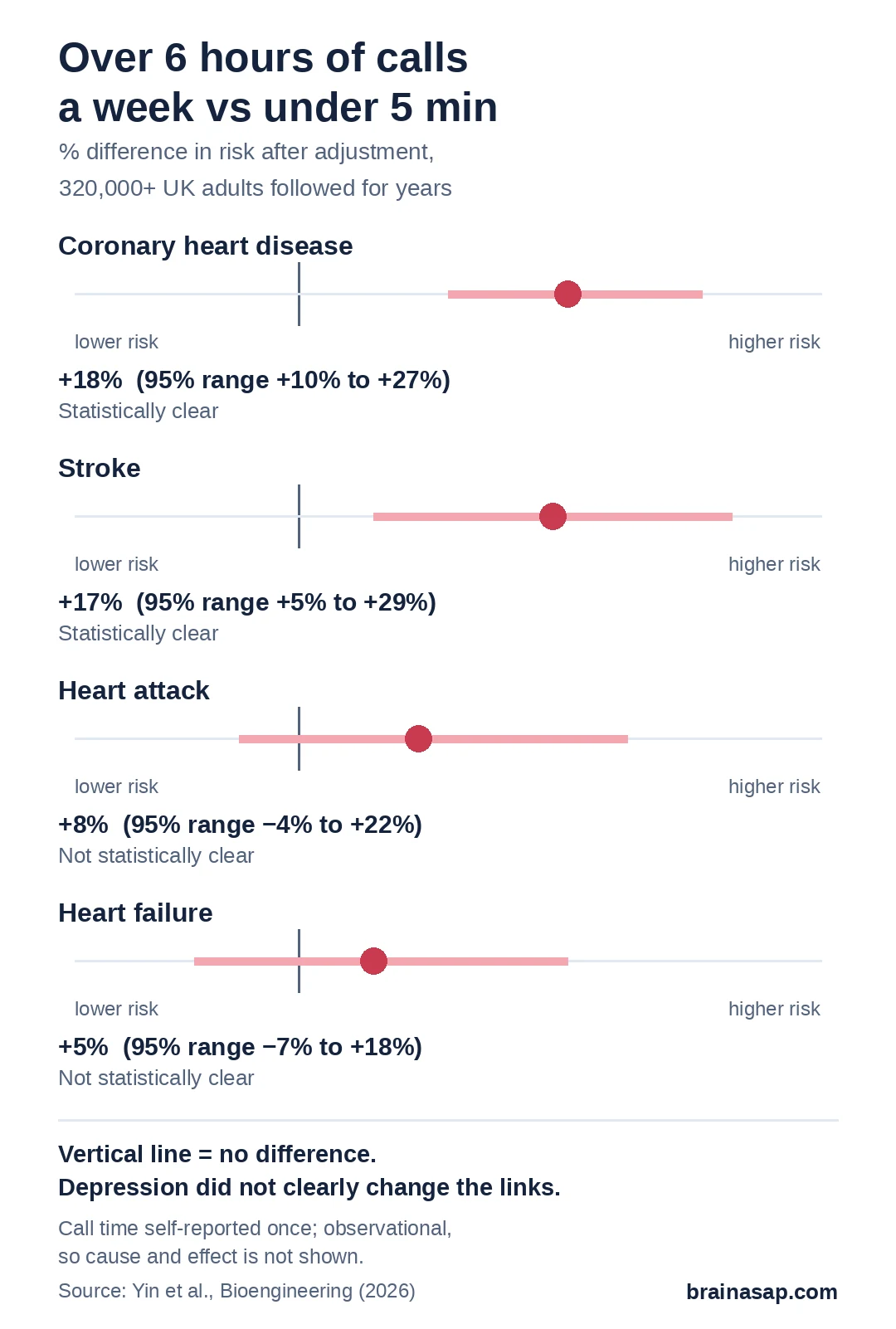
Before any adjustment, people who talked more actually looked healthier. Heavy callers were younger on average, which could help explain that pattern.
Once age, sex, body weight and other factors were taken into account, the picture flipped. Compared with people on calls under 5 minutes a week, risk of coronary heart disease was:
- 1 to 3 hours a week: 10% higher
- 4 to 6 hours: 13% higher
- More than 6 hours: 18% higher
Stroke followed a similar pattern, from 10% to 17% higher. Heart failure and heart attack showed no clear link after full adjustment.
Where Does Depression Fit In?
Yin and colleagues tested depression in 2 ways:
- Recorded diagnosis: Whether people already had a hospital record of major depression at the start. It made no clear difference to the phone-call links for any of the 4 conditions.
- Genetic analysis: A method called Mendelian randomization uses gene variants linked to a habit as a natural experiment. Genes linked to longer calls were also linked to depression and coronary heart disease, but the step-by-step test of whether depression carried the link did not give a statistically clear result.
So depression remains a possible, but unproven, piece of the puzzle. Other habits that tend to go with long calls, such as sitting more and sleeping poorly, could also play a part.
What Should We Keep in Mind?
- One question, once: Call time was self-reported a single time, years before most heart problems appeared.
- Not cause and effect: Even after adjustment, heavy callers may differ in ways not measured, such as job type or stress.
- Calls only: Results don't apply to texting, scrolling or total screen time.
- Genetic caveats: Some genetic results changed with the method used, and the depression measure in that part was broad.
- Who was studied: UK Biobank volunteers, who may be healthier than people who didn't sign up, a bias the team noted.
Worth a Closer Look, Not a Reason to Hang Up
An 18% higher relative rate does not mean 18 extra cases per 100 people. This study cannot show that talking on the phone causes heart disease. Still, it adds to signs that heavy phone use goes along with heart health.
Yin's team called for studies that track phone use objectively and repeatedly, alongside new cases of depression, to test whether depression really links the 2.
Citation: DOI: 10.3390/bioengineering13091035 Yin Y, Luo Y, Liu T, Zhang Q. Mobile Phone Call Duration and Cardiovascular Outcomes: Prospective and Genetic Evidence on a Potential Depression-Related Pathway. Bioengineering. 2026;13(9):1035.
Study Design: Prospective UK Biobank cohort (Cox regression, 4 adjustment models; baseline MDD stratification and 5-df interaction tests) plus two-sample and exploratory two-step Mendelian randomization (UK Biobank call-duration GWAS, FinnGen R11 depression proxy, CVD GWAS).
Sample Size: Outcome-specific at-risk cohorts of 320,343 (CAD) to 328,170 (HF) UK Biobank participants aged 37–73 at baseline (2006–2010).
Key Statistic: Fully adjusted (Model 4), >6 h/week vs <5 min/week: CAD HR 1.18 (95% CI 1.10–1.27); stroke HR 1.17 (1.05–1.29); HF 1.05 (0.93–1.18); MI 1.08 (0.96–1.22). MDD interaction p ≥ 0.115. MR: call duration → MDD OR 1.56 (1.04–2.33), → CAD OR 1.69 (1.13–2.55); no primary two-step indirect effect excluded the null.
Caveat: Single self-reported baseline exposure; residual confounding and healthy-volunteer selection; baseline MDD may predate phone exposure; MR limited by few instruments, heterogeneity, possible sample overlap and pleiotropy; stroke HR averaged over follow-up (non-proportional hazards).