TL;DR: In a small UK trial, 60 people with depression that hadn’t responded to standard treatment got either one 25-mg dose of psilocybin or a placebo, plus therapy support. Three weeks later, 13 of 30 people in the psilocybin group had responded, versus 1 of 29 assessed in the placebo group. That’s a big gap, but 20 of 23 people asked correctly guessed which treatment they’d received, so the true size of the effect is unclear.
Key Findings
- The trial ran smoothly: 59 of 60 people completed every depression assessment, and all 60 attended their dosing day.
- Depression scores dropped more with psilocybin: At week 3, the psilocybin group scored about 10 points lower than the placebo group on a clinician-rated depression scale.
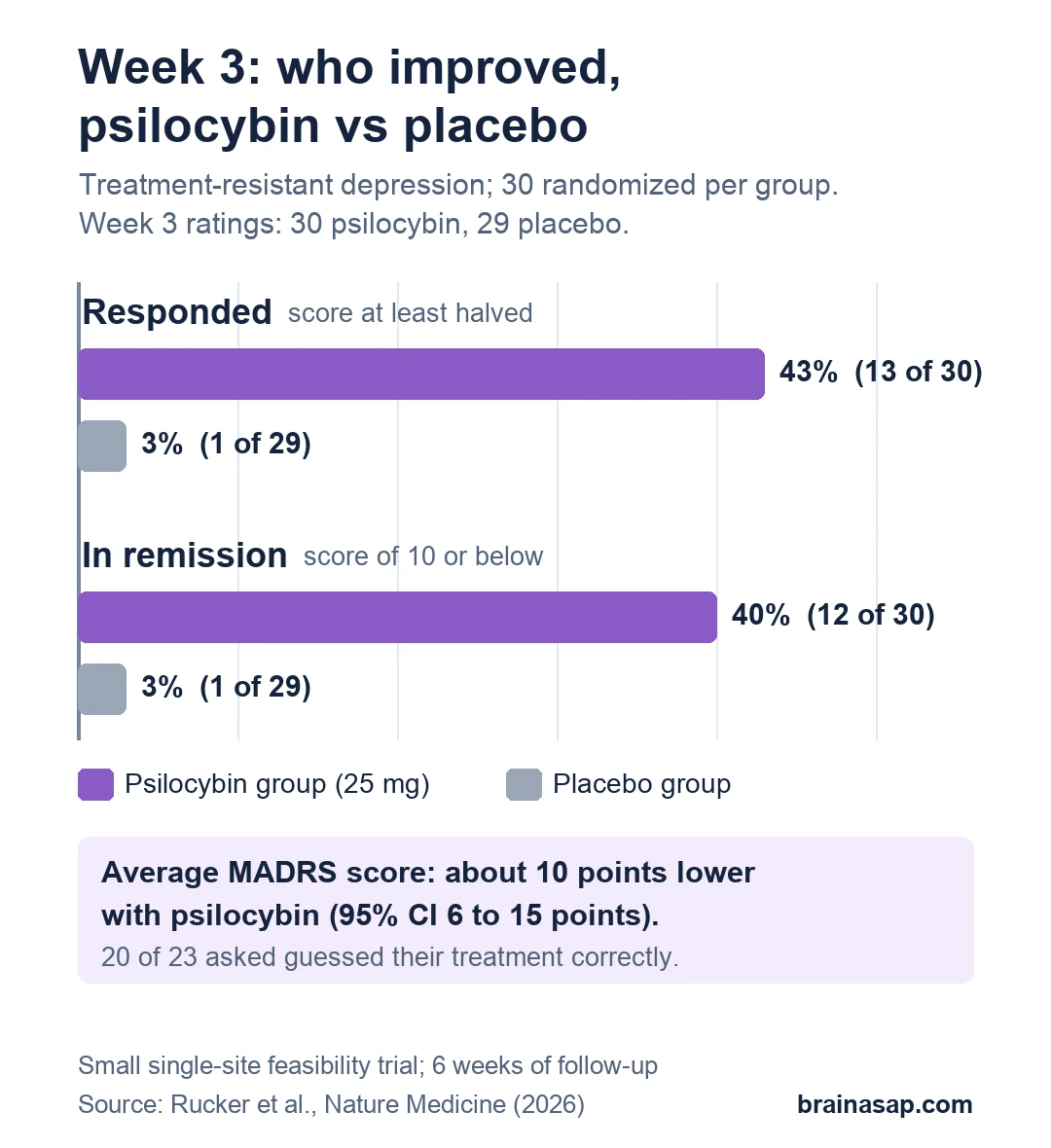
- Response was rare with placebo: At week 3, 13 of 30 people on psilocybin (43%) had their depression scores at least halve, versus 1 person on placebo (3%; 29 assessed).
- Side effects were more frequent with psilocybin: 164 non-serious side effects were logged in the psilocybin group versus 123 in the placebo group, and far more were judged related to the treatment.
- Blinding appeared weak among those asked: All 13 psilocybin-group participants who were asked guessed correctly, as did 7 of 10 in the placebo group. Only 23 of 60 participants were asked.
Source: Nature Medicine (2026) | Rucker et al., PsiDeR trial
Depression that doesn’t budge after two or more antidepressants is called treatment-resistant, and it affects roughly one in three people with major depression. The options that come next, such as ketamine, brain stimulation, or added psychotherapy, are hard to get. Psilocybin, the active ingredient in “magic mushrooms,” has been talked up as another option, so a question keeps coming up: can a public health system actually run a proper trial of it?
That was the main goal here. The results on depression are a bonus, and an interesting one, with some big footnotes.
What the Researchers Did
The team at King’s College London and the South London and Maudsley NHS Trust ran a double-blind, placebo-controlled trial at a single NHS site in England. Between 2021 and 2024 they randomly assigned 60 adults to one of two groups:
- Psilocybin group (30 people): one 25-mg dose of a pharmaceutical-grade psilocybin (COMP360).
- Placebo group (30 people): matching capsules with no active drug.
Everyone in the trial had major depression and hadn’t improved enough on at least two antidepressants (or one antidepressant plus one course of psychotherapy). On average they had felt significantly depressed for about 20 years. The median age was about 41, and half were women.
Before dosing, participants stopped their usual antidepressant, antipsychotic, or mood-stabilizing medications and had preparation sessions with a trial therapist. On dosing day, they spent about 6 hours in a quiet room with a therapist and chaperone, with an eye mask and a curated music playlist if they wanted them. Follow-up visits with brief “integration” therapy came 1 day, 1 week, 3 weeks, and 6 weeks later.
The Feasibility Results
Because this was a feasibility trial, its official main outcomes were practical ones, and the numbers were strong:
- Of 75 people screened, 62 were eligible and 60 were randomized.
- All 60 attended the dosing visit and received their capsules.
- 59 of 60 completed the main depression rating at every visit. The one missing person withdrew from the placebo group for personal reasons.
The authors set no pass/fail targets ahead of time, but they conclude the design worked well enough to support a larger confirmatory trial.
What Happened to Depression Scores
The team measured depression with the MADRS, a rating scale completed by an independent clinician, where higher scores mean more severe depression. Scores in the psilocybin group ended up well below the placebo group:
- Week 1: about 11 points lower.
- Week 3: about 10 points lower (95% CI, 6 to 15 points).
- Week 6: about 13 points lower (95% CI, 8 to 17 points).
Two terms help make sense of the individual-level results. Response means a score at least 50% lower than at the start. Remission means a score of 10 or below, which is the range of little or no depression.
At week 3, 13 of 30 people in the psilocybin group (43%) had responded and 12 (40%) were in remission. In the placebo group, 1 of 29 assessed participants (3%) met each mark. At week 6, 15 people in the psilocybin group (50%) met the response bar.
A self-reported depression questionnaire, anxiety scores, work and social functioning, and a mental wellbeing scale all favored psilocybin too. For example, at week 6, 5 of 30 people in the psilocybin group (17%) still reported moderate or worse anxiety, compared with 18 of 29 people in the placebo group (62%).
The paper reports a Cohen’s d of about −1.7 at week 3, which is very large by research standards. The authors themselves flag that this is likely inflated, for reasons covered below.
Side Effects and Safety
During the six-week main phase, participants logged 164 non-serious adverse events in the psilocybin group and 123 in the placebo group.
Most were mild (68% and 63%). Psilocybin brought more headaches and other neurological complaints (53 events vs. 32) and more mood-related events (30 vs. 13). About 18% of psilocybin-group events were rated as definitely related to the treatment, versus 2% in the placebo group. Colds and other respiratory infections went the other way (12 vs. 24).
Four serious adverse events occurred across the whole study, including its 12-week open-label extension: three in people who received psilocybin and one in the placebo group. The authors judged all but one of them unrelated to the study drug; the one possibly related event was in the placebo group.
Suicidal thoughts on the standard clinician scale looked similar across groups over time. People at high suicide risk were excluded, which the authors say limits what this can show.
Why the Big Numbers Need Caution
- Blinding didn’t hold: Psilocybin is hard to mistake. All 13 psilocybin-group participants who were asked guessed correctly, and 7 of 10 placebo-group participants did too. That was only measured in 23 people, partway through the trial. Expectation alone can shift depression scores, and here it likely accounts for part of the gap.
- The placebo group barely budged: The authors note that scores in the placebo group showed no meaningful reductions, which makes the difference look larger. A more active placebo might have been a tougher comparison.
- Small and single-site: With 60 people, estimates are imprecise. The trial wasn’t built to test a hypothesis; it was built to see whether a bigger trial is workable.
- Short follow-up: Results stop at 6 weeks. A 2-year follow-up is underway.
- Who took part: The group was highly educated and mostly White (75%). The researchers fell short of their recruitment target for Black participants and say this is an important limitation.
- Medication washout: Everyone came off their usual psychiatric medication first, so this doesn’t tell us how psilocybin works alongside it.
- Industry ties: The drug was supplied by COMPASS Pathways, which had no role in design, conduct, or analysis. Some authors report grants or employment linked to the company.
Why It Matters
This trial is one more piece of evidence that psilocybin plus therapeutic support may help some people with hard-to-treat depression, and it shows that such a trial can be run inside an ordinary public health service, including in a community mental health building after a mid-trial move.
Its own conclusion is measured: the findings “support a future confirmatory trial,” not a new treatment. Psilocybin isn’t an approved depression treatment, and the study can’t say how well it works compared with existing options, or whether the benefit lasts.
If you’re struggling with depression or thoughts of suicide, a doctor or crisis line can help. In the U.S., call or text 988.
Citation: DOI: 10.1038/s41591-026-04541-0. Rucker JJ, et al. Psilocybin-assisted therapy for treatment-resistant major depressive disorder in a public healthcare setting: a randomized controlled trial. Nature Medicine. 2026;32:3430–3437.
Study Design: Single-site, double-blind, randomized, placebo-controlled phase 2 feasibility trial with 6 weeks of follow-up, plus an optional 12-week open-label extension (not reported here).
Sample Size: 60 adults with treatment-resistant major depression, randomized 1:1 (30 psilocybin, 30 placebo).
Key Statistic: Adjusted MADRS difference at week 3: −10.41 points (95% CI −14.86 to −5.95), favoring psilocybin; 59 of 60 participants completed every assessment.
Caveat: Feasibility trial with no hypothesis testing; 20 of 23 participants asked guessed their treatment correctly, so expectation effects may account for part of the difference, and follow-up was only 6 weeks.